
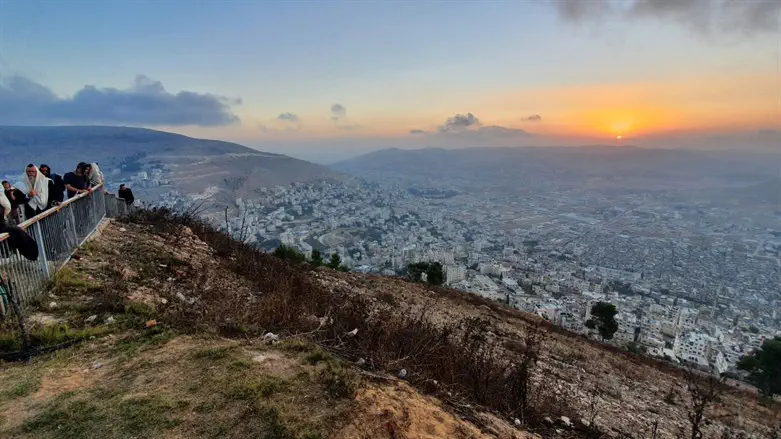
SEE THE STAND AT MOUNT GERIZIM AND MOUNTAIN EBAL - TODAY: AND EVERY DAY.’
Our Parasha continues relating the final admonition of Moshe Rabeinu to his beloved flock:(11:26-32) ’See, אנכי: i present before you today a blessing and a curse.
‘The blessing that you hearken to thr commandments of Hashem, your G-d, that I command you today. And the curse: if you do not hearken to the commandments of Hashem, your G-d.
‘It shall be when Hashem, your G-d, brings you to the Land to which you come, to possess it, then you shall deliver the blessing on Mount Gerizim, and the curse on Mount Ebal.
‘Are they not on the other side of the Jordan.. in the land of the Canaanites.. near אלון מורה:?the plains of Moreh?
‘For you are crossing the Jordan to come and possess the Land that Hashem, your G-d gives you; you shall possess it and you shall settle in it. You shall be careful to perform all the decrees and the ordnances that I present before you today.’
The events at the two mountains, is described in detail in the later Parashat Ki Tavo, where the curses - but not of the blessings - are brought.
Rav Zalman Sorotzkin comments :’Query: Why here - in our Parasha - the Torah mentions the matter of ‘blessings and curses’, and goes no further, and only in Parashat Ki Tavo does it set out their details?
‘If we reflect on this chumash being called משנה תורה: ‘the repetition of the Torah’, we will note that it is replete with mussar and rebuke, combined with the events that befell Israel, from the time of the exodus from Egypt till the departure of Moshe from this world - and only from our Parasha onwards, does Moshe repeat some of the mitzvot.
‘Just as the mussar and the rebukes are said at the outset of the repetition of the mitzvot - and at its conclusion - so too, the blessings and the curses are set out in Parashat Ki Tavo, after the mitzvot, and the admonition to observe them, at the beginning of our Parasha.
‘Meaning: only after the warning to observe the mitzvot - that the blessings and the curses, are dependent on their observance - does the Torah return to go over the mitzvot, and when it has completed doing so in Parashat Ki Tavo, it sets out the blessings and the curses, and the manner of their giving and of their acceptance, by Bnei Israel’.
Adds the Rav: ’In mentioning אלון מורה: the Plains of Moreh - which might appear at first glance, as superfluous - the Torah alludes to the place where Avraham Avinu first erected an altar to Hashem, when he entered the Land, and where Hashem promised that He would give the Land to his descendants ( Lech Lecha 12).
‘Therefore Hashem commanded, that as soon as they crossed the Jordan and entered the Land, they should go there, to thank Hashem for fulfilling His promise, and to erect there an altar - as described in Parashat Ki Tavo - and to accept upon themselves the blessings and the curses of the observance of the Torah, as only on that condition, did Hashem give them (Ps’ 105)’the land of the nations’.’
Abarbanel expounds:’After saying that the mitzvot in themselves are a blessing or a curse - depending on the recipient, in hearkening or not hearkening -in addition, blessings and curses will be given verbally on mount Gerizim and on mount Ebal.
‘This is what is said:’And it shall be when Hashem, your G-d, brings you to the Land which you are coming to inherit, and you will give the blessings on Mount Gerizim and the curses on Mount Ebal’ - they being two mountains, after you have crossed the River Jordan , to the west - and ‘by Elon Moreh’, where Avraham Avinu sat, as when they come there, they are to make in open display, the ascent of six tribes to the peak of one of the mountains, and six to the peak of the other, with the Leviim in the valley, with the Ark of the Covenant.
‘They will then say aloud :’Blessing - to whoever will observe the words of the Torah, and an awesome curse, to whoever will not uphold it’. All the people will answer:’Amen’ - loudly and clearly.
‘As the manner of this mitzvah and its subject, it will be brought after the mentioning of the mitzvot, in Parashhat Ki Tavo, its proper place being there, in the relating of the mitzvot and the strengthening of the observance of the Torah.
‘This is why that it is only brought briefly in our parsha - to teach that, apart of the mitzvot being a blessing in themselves, there will further be given on them blessing actually and verbally in the place that is mentioned.
‘Moshe apologized, as to why these blessings and curses, were not said now, in his presence - but that he commanded that they be given later, on Mount Gerizim and Mount Ebal - by saying: ’Because you are crossing the Jordan, to come to inherit the Land..and you shall observe and keep all the decrees and all the ordnances.. - meaning: because you are entering the Land, and there you will keep and observe all the laws and ordnances that I commanded you, it is therefore proper that there, when you have entered, you shall make this covenant, and give the blessings and the curses, on Mount Gerizim and Mount Ebal - and not here, in this place.’
The Alshich Hakadosh elucidates:’It should be noted, that the Torah here, chose to use the word:אנכי, ‘I’, and this being from the mouth of Hashem Himself, whereas what was said on the two mountains, was said by Bnei Israel.
‘This may be likened to a king who says to his subjects: ’Till now I did not benefit you, though I commanded you to serve me - so now I will not burden you by harsh punishment, on whoever does not serve me, but - rather - I give you advice, that if you perform my will, it will be to your benefit - though I will not afflict you with harsh punishment, if you should transgress my will - there is no need to say that this merits harsh punishment, as you, from yourselves, know that harsh punishment, is merited, and, from yourselves, yoo will be punished, if you transgress my will.
‘For this reason, I give before you blessing and curse, not by oath or swearing - this because it is היום: today, when you have not yet crossed the Jordan and inherited the Land - therefore, I am not burdening you, but only placing the matter before you, the blessing not being:’If you uphold this Torah’, but that ‘you hearken’, and the curses; if ‘you do not hearken’.’
The Kli Yakar posits:’One suggestion provides an answer to all that troubles us, that is that the blessing and curses - those that were said on the two mountains -in Parshat Ki Tavo, - why were only the curses mentioned, and not the blessings?
‘However, the blessings here, were principally in the world-to-come, as it is there that Hashem confers His blessings - and the Torah spells out the blessings, in saying ואת הברכה: ‘AND the blessing’- that is the blessing: ‘That you hearken’, in the future, ‘to the Mitzvot of Hashem, your G-d’ - because, in this world אנכי עומד בין ה' וביניכם: ‘i stand between Hashem and you’.
‘This is what he said: ’Which I command you today’: in this world - but in the future, you will merit to hear them yourselves.
‘In the curses, he didn’t want to say that there is no other curse, only that they will not achieve completeness, as this is not sufficient - but, rather, that the actual curse will fall on the head of the wicked, the curses being those set out in Parashat Ki Tavo, which will fall on the head of those who do not hearken and accept the mitzvot of Hashem.
‘As to why he said: ’אשר אנכי מצוה אתכם היום:’ which אנכי commands you TODAY - because they heard from the mouth of Hashem the first two commandments:’אנכי’ and 'לא יהיה': he therefore made two divisions, and said that the curse should fall ‘if you do not hearken to the mitzvot of Hashem, your G-d’, meaning the two first Dibrot: אנכי and לא יהיה לך, which they heard from Hashem - as on these plainly the curse should fall if you do not hearken to observe them: but even should you stray from the way ‘which I command you today’, and delude yourselves that I made this up, this will not exempt you from the punishment - and, as he had not yet specified what were the mitzvot that they had heard from Hashem, he now said:’To follow other deities’ - which is against אנכי and לא יהיה לך, which alludes to the opening words:’if you will not hearken to the mitzvot of Hashem, your G-d’.
‘This addresses all the queries that troubled the commentators.’
Rav Shimshon Raphael Hirsch expounds: ’Hashem here gave them the choice between blessing and curse, and when they entered the Land, it was given publicly to the entire nation - say, therefore, it expresses that this choice is given to the decision of each person, and, thereby, the nation declares, that the observance of the mitzvot by all is the task of the entire nation and that the success of the nation is dependent on its achievement.
‘As we read in the later Parashat Ki Tavo, the whole nation gathered on the two mountains - one half on Mount Gerizim and one half on Mount Ebal, with the Kohanim and the Leviim between them, in the valley - the Kohanim and the Leviim saying the blessings and the curses, and the saying of ‘Amen’ by the people, will be their acceptance.
‘We find that the nation stood there - on the two mountains - and accepted and committed itself and all its generations, the choice between blessing and curse.’
‘At the time of the saying of blessings, the Leviim turned to face Mount Gerizim, whereas at the time they said the curses, they turned to face Mount Ebal, because the blessings and the curses were seen from the appearance of the two mountains, which were opposites in their nature.
‘Whilst both of these mountains were amongst the mountains of Ephraim, they were visibly different:
Mount Gerizim lay in the south of the mountain of Shechem, and was covered with verdant greenery, whereas Mount Ebal lay in the north, and was bare and desolate. Mount Gezirim was slightly higher than Mount Ebal, and therefore these two mountains that stood side-by-side beautifully expressed the blessing and the curse, both arising from the same earth and both receiving the same rainfall and dewfall and sharing the same air - yet Mount Ebal remained barren and frozen, whilst Mount Gerizim was covered by greenery to its very peak.
‘So, too, blessing and curse are not dependent on external factors, but on the internal ability to accept this or that - by their relationship to that which brings the blessing.
‘When we cross the Jordan, we will plant our feet on the holy earth, and turn our gaze to these two mountains - their appearance will instruct us that we need to make the choice between blessing and curse, and by our ethical conduct, we decide for ourselves to which mountain our faces incline.
‘Avraham Avinu reached this very place when he entered the Land, and here he erected the first altar to Hashem Who appeared to him - and it may well be that the name of the place: מורה, alludes to the teaching that it gives to us.’
Rav Yosef Salant, a lengthy parting gem: ’We need to note several matters: Why does the Torah use the word ‘see’, which alludes to the senses and not to speech - where ‘hear’ would seem to be more apt? ; Why does it open with the singular ‘see’, yet conclude with the plural:לפניכם: before you’? why does it say;’the blessing and the curse which I give before you TODAY, when it is not given till later, after they have crossed the Jordan?; what was the reason that the people were divided into two camps, half on the one mountain and half on the other mountain, rather than they all being together and that the blessings and the curses said to the whole nation - instead the Torah choosing to separate them, and to give the blessings to one half, and the curses to the other half?
‘It can be said, that the division into the two halves, was to teach that which the Gemara says;(Kid’ 40;)’A person should at all times see himself as if he is חצי חייב half liable and חצי זכאי: half entitled - perform one mitzvah, and blessed is he, as he has determined himself to the side of merit; if, on the other hand, he commits a transgression, he determines himself to the side of obligation.
‘Rabbi Elazar ben Shimon says:’ As whole world is judged according to the majority, if you do one mitzvah - fortunate are you, that you have determined yourself and the whole world to merit - do one transgression and, alas, you have determined yourself and the whole world, to be liable.
‘To demonstrate this matter, the people were commanded to divide themselves on the two mountains in the manner specified, so it should look as if half merit blessing, and half deserve curses - as if they have not observed the Torah, to awaken and warn every person to his responsibility now - and at all times - to always see himself as half meritorious and half liable, as if his fate and that of the whole world is dependent on him.
‘This is why the Torah chose to use the word: ’See’ - at all times to see before him this picture, of the nation divided into two equal halves, and that it is in his hand to determine the outcome.
‘This, too, is why the Torah opened in the singular - and said ‘Today’, as every minute of our lives, this picture should be before our eyes - and concludes in the plural: Before you’, to remind us that our decision may well determine the outcome of the whole world.’
לרפואת נועם עליזה בת זהבה רבקה ונחום אלימלך רפאל בן זהבה רבקה, בתוך שאר חולי עמנו.