
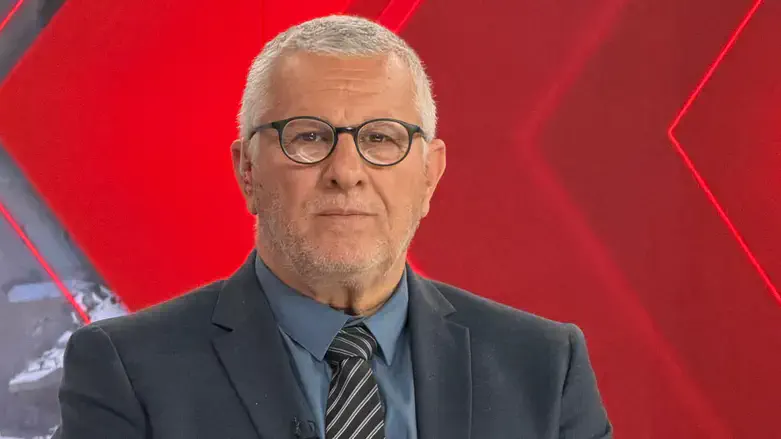
Against the backdrop of Prime Minister Benjamin Netanyahu's visit to Washington and the latest developments surrounding Iran, Col. (res.) Amir Noy, former head of the security coordination office with the U.S. military and a security analyst, believes that little weight should be given to statements coming out of the White House.
According to Noy, the primary focus should be on the concrete steps the United States is taking, as its policy toward Iran is part of a carefully planned strategic campaign rather than a series of ad hoc responses.
He argued that the seemingly contradictory announcements by the American president are part of a broader regional strategy being pursued by Washington. "I believe that the entire sequence of announcing a strike and then canceling it is part of a strategic plan that the Americans are leading in the region, and it has a strategic purpose," he said.
Noy believes the United States is confronting Iran on three parallel fronts. "The first is the military track, the second is the economic track, and the third is the diplomatic track," he explained. According to him, "Whenever the Iranians deviate from the diplomatic track, the process returns to the military track," adding that he expects this pattern to continue in the near future.
Regarding the objectives of the U.S. administration, Noy said he believes Washington ultimately seeks to bring about significant change in Iran. "I think that, in the final analysis, their primary objective is to bring down the regime in Iran," he said. He added that, alongside the nuclear issue, the United States also seeks to reduce Iran's ballistic missile capabilities so they no longer pose a threat to the Middle East.
Commenting on the Gulf states, Noy assessed that they have no interest in a broader regional escalation. "The Gulf states are a moderating factor," he said, explaining that a large-scale military conflict would severely harm them. Nevertheless, he added that, in his view, "There will be no alternative-they will have to confront Iran in the most military way possible."
Noy also addressed regional threats that could grow in significance even if Iran is weakened. "Sunni jihadist Islam is no less dangerous than Shiite jihadist Islam," he said. According to him, "The two countries we need to watch very, very closely are Turkey and Qatar," adding that Egypt's military buildup "has certainly not escaped our attention."
He further argued that Qatar and Turkey operate in coordination based on shared interests. "Qatar needs to rely on Turkey... to serve as its protector," he said, explaining that because of its small size and lack of significant military power, Qatar depends on a regional power to provide it with security.