
Lt. Col. (res.) Adv. Maurice Hirsch, a senior researcher at the Jerusalem Center for Security and Foreign Affairs, argues that the Palestinian Authority's terrorist reward program does not end with payments to terrorists imprisoned in Israel. Rather, it also includes a permanent system of payments and employment for terrorists after their release.
According to Hirsch, senior Hamas officials who he says were involved in planning, financing, or carrying out the October 7 massacre also received money under this framework.
"Usually, when people discuss the PA's reward program, they focus on payments to terrorists in prison. But there is another side to this policy-the question of what happens to a terrorist after he is released. There is an entire set of laws and regulations, ranging from a release grant for every freed terrorist to an employment program," Hirsch told Arutz Sheva.
Under this employment program, any terrorist who served between five and ten years in an Israeli prison receives priority for employment with the Palestinian Authority. If no position is available, the released terrorist is paid a salary without having to work. Anyone who served more than ten years in an Israeli prison is guaranteed a position within the PA and receives a salary according to the seniority pay scale.
"They are only required to report for work if they are actually called in, but thousands sit at home collecting salaries based on the employment grades of senior PA officials," Hirsch said.
According to Hirsch, the result has been that hundreds and even thousands of terrorists released to Gaza became eligible for these benefits.
"When I served as Deputy Military Advocate in Judea, Samaria, and Gaza, we prosecuted terrorists who were imprisoned, later released, returned to Gaza, and then became entitled to employment by the Palestinian Authority and to receive money," he recalled. "Then came the Shalit prisoner exchange, when hundreds were released to Gaza, including Yahya Sinwar. Palestinian law states that anyone who served ten years in prison becomes a PA employee, and that was also true of Sinwar, who spent twenty years in prison. The law makes no distinction between different terrorist organizations. Everyone falls under its umbrella and receives payments."
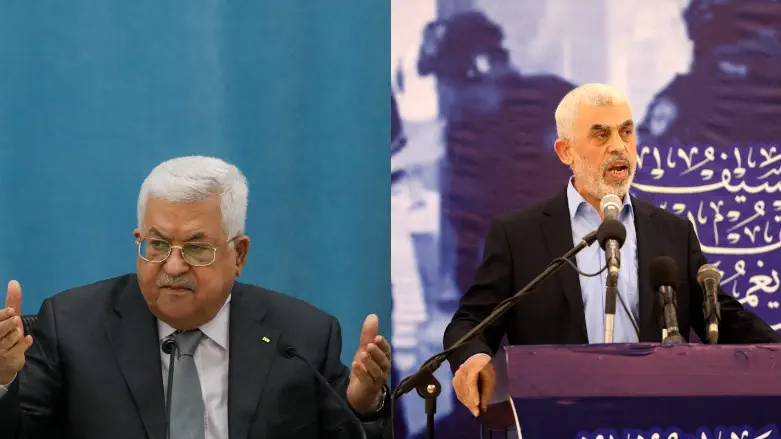
Hirsch stresses that attention should be focused on the period leading up to October 7, during which the Palestinian Authority paid salaries to senior Hamas members released from Israeli prisons, including Yahya Sinwar, Zaher Jabarin, Rawhi Mushtaha, and Tawfiq Abu Naim, all of whom he says were involved in planning, financing, or carrying out the October 7 massacre. These payments were part of a broader system under which many terrorists released from Israeli prisons received salaries, including individuals living abroad, such as Salah al-Arouri, Sinwar's deputy.
In practice, Hirsch argues, the regular payments deposited into their bank accounts by the Palestinian Authority-without requiring them to work-freed up their time and resources to prepare and plan numerous terrorist attacks, including the October 7 massacre.
Asked whether Palestinian Authority President Mahmoud Abbas could claim that he was unaware of what these released terrorists were doing, Hirsch responded by noting that Abbas has never condemned the October 7 massacre or described its perpetrators as terrorists or as criminals acting contrary to the PA's principles.
He also pointed out that, "In the first days after the massacre, the Palestinian Authority boasted that members of Fatah had also participated in the attack."
According to Hirsch, these findings are particularly significant in light of lawsuits filed by thousands of terrorism victims against the Palestinian Authority, as courts have argued that it is difficult to establish the PA's responsibility for terrorist attacks and the October 7 massacre.
He contends that the salaries paid by the Palestinian Authority to perpetrators and planners released from Israeli prisons constitute a connecting link between the PA and the massacre, arguing that the payments enabled those individuals to carry out the attack and that the funds themselves may also have been used to organize and prepare for it.