
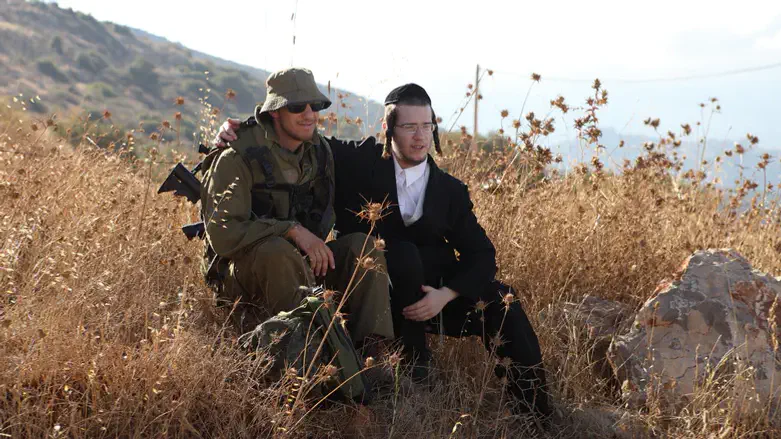
Chaza"l famously teach that any generation in which the Beit Hamikdash is not rebuilt, it is as though it was destroyed in that generation. This means that if we have not yet merited the Redemption and the rebuilding of the Beit Hamikdash, we ourselves are guilty of the sins that brought about its destruction.
The Second Temple was destroyed on account of Sinat Chinam, baseless hatred. Even though they studied Torah with great dedication and observed the Mitzvot, they did not have unity and Ahavat Yisrael. This is in contrast to the destruction of the First Temple which was caused by the Chamurot, the most severe sins of idolatry, murder and sexual immorality.
The Gemara (Yoma 9b) teaches that we learn from this, that Sinat Chinam is equal to all three severe sins combined. From the fact that the first exile in Bavel lasted only 70 years, whereas our present exile has lasted close to 2000 years, one could even say that the sin of Sinat Chinam is far greater.
The Gemara continues that because the sin of the First Temple era was revealed, the end of the exile was revealed. But because the sin that brought about the destruction of the Second Temple was hidden, the end of their exile was also hidden.
Rabbi Shmuel Eidels - the Maharsha, explains unlike the very public sins of murder, idolatry and sexual immorality, the sin of Sinat Chinam is hidden in the heart. We find a parallel in the punishments of the Ganav (thief) and Gazlan (robber). The Ganav, who steals in secret, incurs a greater punishment than the Gazlan who does so brazenly. This is because one who sins in private shows that whilst he cares about what other people think, he is not bothered to sin before Hashem who knows all.
In his work Ben Yehoyada, the Ben Ish Chai explains this teaching as follows. Everyone recognises clearly that the sins of murder, idolatry and immorality are serious. So they would have certainly felt true remorse, which is a primary element of Teshuvah. As a result, their punishment was reduced to only 70 years. But because Sinat Chinam is not viewed as a serious sin, we do not truly feel remorse and even if we do Teshuvah, it will not be complete.
Offering a fascinating insight into human behaviour, the Baal Hatanya observes that we do not only hide Sinat Chinam from others, we also hide it from ourselves. What makes it so difficult to do Teshuvah for, is that we fool ourselves by rationalizing our hatred. We give reasons for our hatred and feel justified and even righteous, in our feelings. We tell ourselves that we are not guilty of Sinat Chinam and that the other is deserving of our treatment.
In the lead-up to the destruction of the Second Temple, there were deep rifts and schisms within the Jewish people. These were driven by political ideologies and religious outlooks. Even as the Romans laid siege to the Holy City, the sectarian violence of Jew against Jew was destroying the city from within. In an effective civil war, the supplies of the city were burned by vigilantes and Jewish blood was spilled at the hands of fellow Jews.
Only when the Temple was about to be destroyed and they were about to lose the one common thread that bound them together, did they join forces. But it was too late and all of the parties were at fault.
Hashem was like a father, who says to his children, that if they cannot love one another and get along, he no longer wishes to dwell amongst them.
Tragically, with the scenes we have witnessed in Israel these past few weeks, we have failed to learn our lesson. We have seen video footage of Yeshivah students cursing soldiers with the most horrific abuse and curses. Jewish women, daughters of Sarah, Rivka, Rachel and Leah have been branded “Shiktzas". Jews have spat on one another and raised hands in violence. Fires literally and figuratively are burning the streets.
And we heard the shocking words of a senior Rosh Yeshivah, a “Gadol Hador", maligning a whole segment of Am Yisrael, the “Kippah Seruga" community, and accusing our holy soldiers of murder ר“ל.
The Midrash (Shir Hashirim Rabbah 1:6) teaches that even the Neviim were punished for slandering the Jewish people.
Moshe was punished for calling them מורים - rebels, when he struck the rock. When Yishayahu described the Jewish people as עם טמא שפתים, a people of impure lips, Hashem said that his own mouth deserved to be singed for having spoken דליטורייא against the Jewish people. Eliyahu Hanavi was likewise chastised for his Lashon Hara about Klal Yisrael, when he complained how they had forsaken Hashem’s covenant and destroyed his altar.
These Neviim were rebuking the Jewish people who were guilty of the worst of sins that would bring about the destruction of the Temple. They were speaking the word of Hashem through prophesy. Yet they were punished.
The Yalkut Shimoni teaches that Hashem does not associate His Name with words of rebuke, even when delivered by the prophets. Whereas Yirmiyahu’s prophesy of comfort is introduced with the words כה אמר ה‘, “thus says Hashem, I remember the kindness of your youth", his words of rebuke, that are read in the lead up to Tisha B’av, begin דברי ירמיהו, “the words of Yirmiyahu".
No Rabbi today, not even with the greatest “Daas Torah", speaks words of Nevuah. And our generation are in no way as corrupt and sinful as the generations of Yishayahu and Yirmiyahu. On the contrary, after all of the suffering we have faced in exile, no Jew can ever be labelled Chiloni (unholy). Every Jew is holy and pure. How much more so does this apply to the brave soldiers of Tzahal who are Moser Nefesh to defend the Jewish people in our homeland.
With elections coming up and with the critical issues such as the draft of Yeshivah students front and centre, we need to remember the lessons of the Churban.
This does not minimize the very real issues that need to be addressed. Like the generation of the Churban, we have different political and Hashkafic opinions on matters that we feel passionately about and that affect us to our core that can also be seen as matters of life and death. deeply. But we need to make sure that the discourse and rhetoric remains respectful.
We are one people, one family. Brothers can disagree and live completely different lifestyles. But they are bound together with love and know that there are red lines that can never be crossed.
The correction of the sin of Sinat Chinam is with Ahavat Chinam, unconditional love. Ahavat Chinam is not when we think the same and share the same values and outlook. This Ahavah is rational and logical. Ahavat Chinam requires us to transcend ourselves, to love and respect one another even when we disagree.
With our efforts to maintain unity and Ahavat Chinam (which is specifically when we don’t agree), we will repair the sin that brought about the Churban, and merit the ultimate Nachamu comfort, the coming of Moshiach and the rebuilding of the Beit Hamikdash Hashlishi.