
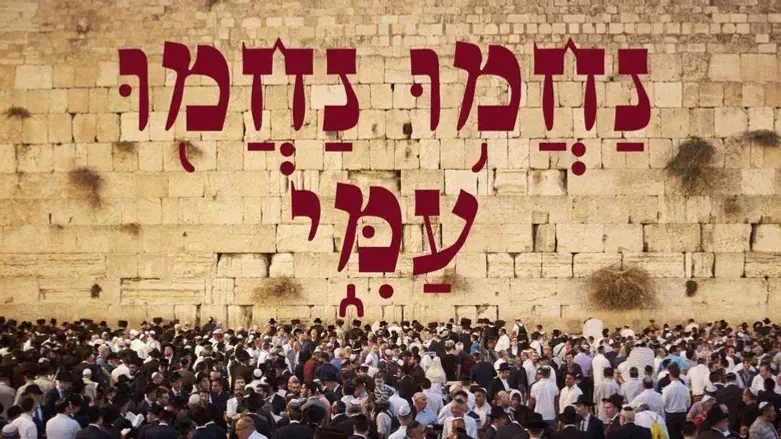
Every year on Shabbat Nachamu, we face a powerful question. Only a few days earlier, we sat on the floor mourning the destruction of the Beit HaMikdash and the suffering of exile. Suddenly, we are told: “Nachamu, nachamu ami - Be comforted, be comforted, My people." But what has really changed? The Beit HaMikdash has not yet been rebuilt, and many of our struggles remain.
The answer is that true comfort does not always come from a change in our circumstances. Sometimes it comes from a change in the way we understand those circumstances.
When we experience pain and loss, it is natural to feel that we are surrounded only by middat hadin - the attribute of strict justice. Yet the way Hashem guides the world is far deeper than what our eyes can see. Middat hadin and middat harachamim - justice and mercy - are never separate. They exist together, even when we can only perceive one of them.
A loving parent may sometimes need to discipline a child. At that moment, the child may feel only the pain of the discipline. But the parent’s true motivation remains love. Because of that love, the parent limits the punishment, protects the child, and eagerly awaits the moment when closeness can be restored.
So too, with Hashem. Even when we are living through a period of din, Hashem’s rachamim is always present. It may not always be revealed to us, but it is there - giving us the strength to endure, protecting us in ways we do not always recognize, and preparing the path toward better days.
The din is temporary. Hashem’s mercy is eternal.
This idea is beautifully expressed in the famous Gemara in Masechet Makkot. After the destruction of Yerushalayim, Rabbi Akiva walked together with the other Sages. When they saw the Romans living peacefully while the holy site lay in ruins, they cried. Rabbi Akiva, however, smiled.
The Sages asked him why he was able to rejoice at such a painful moment. Rabbi Akiva answered with a kal vachomer: if Hashem allows those who do not follow His will to receive reward in this world, how much greater must be the reward awaiting those who remain faithful to His Torah.
Later, when they saw a fox emerging from the place of the Kodesh HaKodashim, the other Sages cried again. Rabbi Akiva comforted them. He explained that just as the prophecies of destruction had been fulfilled, so too the prophecies of redemption and comfort would certainly be fulfilled.
Rabbi Akiva taught them a timeless lesson: the darkness of galut is real, but it is not the final chapter of our story.
This message speaks directly to our generation. After years of war, tzarot, and uncertainty in Eretz Yisrael, it is easy to feel surrounded by an overwhelming middat hadin. We see threats from outside and painful disagreements within. At times, the unity we so deeply long for seems distant.
But even within this difficult reality, Hashem’s rachamim remains present.
We see it in the quiet acts of chesed taking place every day. We see it in the courage and mesirat nefesh of our soldiers. We see it in the protection Hashem has given us from dangers that we may never fully know. We see it in the emunah of people who continue to build, to help, and to believe.
On Shabbat Nachamu, we do not deny the pain. We do not pretend that the challenges have disappeared. Instead, we are taught to look more deeply.
We remember that even when the darkness feels overwhelming, Hashem’s compassion is never absent. Behind the din stands His endless rachamim. And with that knowledge, we continue forward with hope, unity, and the certainty that the time of the complete Geulah Sheleimah will come.
Rabbi Eliezer Simcha Weisz is a member of Israel's Chief Rabbinate Council.