
Zeev Jabotinsky wrote a novel called “Samson." Toward the end of the story, when Samson is captured by the Philistines, he manages to send a message back to the Jews telling them to stock up on iron - meaning to arm themselves for war. As the messenger departs, Samson calls him back to impart one other thing. “Tell them not to forget how to laugh," he says - meaning that even when things seem bad, a Jew must always cling to the shield of laughter and optimistic belief.
Today when Israel is troubled on all sides, from without and within, here’s a short story to help cheer up our spirits.
Operation Hallel
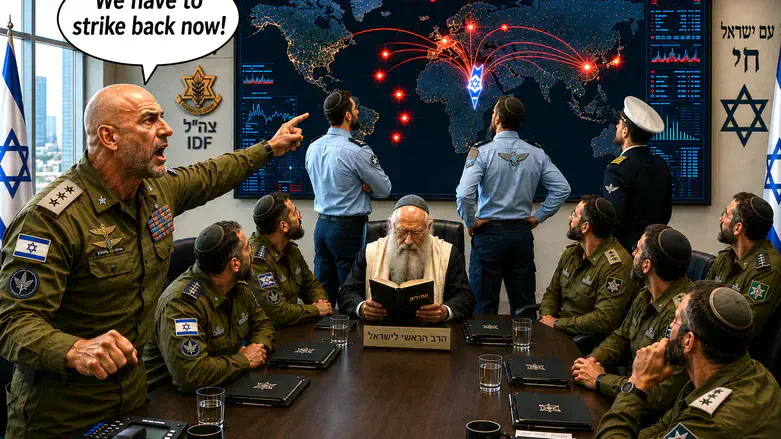
The Chief of Staff, generals, and heads of Israeli intelligence stood staring at the panoramic screen in the IDF's Strategic Military Control Center. The computerized screen spanned an entire wall in the war room which had been code-named "Magen David" because of its star-shaped design. Up on the screen was a satellite map of the world. Israel was a small red light in the center of the globe, like a heart amidst the organs of the body. Other lights were flickering on the screen from all over the northern hemisphere. Each light marked the launching of a nuclear warhead from an underground silo.
China had started the massive attack only a minute before with a wave of missiles which were now on their way over Turkey and arcing steadily closer toward Israel. Jet bombers were streaking toward the Mediterranean. None of the bearded men in the room seemed surprised when the United States joined in the air strike. America's participation in the UN coalition against the tiny Jewish State had been predicted for weeks, ever since the mass arrests of Jews in America.
The Arab oil embargo had crippled world economy and left Americans angry and cold. Until "Palestine" was freed, the Arabs were refusing to export their oil. Once again, the Jews had been set up for slaughter. On the screen in the war room, lights were flickering now over Pakistan and, France, and Germany.
"It's seems like everyone with an A-bomb wants to get a crack at us," Yehuda growled, throwing up his hands in dismay.
Yehuda, the world-famous, Israel air-force commander was the only non-religious officer in the underground center. The secret bunker had been re-nicknamed "The Covenant Room" because all of the bearded, skull-capped men present believed that this was the place where G-d would reaffirm, before the eyes of the world, the ancient Covenant He had made with Abraham, bequeathing the Land of Israel to the Jews.
Yehuda wasn’t a believer. He was a simple man, a soldier's soldier, born with an ardent love for his land and his people. In war after bloody war, he had risked his life on the battlefield and in the skies. Both Jews and Arabs called him the Lion of Yehuda. Now, once again, he had stayed on to fight, long after many others had left, because he knew, in the way only a military specialist could know, that Israel's great victories over much vaster forces had been caused by something more than military prowess and weaponry. Yehuda had sensed, almost mystically from his very first battle, the presence of some unseen helping hand.
Yehuda gazed at the bearded faces around him. They all had become baale tshuva after the long war against Hamas, Hezbollah, Iran, and Russia. Seemingly overnight, the nation had returned to the Torah. After the last elections, when the majority of the Knesset became religious, most of Yehuda's contemporaries had fled - the people he had grown up with, the builders of the country, had become a tired and spiritually empty minority - all of the socialists, liberals, democrats, anarchists, university professors, and leftist journalists who had lacked the final faith to continue the struggle against what seemed like insurmountable odds.
Yehuda himself had his share of doubts. There had even been moments of fear. Not fear of dying. His battle scars proved that he didn't fear death. His fears came from not understanding what was happening to his country. His mind couldn't comprehend the great religious upheaval. He simply couldn't fathom the fervent practice of a law and tradition he had never bothered to learn.
Yehuda glanced down at the one man who remained seated in the war room - the eighty-two year old Chief Rabbi. Neither the Chief of Staff of the army, nor the Minister of Defense would make a decision without his assent. Unlike the uniformed men in the room, the Rabbi wore a long black coat, black hat, and tefillin. An old, fraying Psalm book lay clutched in his hands. He never bothered to look up at the screen. He didn't have to, he said. Everything had already been written. Yehuda had waged a fierce battle against the Rabbi's inclusion amongst the Joint Chiefs of Staff. Military decisions and strategy demanded real combat experience, he argued. But the country's new prime minister insisted that the elderly Sage have the final word.
Up on the screen a storm of atomic warheads were arcing through the heavens from American and Chinese space stations. Yehuda looked down at the white-bearded Rabbi.
"I think it's about time we did something, sir."
"Hallel," the old Rabbi whispered. “Operation Hallel."
There was a spontaneous cheer in the room, a burst of applause and confident embraces. Amidst all the tumult, the Chief Rabbi continued on with his prayers.
Yehuda glanced at the digital clock on the screen. The countdown clicked down to one minutes and twenty seconds until the first missiles would reach Israel's borders. With a steady, battle-tried hand, he picked up the red telephone on the table. "Operation Hallel," he repeated.
Yehuda shuddered. In the past, his brilliant strategies had crippled enemy forces. His pilots had paralyzed Syrian missiles and Russian-built tanks. His special units had executed stunning assassinations in Iran, Tunis, and Iraq. He himself had piloted bombers and rescue missions since the earliest days of the State. He had parachuted behind enemy lines to lead attacks on terrorists bases in missions that were never reported. But Operation Hallel was something much different. Operation Hallel was madness.
"This is national suicide!" he shouted in protest. "Those aren't Scud missiles headed our way - they're nuclear bombs!"
Once again he aimed the remote control at the screen. The scene switched to a view of the Temple Mount. Yehuda paused. Everyone held their breath.
"What are you waiting for?!" somebody yelled.
Suddenly, the paratrooper commander, and onetime kibbutznik who had moved his family to Hebron, jumped Yehuda from behind and grabbed the remote control from his hand.
"If he won't do it, I will," he said and pushed on a button.
Up on the screen, a gigantic explosion rocked the ancient Mount. The golden dome of the Moslem shrine was blown to smithereens. A cloud of gold dust spread over the Kotel.
The war room resounded with cheering. Across the room, Israel's highest ranking general raised a shofar to his lips and gave a piercing blast. "They're all madmen," Yehuda thought. His friends who had abandoned the country had been right after all. The government of Israel had been captured by crazies.
Yehuda grabbed back the remote control from the paratrooper commander. He flicked the screen back to the map of the world. Nuclear missiles and bombers were zeroing in on the tiny Jewish State, yet his colleagues in the war room were clapping their hands. "Switch it back to the Temple Mount!" they demanded.
With the clock counting down to thirty seconds, all eyes focused on the scene in Jerusalem. The Moslem shrine had vanished. Israeli tanks smashed into the Temple Mount courtyard. Another cheer went up as the voice of the tank commander came loud and clear over the radio. "Har HaBayit b'yadanu!" he shouted. "The Temple Mount iis in our hands."
On screen number two, a team of Levites and Kohanim were erecting an altar which a flatbed truck had driven into the Temple Mount courtyard. A jeep sped onto the scene, towing a trailer behind it. The ramp of the trailer swung open. Precious time was ticking away as a Kohen tugged on a rope and led out the pure red heifer which Technion geneticists had bred.
Yehuda flashed the screen back to the space map. Startled eyes watched as the rainbow of lights arcing over the earth began to flicker and fade. One by one, they disappeared from the screen. Another wild cheer filled the war room.
On the Temple Mount, the Leviim sang the Hallel. "Why should the nations say, Where is their G-d? Our G-d is in heaven. Whatever He desires, He does."
The men in the war room were all strapping on their tefillin. An army commander, a Chabadnik, walked over to Yehuda and invited him to don a pair too. The diehard kibbutznik gazed down at the small black boxes and shook his head no.
"Are you sure," the Hasid asked.
"Yes, I'm sure," Yehuda answered.
"You needn't feel embarrassed," the Hasid persisted.
"Leave him alone," the Chief Rabbi ordered.
The Chabadnik withdrew. Of all the battles which Yehuda had faced, the battle he was fighting right now in his heart was the fiercest. How could he change a whole lifetime of belief? Even if he wanted to, he couldn't. He was that kind of man. Principles were sacred, whether right or wrong. If he had championed misguided ideals, he would stand up to the punishment. Wasn't his presence enough for them? He was there, just like the rest of them, standing in the war room beside the Chief Rabbi. He had devoted his life to his people - with all of his heart, with all of his soul, with all of his might. That was the religion he knew. If that wasn't enough for them, or for G-d, so be it.
"We can still knock out New York and Peking with our A-bombs," the air-force commander insisted.
"No," the Rabbi answered.
"We can't just do nothing," Yehuda protested.
"Pray with the others," the soft voice replied.
"I can't," Yehuda said.
"Try. Hashem wants to hear. It's your voice that's missing."
Yehuda felt faint. In all of his sixty-five years, he hadn't prayed once. He didn't know how. He didn't know even to whom. Up on the Temple Mount, ashes from the slaughtered red cow were being sprinkled over the Kohanim. The sight was too much for the man called the Lion. Feeling his legs weaken, he collapsed into the chair beside the Rabbi. The world's stockpile of nuclear warheads was approaching the borders of Israel, and the leaders of the Jewish nation were sacrificing a cow on the Temple Mount altar!
"Do something, G-d," Yehuda prayed for the first time in his life.
On the Temple Mount, the smoke of incense rose in a column up to the sky. A hand clutched Yehuda’s arm and dragged him into a circle of dancing that had spontaneously began in the war room. The generals, commanders, and army chiefs of staff were all holding hands in a circle and singing: "All the nations surround me. In G-d's name I cut them down. They surrounded me like bees. They were extinguished like a thorn fire."
Before the dancers had completed their first circle, Yehuda was singing along with them. The words of the Psalm formed on his lips as if he had been chanting it in synagogue for years. A great elation washed over him. "Open for me the gates of righteousness. I will enter them," he sang. "I will give thanks unto G-d."
The clock clicked down to zero. The dancing ended. Eyes stared up at the map. When the lights on the screen overshot Israel and continued on toward Cairo, Damascus, and Amman, pandemonium broke out in the war room.
Yehuda picked up the bearded man next to him and gave him a kiss. A dispatch from the Golan Heights reported that a storm of hailstones bigger than basketballs had paralyzed Syria's tank force. Tidal waves had overturned enemy battleships and submarines like toys. An earthquake registering 9.2 on the Richter Scale had devastated Iran. In Russia and China entire army divisions had plummeted into the earth.
Yehuda joyously sang with the others:
"This is the Lord's doing; it is marvelous in our eyes. This is the day that the Lord has made. Let us exult and rejoice in Him."
Within minutes, the cities of Cairo, Damascus, Istanbul, and Tehran disappeared from the map. Half the country of Libya fell into the sea.
"The air forces and armies of the world have amazingly disappeared," an American TV reporter explained to his satellite viewers. "A freak technical failure has saved the city of Jerusalem today. Unusual weather conditions, thick fog, and a chance summer hailstorm, have paralyzed the world's nuclear arsenal and spared the indestructible Jewish nation."
"The hell with unusual weather conditions," Yehuda exclaimed.
On the screen in the war room, the CNN reporter continued his eyewitness coverage. "Scientists from the Cape Kennedy Research Center in Florida are saying that planetary disturbances which transpired over two billion light years ago are the cause of the startling events," he explained.
"Shtuyot!" Yehuda said loudly. "That’s utter nonsense. G-d did it all. G-d saved us. It was Him, plain as day!"
Yehuda turned to the Chief Rabbi. "Can't they see it?" he asked.
A kind, wise smile spread over the Rabbi's face. "It's hard enough for our own people to see it," he answered. "What do you expect from the goyim?"