
This Shabbat we begin reading the Book of Devarim in which Moses stands before the people of Israel towards the end of his life and looks back on the defining moments of their national journey.
His words are not merely a history lesson. They are a reminder that memory shapes identity and that the places where Jewish history unfolded continue to matter today.
Among the episodes Moses recounts is one that often receives less attention than it deserves: Israel's stunning victory over Og, king of Bashan.
"We captured all his cities... sixty fortified cities... all these were fortified with high walls, gates and bars" (Deuteronomy 3:4-5).
The Torah is strikingly detailed. It emphasizes not only the military triumph but also the territory itself. Bashan was no barren wasteland. It was fertile, strategically situated and heavily fortified. Conquering it required courage, determination and faith.
That victory also shattered one of the greatest psychological barriers facing the Israelites. Og was no ordinary monarch. He was the last survivor of the Rephaim (verse 3:11), whom the Ramban (Rabbi Moshe ben Nachman, 1194-1270) says was a large nation of giants of enormous stature. Yet despite his imposing reputation, he was defeated because the Jewish people understood that their mission was rooted in something larger than military calculations alone.
The conquest of Bashan demonstrated a timeless truth: when the Jewish people possess both faith and resolve, even seemingly insurmountable obstacles can be overcome.
For many readers, Bashan is simply another Biblical placename, buried beneath the dust of antiquity.
But it is very much a real place.
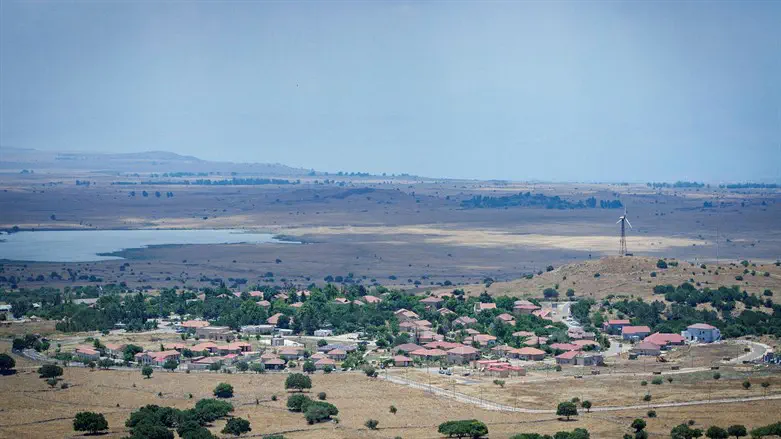
Its territory encompasses much of what is today the Golan Heights and the adjoining region stretching toward Mount Hermon. Long before modern borders were drawn or international diplomats debated ceasefire lines, the Torah recorded that these lands became part of the inheritance of Israel under Moses himself (verse 3:18).
Indeed, unlike much of the Land of Israel, which was conquered later under Joshua, Bashan entered Jewish possession even before the Israelites crossed the Jordan River.
That historical fact carries particular resonance today.
Since the collapse of the Assad regime in Syria, the strategic landscape along Israel's northern frontier has undergone dramatic change. The threats emanating from Syria have not disappeared; they have merely evolved. Turkey continues to seek influence, jihadist organizations remain active, and the future of Syria remains uncertain. Israel has therefore been compelled to secure additional positions near Mount Hermon and adjacent areas in order to protect its citizens.
Predictably, much of the international community views these developments solely through the prism of geopolitics.
But Parshat Devarim reminds us that there is another dimension that is too often ignored.
For the Jewish people, places such as Bashan are not patches of territory. They are locations where Jewish history unfolded, where Biblical promises were realized and where our national story took shape thousands of years before the emergence of the modern Middle East.
We must therefore never allow ourselves to forget the historical and spiritual significance of these places.
Far too often, discussions about Israel's borders begin in 1949, 1967 or 1973, as though Jewish history suddenly sprang into existence in the twentieth century.
The Torah tells a very different story.
Long before there was a League of Nations, the United Nations or any modern state, there was Bashan.
Long before today's headlines spoke of the Golan Heights, Moses spoke of the conquest of Og.
And long before talking heads on television debated who belongs where, G-d entrusted the Golan and Bashan to the people of Israel.
That is why Moses begins Devarim by recounting these events once again. He understood that nations which lose their memory eventually lose their confidence and that a people disconnected from its past will struggle to defend its future.
As we read Parshat Devarim during these challenging days, its message is clear.
The story of Bashan is not merely ancient history. It is part of the enduring bond between the Jewish people and the Land of Israel.
The names may have changed. The political circumstances may be different. But the underlying truth remains the same.
The hills of Bashan still testify to the remarkable journey of a people who overcame giants, fulfilled an ancient promise and continue, thousands of years later, to write the next chapter of that extraordinary story.