
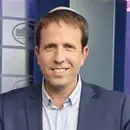
Rabbi Yair Paran, principal of the middle school division at Shacharit High School in Jerusalem and great-grandson of Rabbi Ovadia Yosef, spoke with Arutz Sheva about the controversy surrounding the Basic Law: Torah Study and the public debate over haredi enlistment.
According to Rabbi Paran, his public activity does not contradict the legacy of Rabbi Ovadia Yosef, but rather continues it out of concern for all of the Jewish people.
Rabbi Paran said that he tries to examine his path through a commitment to the Torah and to the reality in which the state exists. “I try to ask myself what the Holy One, blessed be He, wants from me in this world, in light of the Torah that I study and in light of the reality that we see around us," he said. He added that he sees concern for the Jewish people as the principle that guided Rabbi Ovadia throughout his entire life.
Regarding the proposed Basic Law: Torah Study, which was approved by the Knesset, he said that he agrees that Torah study is a fundamental value among the Jewish people, but that the law itself harms the Torah.
“I think this law demeans the Torah much more and divides the Jewish people," he said, adding that, in his view, the move is intended “to perpetuate and provide constitutional infrastructure for the injustice of exemptions and evasion [from military service]."
According to Rabbi Paran, the claim that Torah learners are being persecuted does not reflect reality. “No one in the State of Israel has ever been persecuted because he studied Torah," he said. “In Israel, they are pursuing draft evaders because they are draft evaders."
He also criticized the government and claimed that advancing the law stems from political considerations ahead of the elections. “He is selling the country, he is selling all of our values… for another political term," he said, referring to the prime minister.
However, he stressed that haredi enlistment must be carried out while preserving their identity and way of life. According to him, there is no place for a policy of a “melting pot," and every person should be allowed to live according to his faith, while maintaining a shared commitment to serving the state.
“I do not want to change any haredi person, and I do not want to undermine anyone’s identity," he said. He added that a reality must be created in which “a haredi young man can enter the army as a haredi and leave the army as a haredi."
In this context, he said that, in his view, the general public will also have to make value-based compromises in order to enable broad integration of haredim into the IDF. He explained that although he fundamentally supports keeping all options open for women, there may be a need for separate service frameworks in order to allow meaningful haredi enlistment.
Later in the interview, he also addressed the responsibility of the political leadership following the events of October 7. According to him, while senior defense officials accepted responsibility for the failure, “at the political level no one took responsibility, no one put down the keys," and he claimed that this created a deep crisis of trust between the public and the country’s leadership.
Regarding the desired model for haredi enlistment, he said that as long as Israel has a mandatory draft law, it must apply equally. “There cannot be a distinction between blood and another," he said.
Alongside this, he added that practically speaking, the process should be carried out gradually: first recruiting those who are not studying Torah and allowing adjustments that would assist the process, while making clear that the ultimate goal is service by the entire public.
According to him, alongside dialogue, there is also room for economic sanctions against those who do not enlist. He said that in his opinion it is impossible to imprison tens of thousands of draft evaders, and therefore “what will bring the change is through the wallet."
In his view, families or institutions that do not fulfill their civic obligations should not benefit from state funding, including child allowances and additional benefits, subject to legal regulation.
On the other hand, denying the right to vote is unacceptable to him. “The right to vote is a fundamental value in a democratic state," he said, adding that even prisoners can vote, and therefore denying this right in the context of military service obligations would be an extreme step.
At the end of the interview, he was asked about the attitude within his family toward his views. Rabbi Paran said that there are different opinions within the family, but “at the end of the day, we are family, and we meet at family celebrations."
He added that despite the disagreements, close relationships continue with family members who hold different opinions.
Regarding the legacy of Rabbi Ovadia Yosef, he said that the central principle that guided him was concern for the Jewish people and the Torah world. According to him, those who present themselves as continuing Rabbi Ovadia’s path should be examined according to the question: “Is there concern here for the Jewish people and the Torah world?" - and not according to a desire to preserve a particular social framework.
Asked whether he intends to enter politics after various parties approached him, he replied that he wants to continue acting wherever he can contribute to the Jewish people.
“I try to place myself in a place where I can do the will of our Father in Heaven and contribute to the Jewish people," he said. He added: “Wherever it will be good, I will be."