
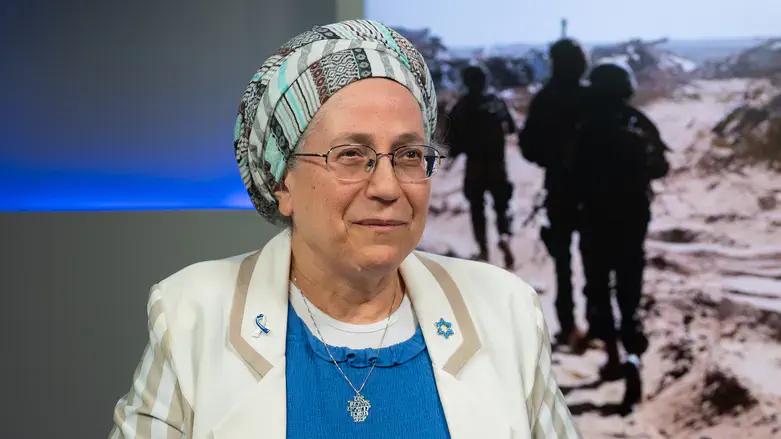
Cabinet Minister Orit Strock outlined to Arutz Sheva - Israel National News her vision for expanding Israeli communities in Judea and Samaria, calling for future settlement efforts to extend into Areas A and B as well as Area C.
According to Strock, the current government has reversed the damage caused by the Oslo Accords and the 2005 Disengagement in Area C, but this is only the first stage of the process.
"The entire Land of Israel is ours - not only Area C, but also Areas B and A," Strock said. "There are 1.3 million dunams of land that are free of any settlement, and we need to take them because they are ours. We need to move into Area A."
Turning to the upcoming elections, she criticized politicians whom she said support territorial withdrawals.
"Anyone who believes Oslo was a disaster, anyone who believes the damage caused by Oslo can and should be repaired, should not vote for Hili Tropper - they should vote for us," she said, adding that her party's goal is "not to abandon our land to foreign hands."
Strock also discussed the work of the Settlement Ministry, saying the government is advancing legislation that would allow the establishment of local authorities for new communities before residents move in. According to her, the measure would facilitate the creation of new communities in the Negev, including the planned cities of Tila and Kasif, as well as the expansion of settlement in the Galilee and along Israel's eastern corridor.
Asked about the October 7 massacre and the ensuing war, Strock emphasized that the October 7 Hamas attack was the result of Israel's previous withdrawal policies.
"This is the first war since the Six Day War whose political outcome is not another Israeli withdrawal," she said, adding that Israel is now operating "inside enemy territory" in Lebanon, Gaza, and Syria.
Concluding the interview, Strock discussed the proposed Draft Law, stressing, "I obviously believe the haredi public should enlist in the army and share the burden of the war like the rest of us," she said, adding that enlistment should take place in a way that allows haredi recruits to serve within frameworks adapted to their religious needs.