

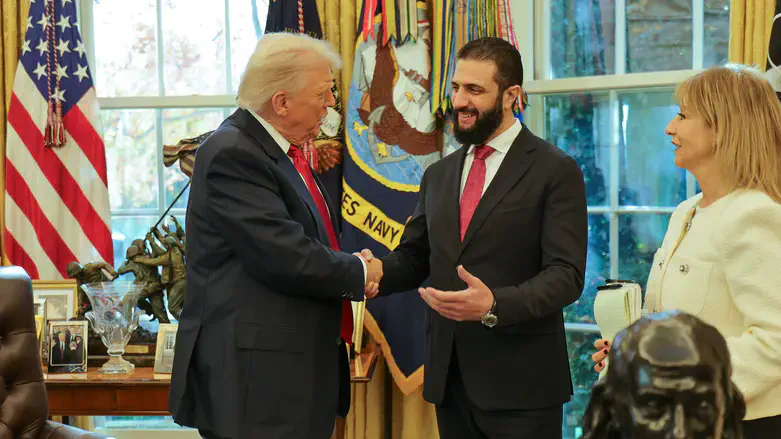
The recent declaration by President Donald Trump indicating a willingness to remove Syria from the U.S. State Department’s list of state sponsors of terrorism marks a perilous pivot in American foreign policy. Coupled with optimistic projections regarding an Israeli military withdrawal from southern Lebanon, Washington appears to be rushing toward a premature stabilization narrative in the Levant. At the center of this strategy is Ahmed al-Sharaa, the interim Syrian president who assumed power following the dramatic collapse of the Bashar al-Assad regime.
Sharaa's sudden elevation from an international terrorist to a prospective diplomatic partner is not a triumph of moderate reform. Instead, it represents the most sophisticated mutation of Salafi-jihadist ideology observed in the modern era, posing a severe long-term threat to Western security and regional minorities.
The Illusion of Transformation
To understand the danger of the current U.S. trajectory,we must examine the meticulous career of Sharaa, previously known by his battlefield moniker, Abu Mohammad al-Jolani. Sharaa is a veteran of the global jihadist movement who gained operational experience fighting American forces alongside al-Qaeda in Iraq after the 2003 invasion. Following his subsequent incarceration at Camp Bucca, he spearheaded the creation of Jabhat al-Nusra, which operated as al-Qaeda’s official Syrian franchise.
Under his command, the group executed horrific suicide operations, systematically targeted religious minorities, and enforced an uncompromising version of Islamic law. His subsequent break with al-Qaeda and the creation of Hay'at Tahrir al-Sham, or HTS, were widely interpreted by Middle East experts as tactical maneuvers rather than genuine ideological transformations.
The institutionalization of HTS under Sharaa demonstrates how modern radical groups adapt their vocabulary for Western consumption without abandoning their core Islamist objectives.
Scaling the Islamist Deep State
The rapid offensive that overthrew the Assad regime catapulted Sharaa into national governance, prompting a swift superficial makeover. By trading his military fatigues for Western business suits and adopting a technocratic lexicon, Sharaa has successfully manipulated desperate Western observers and regional actors who are eager for stability. Proponents of normalization argue that his anti-Islamic State operations and his apparent rupture with Iran justify U.S. sanctions relief.
However, this optimism ignores the structural realities on the ground in Damascus. The governance apparatus currently being deployed across Syria is merely a scaled-up version of the totalitarian model Sharaa perfected in the Idlib Governorate. HTS loyalists have quietly secured control over key administrative, financial, and intelligence sectors, ensuring that the underlying Islamist infrastructure remains absolute beneath a veneer of pluralism.
Regional Insecurity and the Minorities Crisis
Islamist organizations utilize tactical moderation to achieve international legitimacy before consolidating absolute power. Removing Syria from the terrorism list without ironclad, verifiable concessions would strip Washington of its primary leverage and abandon vulnerable communities. Syria’s historic minorities, including Christians, Alawites, Druze, and Kurds, currently face profound existential uncertainty.
While the interim government issues reassuring statements to international media, reports from formerly regime-held territories indicate persistent sectarian intimidation and the steady infiltration of Sunni Islamist networks into public life. Furthermore, a consolidated Islamist state in Damascus will inevitably destabilize neighboring states, given HTS’s historical ties to transnational jihadist networks and its deep patronage links to Turkey's own Islamist leadership.
The Strategic Blunder in Lebanon
This lack of strategic foresight extends to Washington’s assumptions about Lebanon. President Trump’s confidence that Israel can safely withdraw from southern Lebanon is dangerously intertwined with the delusion of a stabilized Syria. Any premature Israeli retrenchment, absent the complete and verifiable disarmament of Hezbollah and strict border enforcement, risks creating a catastrophic security vacuum.
An Islamist-dominated Syria cannot be relied upon to police these borders or disrupt Iranian supply lines reliably. Instead, history suggests that Sharaa’s regime will exploit regional vacuums to maximize its own strategic depth, potentially aligning with whatever faction serves its immediate survival, including remnants of the old resistance axis or rival extremist groups.
The Case for Principled Realism
The temptation to embrace a transactional shortcut in Syria is understandable given the immense human suffering and geopolitical exhaustion caused by decades of conflict. Yet, treating Ahmed al-Sharaa as a reformed statesman repeats the disastrous Western policy failures of the Arab Spring, during which the Muslim Brotherhood and similar factions were falsely hailed as democratic alternatives. The Trump administration must shift from a policy of wishful engagement to one of rigorous, conditional realism.
Any alteration to Syria's terrorism designation or the easing of economic sanctions must be back-loaded and strictly tied to irreversible benchmarks. These requirements must include the absolute dismantling of HTS’s security state, explicit constitutional protections for secular governance, and international monitoring of minority rights. Celebrating a polished facade while ignoring the jihadist core beneath guarantees a resurgence of radicalism that the West will eventually be forced to confront at a much higher cost.
Amine Ayoub, a fellow at the Middle East Forum, is a policy analyst and writer based in Morocco. Follow him on X: @amineayoubx