

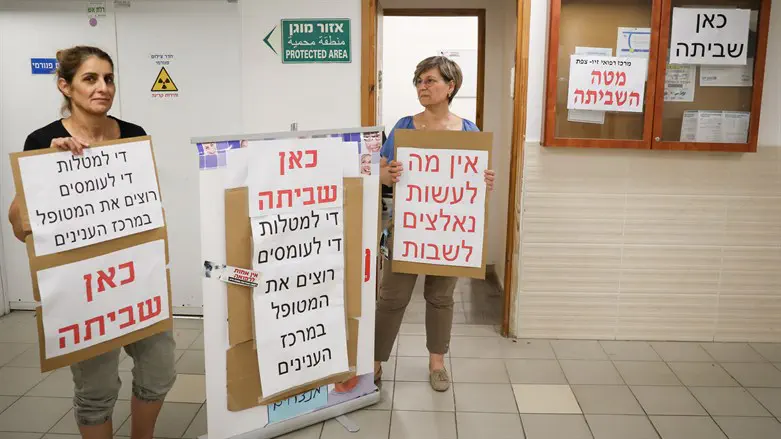
The Nurses' Federation announced today (Thursday) a comprehensive labor dispute in the health system, which is expected to affect approximately 60,000 workers.
The step was taken against the backdrop of increasing workloads, severe physical and mental burnout, and the state and employers' rejection of workers' demands to improve their conditions. The dispute will encompass hospitals, clinics, institutes, baby and child care centers (Tipat Chalav), nursing schools and other medical institutions.
Among the main reasons for declaring the dispute are a constant increase in the workload imposed on nursing teams in hospital departments, the community and public health, without an appropriate response from the system. The workers' representatives warn of a significant impairment of working conditions that endangers the quality of care, physical, mental and professional burnout, and a low ratio between the number of caregivers and patients.
In addition, the workers complain about a shortage of infrastructure, hospital beds and professional manpower, alongside restrictions and cuts that prevent the recruitment of new workers.
In addition, the nurses are protesting the harm to the profession following the replacement of the "bathing nurse" role in the operating rooms by a non-professional technical worker. Another reason is the intention to unilaterally privatize the student health service, a move that has direct implications for the conditions and rights of the brothers and sisters.
The labor dispute was declared in a long list of institutions, including the Ministry of Health, government medical centers, Clalit Health Insurance, Meuhedet Health Insurance, the local government center and the three major cities, as well as in many hospitals such as Hadassah, Shaare Zedek, Bnei Zion, Assuta and Mayanei Hayeshua.
The chairman of the Israeli Nurses' Union, Shaul Skif, commented on the decision and said: "Precisely at a time when the healthcare system is facing an unprecedented challenge of treating and rehabilitating thousands of physically and mentally wounded in the wake of the war, both male and female nurses continue to shoulder unbearable burdens, alongside a severe shortage of manpower and infrastructure."
According to Skif, "Instead of strengthening those on the front lines of care, the state and employers continue to ignore the increasing distress and burnout. We will not hesitate to use all the means at our disposal to ensure not only the rights of nurses, but also the ability of the healthcare system to provide the public with professional, safe and appropriate care, today and in the future."