

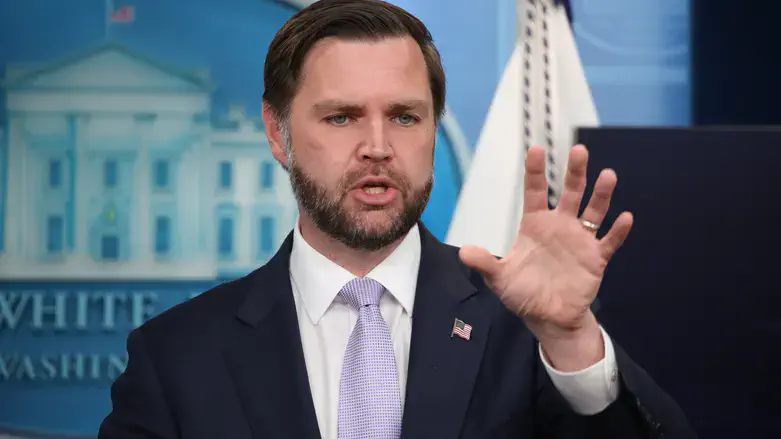
US Vice President JD Vance declared on Wednesday that the Islamic Republic's nuclear ambitions have been severely delayed by recent US combat operations.
Speaking to American military personnel stationed at a local naval air station, Vance highlighted current intelligence metrics regarding the state of Tehran's capabilities.
“If you look at what our own intelligence says about their nuclear program, they are further away from developing a nuclear bomb than they have ever been since basically the last 20 or 30 years," said the Vice President.
He emphasized that the underlying objective of the military operation was to strategically neutralize the country's manufacturing capacity, rendering them incapable of presenting a threat even if they attempted future rearmament.
“What the president asks you to accomplish is to destroy the defense industrial base of that country, so that if they ever decided to rebuild their military, or if they ever decided to rebuild that nuclear program, they would be harmless to do it. You did that exactly as well," Vance said to the assembled audience.
Vance further noted that the performance of the armed forces provided the administration with a significant geopolitical advantage, allowing President Donald Trump to be “negotiating from a position of strength because of you."
He added that the executive branch retains a fluid range of responses should circumstances deteriorate. “If the Iranians try to rebuild the nuclear program, the President’s got options. If the Iranians try to threaten their neighbors or fund terrorism, we’ve got options," stressed Vance.
Turning his attention toward political opponents who have voiced disapproval regarding Washington's current diplomatic engagements, Vance categorized them as the same voices responsible for historical foreign policy missteps.
“What I noticed about the people who are attacking the administration for negotiating is that they are the very same people who, for example, encouraged us to just go a little bit further and just drop a few more bombs in places like Afghanistan. If you go back to the mistakes that were made, those very same people refused to say what we were dropping bombs for."
While defending the current focus on diplomacy, the Vice President made it clear that the administration remains willing to utilize tactical force when specific red lines are crossed.
“We dropped some bombs a couple of days ago… Because the Iranians were shooting at commercial ships… We applied some leverage, and we’ve had free commercial transit for the last three days," Vance claimed.
His comments come as the US and Iran continue their engagement in an attempt to reach a permanent deal after signing a Memorandum of Understanding.
Despite the talks, military tensions escalated over the weekend, as the US twice struck Iranian targets in the Strait of Hormuz in response to Iranian violations of the ceasefire.
Trump warned on Saturday night that the US may be forced to “militarily complete the job" if Iran continued to violate the ceasefire.
Iran later denied that its negotiators would be meeting with Americans in Qatar, claiming that, while a delegation of experts would travel to Qatar's capital this week for discussions on the implementation of the memorandum of understanding with the US, no meetings would be happening between the two countries.
Trump, however, confirmed to reporters the planned meetings in Qatar with Iranian officials, saying they would be "perhaps important, perhaps not".
Subsequent reports indicated that US Special Envoy Steve Witkoff was en route to Doha for the meetings with Iranian representatives.