
The changing approach of U.S. President Donald Trump toward Iran-war, negotiations, renewed strikes, no negotiations, and back again-has left the Iranian public confused, uncertain whether they should once again risk their lives to overthrow the Ayatollahs' regime while waiting for American assistance that has yet to materialize.
Arutz Sheva spoke with Dr. Thamar Eilam Gindin, an Iran expert at the Ezri Center at the University of Haifa, about the mood on the streets of Iran.
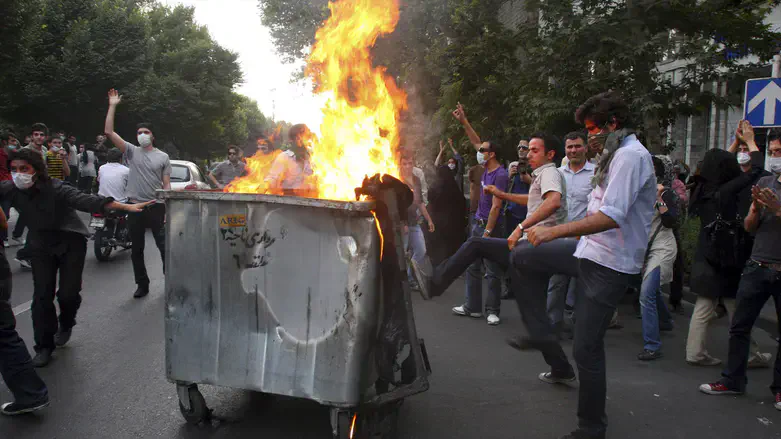
"There is a very strong sense of betrayal" among opponents of the regime, she said. "One of the reasons they burned mosques on January 8 and carried out such bold acts was because Trump had promised to intervene once the regime began killing protesters. But not only did he fail to intervene-he even negotiated with the murderers after they had killed between 30,000 and 70,000 people."
"At the time, some argued that he was simply buying time to rearm, and some are making the same claim today. It is well known that the Islamic Republic buys time, meaning that both sides are buying time. Perhaps Trump's relative unpredictability is actually encouraging, because maybe he will reverse course from where things stand now."
Asked whether these assessments are based on information coming directly from Iran or whether internet restrictions make everything speculative, Dr. Eilam Gindin noted that Iran's internet has recently been reopened to all providers after a period during which only government providers had access.
"Now it's functioning poorly-it keeps cutting in and out-but material is getting out," she said. Among it is an AI-generated video depicting Trump praying in a mosque "like a good Shiite with a green headband," reflecting the view that "they see him as a complete traitor. He compares himself to Obama to show how much better he is, while they portray how much worse he is."
At the same time, Eilam Gindin stressed that it is actually supporters of the regime who are demonstrating against the agreement.
"Yesterday, the Assembly of Experts, which supervises the Supreme Leader, issued a statement saying that reopening the Strait of Hormuz violates the commitments of those responsible and that the nuclear issue must not be subject to negotiations. In other words, there are internal disputes within the government and competition between the Revolutionary Guards and the civilian government, with the Revolutionary Guards effectively serving as the security establishment."
According to her, the demonstrations by regime supporters could well be part of an Iranian deception intended to convince Trump that he should strike a deal with a supposedly moderate government that is itself under domestic pressure to take a tougher stance, rather than risk facing a far more extreme regime.
Eilam Gindin noted that this type of bargaining is known in Iran as "jewelers' negotiations," referring to the practice in Iranian jewelry markets where two merchants initially offer goods at exorbitant prices, leaving customers with no choice but to buy from the cheaper of the two-after which the merchants split the profits.
In reality, however, regime opponents are not taking to the streets en masse, although there have been several small-scale protests in Iran. That is the current situation, she said, though it could change rapidly.
Dr. Eilam Gindin added that while the demonstrations by regime supporters may indeed be part of a "jewelers' negotiation," they could also reflect genuine internal divisions and fractures within the regime.
She pointed to previous incidents in which the government declared one policy while the Revolutionary Guards did the exact opposite-for example, when the president announced there would be no attacks on Gulf states, only for the Revolutionary Guards to ignore him and launch attacks anyway to demonstrate that the president neither knew nor determined policy.
"The Revolutionary Guards have the weapons and most of the money. I once thought perhaps Trump was a genius, giving money to the government in order to increase internal tensions. But then I realized that the Revolutionary Guards are participating in the negotiations too. So perhaps it's the second possibility I mentioned when I said he is either a genius or a complete idiot..."
Asked whether something even more dramatic than previous events would now be required to bring large numbers of Iranians into the streets, given the disappointment with Trump's promises, Eilam Gindin replied: "Fortunately, I see that the spirit has not died. They themselves say that the spirit has not died. They emphasize that it is still alive, but they have come to understand that they are alone, that they cannot rely on Trump or on the promises of foreigners, and that they have to do it themselves. So I assume some sort of preparation is taking place."
"Every two or three years there is a mass uprising. During the Lion and Sun Revolution in January, what was different was the leadership. When the Crown Prince told people to take to the streets on Thursday, they did. It is possible that if he issues another call, they will come out again rather than waiting solely for spontaneous public outrage," she said, emphasizing that these are merely assessments and speculation based on the current situation, and nothing more.