


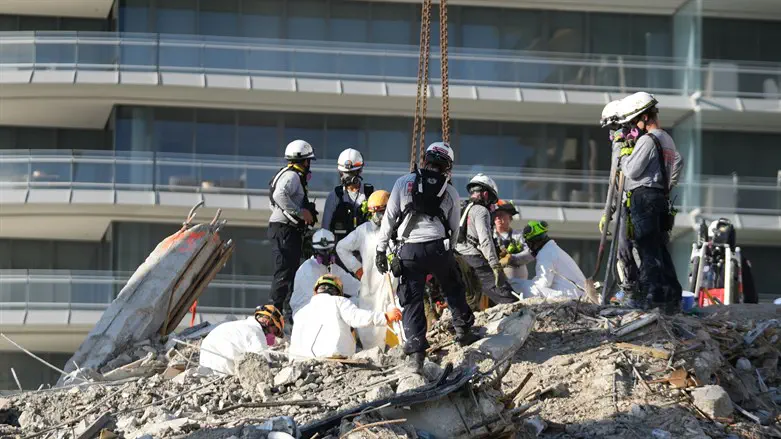
A definitive federal investigation into the 2021 Champlain Towers South disaster reveals that the structural disintegration of the oceanfront high-rise actually commenced weeks before its catastrophic midnight failure, reported The Associated Press.
According to a final report published Monday by the National Institute of Standards and Technology (NIST), the 12-story building had been structurally compromised from its very inception.
NIST investigators identified that a slow-motion failure began around early June 2021, when two critical joints linking the underground parking garage columns to the pool deck slab gave way. Because the initial building design violated standard construction codes, and subsequent modifications over a 40-year period further weakened the property, the remaining components of the deck lacked the structural capacity to absorb the displaced weight.
“When building structures are designed and built to required codes and standards, they have margins against failure, meaning they should be able to support much more load than they are expected to bear," explained Judith Mitrani-Reiser, an investigation co-lead, in an accompanying video release. “In the case of Champlain Towers South, these margins against failure were too narrow from the start."
The exhaustive federal document reinforces a pattern of building distress and fundamental design flaws that gradually came to light following the tragedy. The sudden collapse occurred at 1:22 a.m. on June 24, 2021, catching most inhabitants of the Surfside, Florida complex - located just north of Miami - completely asleep.
The catastrophe claimed 98 lives, impacting a diverse group of residents including members of the local Orthodox Jewish community, the sister of Paraguay’s first lady, her family, and their nanny.
In the aftermath, a Miami magistrate greenlit a class-action settlement exceeding $1 billion to resolve wrongful death and injury claims.
Mitrani-Reiser noted that the building was structurally deficient under the regulatory guidelines of the late 1970s, and the final construction failed to match the architectural blueprints. Unauthorized changes included the installation of massive decorative planters across the pool deck area.
Later renovations around the swimming pool area introduced heavy sand and paving stones, which piled additional stress onto what she described as an “already structurally inadequate" platform. Furthermore, NIST documentation verified that internal steel rebar within the pool deck and ground-level parking garage slabs had suffered from severe corrosion.
Evidence gathered from photographs taken in the weeks leading up to the disaster captured a substantial fracture traversing a planter wall on the pool deck, alongside additional cracking where the planter connected to a structural box. This planter completely broke away from the pool deck less than 24 hours before the ultimate failure.
NIST also tracked an escalating water leak originating from the subterranean garage ceiling roughly a week before the disaster. Eyewitness accounts provided to investigators described the breach as mimicking a "water faucet" just hours prior to the structural failure.
As the catastrophe unfolded, occupants inside the complex witnessed the pool deck giving way. Mitrani-Reiser noted that observers described the deck collapsing “one bay at a time as if dominoes were falling in a sequential chain reaction." Other survivors recalled a sudden rush of air sweeping through the lobby, accompanied by roaring noises resembling a “jet engine."
The Surfside disaster prompted sweeping legislative action in 2022, when Florida lawmakers passed a mandate forcing condominium associations to maintain financial reserves dedicated to structural maintenance. However, when property owners faced unexpected, exorbitant assessments to address decades of neglected repairs, legislators stepped in with a follow-up law granting associations and unit owners enhanced financial flexibility to manage compliance costs.