

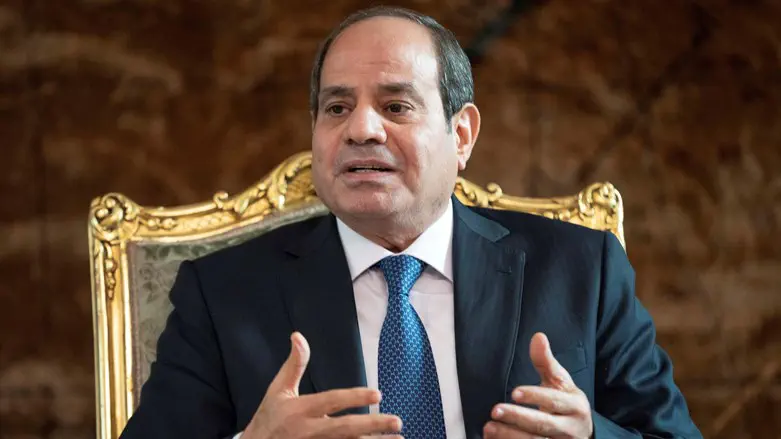
Egypt's recent announcement that it will host an international conference on Gaza reconstruction has been greeted in Western capitals with the usual uncritical praise. President Abdel Fattah el-Sisi is once again being framed by global diplomats as the indispensable regional mediator and a rock of stability.
But a much more troubling reality must be confronted. Cairo’s sudden flurry of diplomatic activity is not a sign of regional leadership. It is a calculated survival strategy by a deeply repressive, economically bankrupt military regime that has mastered the art of leveraging regional chaos into a multi-billion dollar financial lifeline.
For Israel, the illusion of Egypt as a reliable security guarantor is a dangerous trap. While international media outlets portray Sisi as a bulwark against Islamism, the structural reality of his regime suggests a ticking time bomb on Israel’s southern border. Sisi’s foreign policy is not driven by strategic vision or a desire for regional peace, but by a desperate need to keep an unpopular dictatorship afloat.
The true nature of Egypt's balancing act is visible along the Sinai border. Cairo has vehemently rejected any proposals suggesting the temporary resettlement of Gazan civilians into the Sinai Peninsula. The regime frames this as a principled defense of Palestinian Arab sovereignty, but the reality is far more self-serving. Sisi treats the Gaza crisis as a hostage situation, holding the threat of regional destabilization over the heads of the international community. By keeping the Rafah crossing tightly restricted and weaponizing the flow of humanitarian aid, Cairo signals to the United States, Europe, and the wealthy Gulf states that stability in North Africa comes at a high price.
The security argument used by the Sisi regime to justify its harsh border policies is also deeply hypocritical. For over a decade, Cairo claimed to be waging an uncompromising counter-terrorism campaign against jihadists in the Sinai. Yet, the staggering network of smuggling tunnels discovered underneath the Philadelphi corridor proved that the Egyptian military was either completely incompetent or actively complicit in allowing Hamas to build its massive military arsenal.
Sisi has long played a double game with Hamas. When he needs to look vital to Washington and Jerusalem, he acts as the stern mediator. When he wants to pressure Israel, the borders mysteriously become porous. This is a transactional relationship, not a strategic alliance based on shared values.
This pattern of geopolitical extortion extends to Egypt’s western flank as well. Sisi frequently hypes the threat of migration from Libya and security spillovers from the Sahel region to terrify European policymakers. By positioning Egypt as the only force capable of policing these volatile borders and managing energy security, Cairo successfully extracts massive financial bailouts. The multi-billion dollar deals signed with the European Union and the International Monetary Fund are not rewards for good governance. They are protection money paid to a dictator to keep the migration gates shut.
The fundamental flaw in relying on Sisi is that his regime is built on economic ruin and brutal repression, a combination that historically breeds intense radicalization. The Egyptian economy is in a state of chronic collapse, devastated by Sisi’s multi-billion dollar vanity projects, such as a new administrative capital in the desert, and the military’s suffocating monopoly over private enterprise. Inflation has crushed the Egyptian middle class, and poverty rates are soaring.
By completely crushing any legitimate, moderate secular political opposition and imprisoning tens of thousands of dissidents, Sisi has created a dangerous political vacuum. He has ensured that the only viable alternative to his military junta remains the underground Islamist networks. Sisi is not curing Islamism; he is incubating its next, more explosive mutation.
If and when the economic pressure cooker in Egypt finally explodes, Israel will face a chaotic, hostile state on its southern border, completely undermining decades of cold peace.
The upcoming Gaza reconstruction conference in Cairo should therefore be viewed with deep skepticism. It is a public relations performance designed to ensure that the Sisi regime retains oversight over the flow of international funds. Cairo wants to control the reconstruction of Gaza because it allows the military elite to line their own pockets through state-owned construction companies while maintaining a chokehold on the Hamas enclave.
Israel must look past the shiny facade of Sisi’s international conferences and recognize the structural fragility of the Egyptian state. A regime that relies on foreign handouts, external crises, and absolute domestic terror to maintain power is not a pillar of stability. It is a liability. As Jerusalem navigates the complex post-war architecture of the region, it must maintain independent security control and absolute vigilance, recognizing that Cairo’s cooperation lasts only as long as the next international check clears.
Amine Ayoub, a fellow at the Middle East Forum, is a policy analyst and writer based in Morocco. Follow him on X: @amineayoubx