

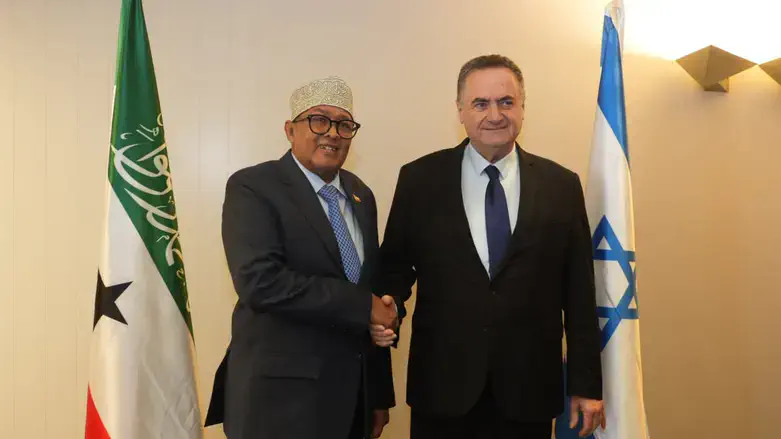
For decades, Somaliland's people built what no one would acknowledge: a functioning democracy in one of the world's most dangerous neighborhoods. They held elections. They maintained borders. They kept the peace. And for thirty-five years, the international community looked away. No recognition. No embassy. No seat at any table that mattered.
Somaliland President Abdirahman Mohamed Abdullahi arrived in Jerusalem. He walked into the President's Residence and met with Isaac Herzog. His country will open its embassy in the Israeli capital, becoming the eighth nation to plant its flag in Jerusalem. It is the first official state visit by a Somaliland president, not merely to Israel but to any country in the world. And when asked what this moment meant to him, Abdullahi gave an answer worth reading twice: "We asked the world: Do you see us? Israel answered first."
Israel recognized Somaliland in December 2025, becoming the first United Nations member state to do so. The decision, framed by Prime Minister Netanyahu in the spirit of the Abraham Accords, triggered an immediate wave of condemnation. Somalia accused Jerusalem of violating its sovereignty. The African Union protested. The Arab League rejected the move. Turkey and Egypt were among the most vocal opponents. All of this was predictable. All of it was wrong.
Somaliland is not a phantom state. It is a country that has governed itself since 1991, with a constitution, an elected parliament, a functioning judiciary, and a democratic tradition that has produced peaceful transfers of power in a region where such things are anything but guaranteed.
The world's refusal to recognize Somaliland has never been about principle. It has been about inertia, about the comfortable fiction that African borders drawn by European colonizers in the nineteenth century are sacred, and about the deep discomfort that a small, successful breakaway democracy creates for the logic of territorial integrity everywhere else.
And today, Wednesday June 17, Defense Minister Israel Katz met with Somaliland President Dr. Abdirahman Mohamed Abdilahi to discuss strengthening military, economic, and diplomatic cooperation
Israel saw through the fiction. And there is a strategic dimension to this decision that goes well beyond the symbolic.
Somaliland sits along the Gulf of Aden, at the southern approach to the Bab-el-Mandeb strait. For the past two years, that waterway has been a killing field for global commerce, with Houthi drones and missiles targeting commercial shipping as punishment for the world's relationship with Israel. The Bab-el-Mandeb is one of the most critical maritime chokepoints on earth, connecting the Red Sea to the Indian Ocean and carrying a significant portion of global trade.
A stable, Israel-friendly partner on that coastline does not merely represent a diplomatic trophy. It represents a security asset of genuine long-term importance.
The cooperation framework announced alongside the embassy opening is telling: agriculture, water technology, energy, and security. That last item is not an afterthought. Israel's experience in naval and maritime defense, drone detection, and intelligence infrastructure is directly applicable to a region under constant threat from Al-Shabaab and from the Houthi supply chains that run through the Red Sea corridor. Somaliland's strategic location and Israel's technical capabilities are a natural match, and both governments appear to understand this.
Critics will say that Netanyahu took a reckless gamble, that offending Somalia, Turkey, and the Arab League served no purpose. This analysis misses the point entirely. Those actors were never going to be Israeli allies. Turkey under Erdogan is already a hostile actor across multiple theaters. Somalia is unable to police its own territory and has spent years in a spiral of Islamist insurgency. The Arab League's opposition to Israel is a structural feature, not a reaction to any specific Israeli policy.
Losing their approval costs Jerusalem nothing.
What Israel gains, however, is substantial. A democratic partner at a critical maritime chokepoint. A precedent that the Abraham Accords model can extend beyond the Arab world into sub-Saharan Africa. And the moral high ground of being the country that looked at thirty-five years of Somaliland's patient, democratic nation-building and said: you deserve to exist.
The familiar accusation that Israel is diplomatically isolated deserves to be retired. A country that is opening new embassies, recognizing new states, and building partnerships in the Horn of Africa while simultaneously at war is not isolated. It is choosing its allies more carefully than its critics give it credit for.
"We asked the world: Do you see us? Israel answered first."
Now Washington should too.
Amine Ayoub, a fellow at the Middle East Forum, is a policy analyst and writer based in Morocco. Follow him on X: @amineayoubx