

The debate over who won or lost the Iran war has consumed Washington for months. Israel's Blue Sparrow missiles killed a supreme leader. American airstrikes obliterated a nuclear program that took decades to build. Iran's proxy network from Beirut to Baghdad is in ruins.
But fixate too long on Tehran's losses and you miss the strategic catastrophe unfolding in Moscow.
Russia's flagship air defense export just failed in the most expensive, most public, and most technically unambiguous product demonstration in the history of the global arms market. The implications for Russian defense sales worldwide may outlast anything that happened to Iran.
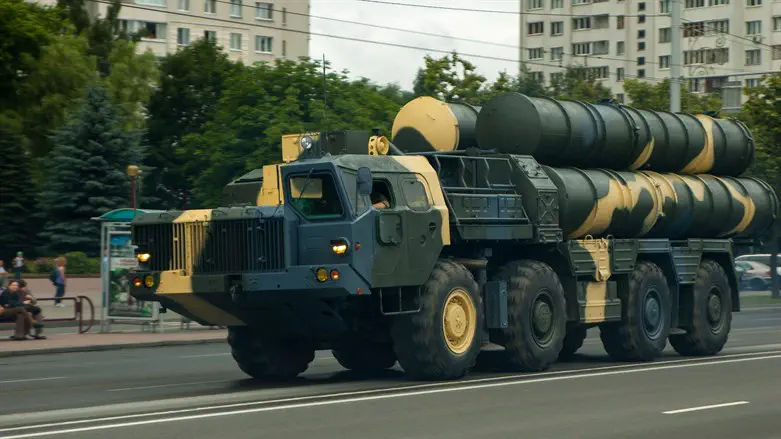
The S-300PMU2 system, Russia's signature surface-to-air missile network and the backbone of Iran's air defenses, was designed during the Cold War to destroy American F-16s and cruise missiles approaching from the horizon. Its 30N6E2 engagement radar, designated "Tombstone" by NATO, sweeps a wide arc scanning outward for threats flying parallel to the earth. It does not look up. Every planar array radar system has what analysts call a "Zenith Blindspot," a massive cone of dead space directly above the battery where the radar is essentially blind. Israel's Blue Sparrow Air-Launched Ballistic Missile was engineered to exploit exactly that gap.
Space analyst Girish Linganna, explaining the mechanics of the strikes on Tehran, put it plainly: "The Blue Sparrow came from directly above, nearly vertical, at hypersonic speed. Iranian air defenders reportedly had only a few seconds of warning. Not enough to do anything meaningful."
The S-300's Tombstone radar cannot engage a weapon dropping vertically at Mach 5. By the time the missile entered the system's theoretical engagement envelope, Russian computers had mere seconds to calculate a firing solution, a mathematical impossibility for hardware built in the 1990s.
Iran attempted to paper over the failure by touting its indigenous Bavar-373 system, claiming it is an "S-400 killer." Defense analysts were unimpressed. The Bavar-373 was reverse-engineered from the S-300 it was meant to supplement, retaining the same planar array radar architecture and the identical zenith blindspot.
Tehran had two air defense systems. Both had the same vulnerability to the same weapon.
For Russia, this is a nightmare that money cannot easily fix. Before the war, Moscow's defense export revival looked credible. Russian arms revenues crossed $15 billion in 2025. Algeria had just taken delivery of two Su-57 fifth-generation fighters in November, the first foreign operator of that type, with twelve more on order. India's defense ministry was, as recently as January 2026, in active discussions for forty Su-57s. Rosoboronexport was publicly boasting that its list of Su-57 customers was "steadily expanding."
The S-300's humiliation in Iran did not merely discredit one platform. It cast a shadow over the entire ecosystem of Russian air defense philosophy, radar architecture, and systems integration on which the Su-57 program is built.
The timing compounds the damage. Russia's customer base had already contracted severely since the invasion of Ukraine, shrinking from 32 nations to roughly 12 over the past decade. Iran was the largest prospective new customer, with leaked Rostec documents from late 2025 indicating an order for 48 Su-35 fighters scheduled for delivery between 2026 and 2028. That contract is now effectively dead. The Islamic Republic cannot afford it, absorb it, or survive the optics of a billion-dollar Russian rearmament deal while its cities are rebuilding.
Into the vacuum, American defense companies are moving fast. US foreign military sales to Gulf states surged in the first quarter of 2026, with potential deals for Saudi Arabia, Kuwait, and the UAE estimated at over $21 billion, centered on the precise missile systems and electronic warfare architectures that performed in Iran. The war produced the most credible live-fire demonstration catalog in American arms export history.
Washington has a decision to make. It can treat this windfall as incidental, a byproduct of a war whose ceasefire negotiations now dominate policymakers' attention. Or it can recognize thatthe Iran campaign handed the United States something it spent decades trying to achieve through other means: a globally witnessed proof of concept that Russian air defense is penetrable,Russian systems are brittle, and American and Israeli alternatives are not.
The State Department and Pentagon should accelerate Foreign Military Sales to every country currently operating Russian air defense equipment, from Algeria to India to Serbia, and pair those offers with the hard technical evidence that Iranian skies have already furnished.
Russia's arms industry does not need another enemy. It already found one, thirty kilometers above Tehran.
Amine Ayoub, a fellow at the Middle East Forum, is a policy analyst and writer based in Morocco. Follow him on X: @amineayoubx