

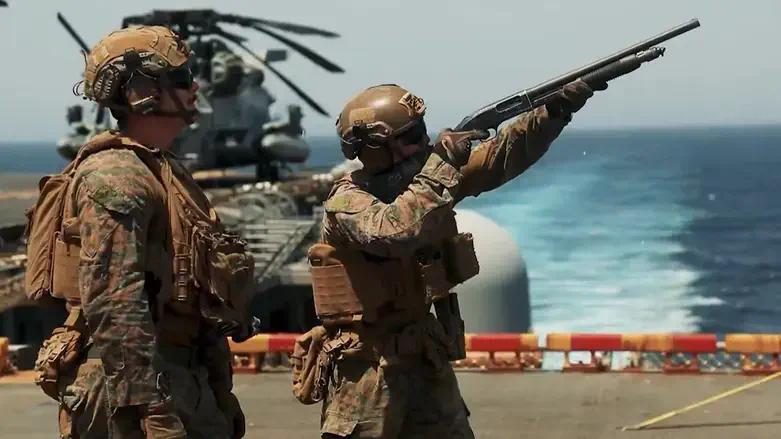
Something remarkable happened Friday in the Sea of Oman. Iran's Islamic Revolutionary Guard Corps launched a missile and a drone as "warning shots" at two United States destroyers, declaring the action a retaliation for America's boarding of a sanctioned Iranian tanker. Hours later, Pakistan's interior minister was in Tehran meeting with Iranian Foreign Minister Abbas Araghchi to explore new pathways for restarting nuclear negotiations.
No American ultimatum followed. No diplomatic pause was announced. The ceasefire, such as it is, continued.
Tehran has discovered that the United States can be simultaneously shot at and negotiated with, and that the two tracks will never be allowed to contaminate each other. Iran has grasped, with unsettling precision, that as long as it keeps its provocations below a threshold of American fatalities, the diplomatic channel stays open and the pressure on Washington to reach a deal remains constant. The result is a conflict in which Iran escalates militarily while harvesting diplomatic progress at the same time, on the same day, in adjacent news cycles.
The Sea of Oman episode is the clearest expression yet of this playbook. The IRGC did not sink the destroyers. It did not wound any sailors. It fired warning shots in the precise sense that a warning shot signals both capability and restraint simultaneously. The message to Washington was unambiguous: we can hurt you, but we are choosing not to, and that choice should be compensated with concessions at the negotiating table. This is coercive diplomacy at its most refined, and the absence of an American punitive response confirms that it is working exactly as designed.
Now look at the parallel track. On the same day Iran fires at American warships, Hezbollah's parliamentary spokesman Nabih Berri surfaces with a carefully worded offer. The group would withdraw south of Lebanon's Litani River, he announced, if Israel withdraws from areas it occupies and a comprehensive, unconditional ceasefire is reached.
The offer sounds reasonable. It is not. It is the diplomatic mirror image of the naval provocation in the Gulf. Both moves carry the identical message: Iran and its proxies are willing to de-escalate on any given front, but only in exchange for Israeli withdrawal, continued nuclear negotiating rights, and the structural preservation of Hezbollah's military infrastructure.
The trap is elegant. Any American administration willing to press Israel on withdrawal, even partially, can claim a diplomatic win. Hezbollah survives south of the Litani so long as the buffer is managed from the Israeli side. Iran extracts sanctions relief and nuclear concessions. And the IRGC firing warning shots at American destroyers gets filed under "ceasefire violations" rather than "acts of war."
Washington's structural inability to integrate these tracks is Tehran's greatest strategic asset.
This explains why Iranian Foreign Minister Araghchi's statement this week that "no tangible progress" has been made on the nuclear file should be read not as frustration but as deliberate pressure. The declaration keeps American diplomatic anxiety elevated. It signals that Tehran can walk away from negotiations at any moment while simultaneously keeping the Pakistan back-channel open.
Iran still holds 440 kilograms of uranium enriched to sixty percent purity, one technical step from weapons-grade material. Every week that passes without a nuclear agreement is a week closer to a threshold crossing. Araghchi knows this. He is using it.
The broader architecture now becomes visible. Iran does not experience this conflict as a single war with a single resolution track. It experiences it as multiple simultaneous theaters, each modulated independently to generate maximum pressure without triggering maximum response.
Lebanon is a theater. The Strait of Hormuz is a theater. The nuclear file is a theater. The Sea of Oman, as of Friday, is now a theater. Each one can be turned up or down independently, creating a system of permanent leverage that outlasts any single ceasefire framework.
The correct American response to warning shots against its own destroyers is not to file the incident under the ceasefire rubric and move on. It is to make explicitly clear that any Iranian military action against American forces, regardless of casualties, constitutes a breach that suspends diplomatic engagement until Iran stands down fully.
If Washington refuses to link these tracks, Tehran will keep firing warning shots indefinitely. Each one builds deterrence at no cost. Each one teaches Iran's negotiators that escalation is consequence-free and that Islamabad will be waiting the next morning regardless.
Amine Ayoub, a fellow at the Middle East Forum, is a policy analyst and writer based in Morocco. Follow him on X: @amineayoubx