

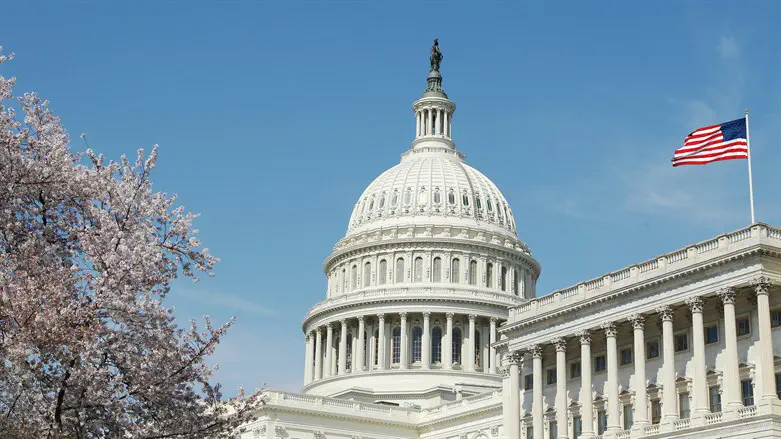
The war powers resolution that cleared the House on Wednesday by a razor-thin 215 to 208 vote will not stop a single missile. It will not bring a single American service member home. It faces a near-certain presidential veto and lacks the two-thirds majority in either chamber to override it.
What the resolution will do, and what its supporters have conspicuously refused to acknowledge, is broadcast to Tehran the precise fault lines running through Washington's war coalition.
Iran's generals were watching. They are already acting accordingly.
The timing is not incidental. Hours before the House voted, Iranian drones and missiles struck Kuwait International Airport, killing at least one person and wounding dozens in what Kuwaiti officials called an attack on "civilian and vital facilities, including diplomatic missions." This was not an isolated spasm. It was part of a coordinated Iranian salvo that followed fresh American strikes near the Strait of Hormuz, and it came as the Trump administration was insisting, publicly, that diplomatic talks with Tehran were "going on continuously."
What Iran read in that public insistence was weakness. What it read in the congressional vote is opportunity.
The strategic logic is not difficult to trace. Since Operation Epic Fury began in late February, Iran has been playing two games simultaneously: a military campaign of attrition against US allies in the Gulf, and a political campaign designed to fracture American domestic will. The second game requires evidence that American resolve is cracking. Wednesday's House vote is the most compelling evidence Iran could have hoped for short of a formal ceasefire that leaves the regime intact.
Four Republicans broke with their own president in wartime to side with a Democratic-led measure that Tehran's state media will now replay on a loop.
Speaker Mike Johnson was right when he argued before the vote that passing the resolution would weaken the president's hand in negotiations. He was understating the problem. The resolution does not merely constrain Trump's tactical options. It tells Iran that there exists a viable domestic constituency for ending the war before the regime has been disarmed, defanged, or fundamentally altered. That is precisely the information Tehran needs to hold out, drag its feet in the Pakistan-mediated talks, and continue hitting Gulf infrastructure in hopes that the political cost to the White House climbs past the point of sustainability.
The constitutional arguments surrounding the War Powers Resolution of 1973 are not trivial. A president waging a three-month war without a formal authorization for the use of military force is a genuine institutional concern. But constitutional sobriety does not require strategic blindness. Democrats invoking the War Powers Act in June 2026 are not primarily motivated by devotion to Article I of the Constitution. They are motivated by the same polling dynamics that drove opposition to the Iraq War in 2005 and the surge in 2007.
In both cases, congressional interference in wartime produced not a faster peace but a more protracted and costly one, because the enemy was watching and adjusted accordingly.
The specific irony here is that the legislators who voted for the resolution are the same voices expressing concern about Iranian drone strikes on Gulf Arab civilians, about disrupted oil markets, and about the broader regional destabilization the war has caused. They are right to be concerned. But Iran is not hitting Kuwaiti airports because the United States is too aggressive. It is hitting Kuwaiti airports because it is testing how much punishment the Gulf Arab coalition will absorb before the political cost of hosting American forces outweighs the security benefit.
The Iranian calculation depends entirely on American inconsistency. Congress delivered that inconsistency on a platter.
The House vote will not be the last. Senate Republicans are already watching their four colleagues who crossed the aisle, and the institutional pressure to assert congressional authority over a war now past the ninety-day statutory deadline will intensify if casualty figures grow and oil prices climb. Each successive vote, whether or not it passes, generates the same signal:
American commitment is conditional, the president's authority is contested, and a different outcome is possible if Iran simply holds on.
There is a way to read Wednesday's events charitably. Congressional oversight exists for a reason. The Trump administration has not been forthcoming about its strategic endgame, and lawmakers asking hard questions about war aims are not inherently or intentionally helping the enemy. But hard questions asked in closed-session briefings serve accountability without serving Tehran's messaging department.
A floor vote broadcast live across the world, framed explicitly as a rebuke of the commander-in-chief in the middle of active hostilities, is something categorically different.
Iran's negotiators in the next round of talks will arrive knowing that the American political clock is ticking. That knowledge is worth more to them than any battlefield gain they have achieved in ninety days of fighting. Congress did not intend to become Iran's most effective strategic weapon.
But intent is beside the point.
Amine Ayoub, a fellow at the Middle East Forum, is a policy analyst and writer based in Morocco. Follow him on X: @amineayoubx