

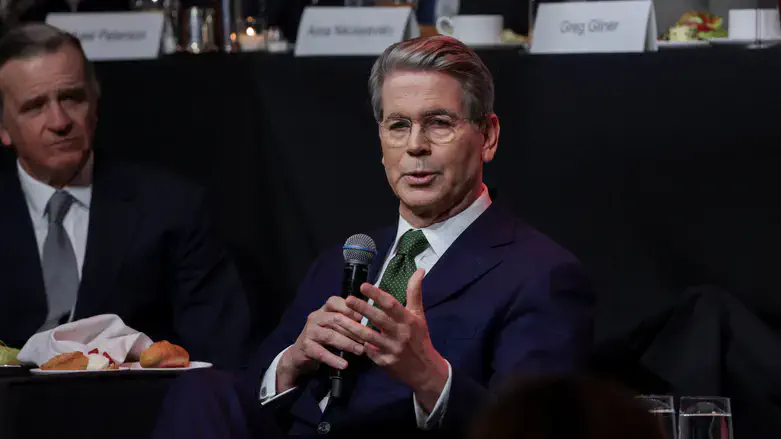
US Treasury Secretary Scott Bessent clarified on Thursday that the ratification of any potential pact with Iran will depend directly on the personal endorsement of President Donald Trump.
“Everything depends on what the president wants to do," Bessent said during a White House press briefing, adding, “And President Trump is not going to make a bad deal for the American people."
The Treasury chief stood firm against revealing specific stipulations of the preliminary accord currently being brokered between the White House and Iranian envoys.
He strongly emphasized that no agreement would receive the administration's blessing unless it thoroughly satisfies Trump's baseline national security criteria. These non-negotiable mandates include a requirement that Iran fully surrender its stockpiles of highly enriched uranium, issue a binding commitment to abandon its aspirations for nuclear weaponry, and guarantee the unhindered passage of international maritime traffic through the Strait of Hormuz.
Furthermore, the Treasury Secretary tempered expectations regarding immediate economic relief for Tehran. When questioned by reporters about whether Washington would roll back its sweeping economic penalties as part of a final compromise, Bessent signaled that the administration would adopt a highly cautious and heavily conditioned approach.
“I would think things would go very slowly in terms of that," Bessent remarked regarding potential sanctions relief.
He further noted that the complex geometry of the ongoing talks requires concrete, verifiable actions from the Iranian regime before the United States concedes any leverage.
“It is a multifaceted agreement and nothing is going to be on the table until we see the Strait of Hormuz open and the Iranians agree that they have to turn over the highly enriched uranium, and that they can’t have a nuclear program," Bessent stated.
The comments followed a confirmation from White House officials that US and Iranian negotiators have reached a tentative agreement on a 60-day memorandum of understanding that would extend the ceasefire and begin negotiations over Iran’s nuclear program.
Two US officials and a regional source involved in the mediation efforts told Axios that President Trump has not yet granted final approval for the agreement.
According to the Axios report, the proposed memorandum would mark a major diplomatic development since the outbreak of the war, though additional negotiations would still be required to address the administration’s demands regarding Iran’s nuclear activities.
Under the terms of the proposed memorandum, shipping through the Strait of Hormuz would remain unrestricted. A US official said the arrangement would prohibit tolls or harassment and would require Iran to remove all mines from the waterway within 30 days.
The report added that the US naval blockade would be lifted gradually, in line with the restoration of commercial shipping.
US officials also said the memorandum would include an Iranian commitment not to pursue nuclear weapons. During the 60-day period, negotiations would initially focus on the disposition of Iran’s highly enriched uranium and the issue of Iranian enrichment.
According to the report, the United States would also agree to discuss sanctions relief and the release of frozen Iranian funds as part of the negotiations. The memorandum would additionally include discussions on mechanisms aimed at enabling Iran to receive goods and humanitarian assistance.
Speaking to reporters later on Thursday, US Vice President JD Vance said that progress has been made but no deal has yet been reached.
“It’s hard to say when or if the President is going to sign the MOU. We're going back and forth on a couple of language points. I do think we’ve made a lot of progress here. It’s very clear, I think, the Iranians want a deal and they want to open the Strait of Hormuz. We want them to open the Strait of Hormuz," Vance said.
“There are a couple of issues on the nuclear stuff and the highly enriched stockpile, the question of enrichment," he continued. “So we’re going back and forth with them. We do think they're negotiating, at least so far, in good faith and we're making some progress."
Vance further said, “Hopefully, we'll continue to make progress and the President will be in a position where he can endorse the agreement, but obviously, that's still TBD."