

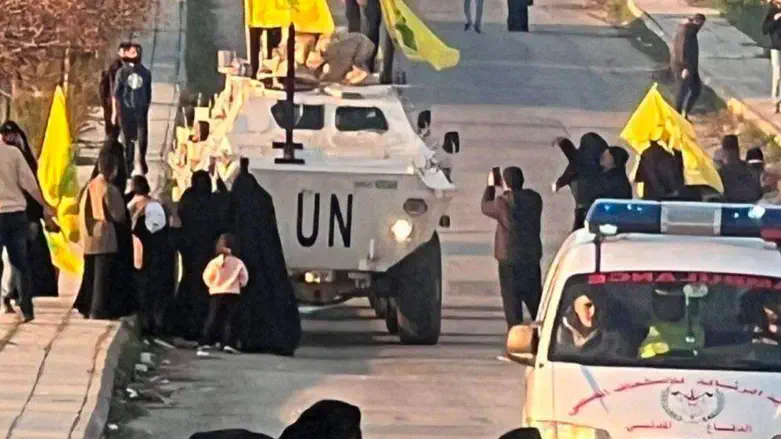
The United Nations Interim Force in Lebanon has been patrolling southern Lebanon for forty-six years!
- It has not disarmed a single Hezbollah fighter.
- It has not prevented a single rocket shipment.
- It has not protected a single Christian or Druze village from the systematic demographic pressure that Hezbollah's parallel state imposed on the country's interior.
The honest reckoning with UNIFIL is not that it failed. It is that it was never designed to succeed. It was designed to provide Western capitals with a diplomatic alibi for inaction while a heavily armed Shiite militia reorganized Lebanese sovereignty around itself.
Now -The aftermath of Hezbollah's military degradation now opens a different possibility, one that bypasses the multilateral fiction entirely and works with the grain of Lebanon's actual social geography.
Lebanon is not a country in any meaningful functional sense. It is an assemblage of confessional communities that have coexisted under varying degrees of coercion and patronage since the French Mandate drew the borders. The Maronite communities of the Metn and Kesrouan, the Druze of the Chouf, the Greek Orthodox villages of the Koura, the Shiite towns of the Bekaa and the southern littoral: each of these has distinct political instincts, distinct threat perceptions, and distinct relationships to the Lebanese Armed Forces, which itself is a confessionally segmented institution held together by patronage rather than doctrine.
What they share is that none of them chose Hezbollah's protection. They endured it.
The military campaign that degraded Hezbollah's command infrastructure, eliminated significant portions of its precision missile stockpile, and killed key figures in its senior leadership has not resolved Lebanon's confessional map. But it has altered the coercive architecture that held that map in place. Hezbollah's ability to enforce compliance through implied and explicit threat is diminished despite its use of explosive drones.
That creates a window, not for a democratic breakthrough or a sovereign renaissance, but for something more granular and more durable: localized security understandings between specific communities and the Israeli security establishment that reflect actual interests rather than UN resolutions.
The Christian communities of southern Lebanon, many of them historically associated with the South Lebanon Army before its 1999 collapse, retain institutional memory of a working security relationship with Israel. That memory has not been eliminated by twenty-five years of Hezbollah dominance. It has been suppressed.
The Druze of Hasbaya and Rashaya occupy a different but structurally adjacent position. The Druze are transconfessional pragmatists by historical necessity. Their communities in the Galilee, on the Israeli side of the border, serve in the Israel Defense Forces and have done so for generations. The notion of a localized understanding between Druze villages on both sides of the Blue Line is not utopian. It is an extension of an existing kinship and political logic that Hezbollah's presence temporarily severed.
The Shiite villages of the south present a more complicated picture, but not an impossible one. Hezbollah and the Amal movement have never had uniform support among Lebanese Shiites. The movement built its base through welfare provision, armed intimidation, and the exploitation of genuine grievances about Shiite marginalization within the Lebanese system. With the welfare network degraded and the armed intimidation less credible, the underlying grievances remain but the mechanism that channeled them toward Hezbollah's agenda is weakened.
Communities that bore the actual physical cost of the 2024 campaign, the destroyed homes and displaced families, are not automatically Hezbollah loyalists awaiting reconsolidation. Some are. Others are exhausted, pragmatic, and looking for a different relationship with the power that now controls the security equation in their immediate environment.
The Israeli security architecture that has emerged from the campaign is not occupation in the classical sense. It is a sustained military presence in a defined buffer zone combined with aerial and intelligence dominance over a broader territory. That architecture works most effectively when it is not purely coercive but when it incorporates local interlocutors who have independent standing in their communities. The Village Leagues model attempted in Judea and Samaria in the early 1980s was flawed in its execution, but the underlying concept of working with localized intermediaries rather than imposing a top-down structure is sound.
What the United States should understand, and what the multilateral community reflexively resists acknowledging, is that the choice in southern Lebanon is not between Israeli security architecture and a functioning Lebanese sovereign state. The Lebanese state has not been sovereign in the south since 1982.
The choice is between Israeli security architecture and a reconstituted Hezbollah. Framed honestly, that is not a difficult choice.
The international community will continue to call for UNIFIL's mandate renewal and the implementation of Resolution 1701. Those calls have been made before. They have produced the outcome we now see.
A different approach, built on real communities with real interests and a real security guarantor, is worth attempting precisely because every alternative has already failed.
Amine Ayoub, a fellow at the Middle East Forum, is a policy analyst and writer based in Morocco. Follow him on X: @amineayoubx