

The rial has lost roughly eighty percent of its value against the dollar since 2019. Inflation in Iran runs above forty percent by official government figures, which means the actual number is higher. The price of bread, eggs, and cooking oil has become a political event in a country where the regime once used oil wealth to insulate the population from the consequences of its ideological choices.
The insulation is gone. What remains is a clerical state that has exported the bulk of its remaining hard currency reserves into a proxy network now significantly degraded, and a population that is being asked to absorb that cost in silence. They are not being silent.
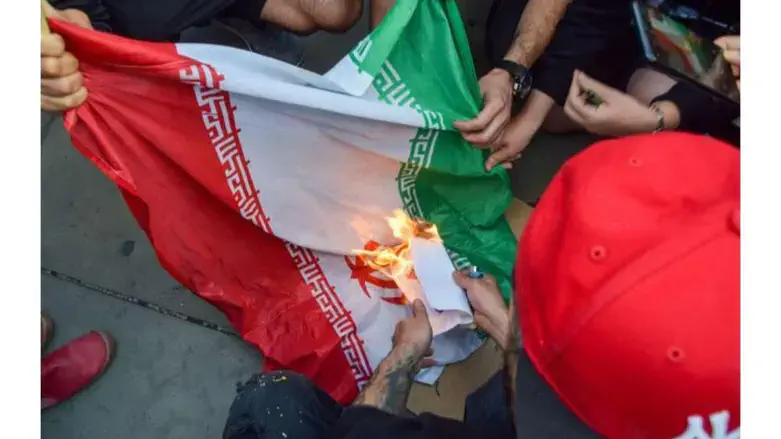
The protests that have followed the military strikes on Iranian territory and the degradation of the Islamic Revolutionary Guard Corps expeditionary infrastructure are not, contrary to some Western analytical frameworks, a spontaneous outburst likely to dissipate. They are the visible expression of a demographic and economic pressure that has been building for a decade.
Iran is a young country with a highly educated population whose professional and civic ambitions have been systematically crushed by a regime that views indigenous talent as a threat to be managed rather than a resource to be cultivated. The women who took to the streets under the Woman, Life, Freedom banner in 2022 were not making a narrow sartorial claim. They were making a civilizational claim about what kind of political community they intended to inhabit. The regime understood that, which is why its response was lethal.
The Jewish world's relationship to Iran's internal opposition is, at present, defined almost entirely by abstention. Israeli officials speak of the Iranian regime as an existential threat with consistent clarity (although, to be fair, there is talk that Israel has transferred arms to the protesters, ed.) . They speak of the Iranian people with awkward diffidence, as if enthusiasm for the population might complicate the strategic case against the government. American Jewish organizations, with some exceptions, treat Iran as a nonproliferation problem rather than a human rights emergency. This is a moral and strategic miscalculation of the first order.
The case for unapologetic Jewish support for Iran's secular, democratic opposition is not primarily a tactical one, though the tactical argument is strong. A post-Islamic Republic Iran, governed by the constituencies that have consistently demonstrated the most sustained opposition to the clerical state, would have no structural reason to pursue nuclear weapons, no ideological investment in the elimination of Israel, and no interest in funding Hezbollah, Hamas, or the Houthi movement. The strategic transformation of the Middle East that a democratic Iran would represent dwarfs in significance every other regional policy question currently occupying Israel or Washington's attention.
But the case is also ethical, and the ethical case deserves to be stated without apology. The Jewish political tradition has an obligation, derived from both historical experience and religious principle, to stand with populations living under theocratic tyranny. The Iranian regime does not merely threaten Israel. It has constructed a system of internal repression in which women are imprisoned for removing a headscarf, in which the Baha'i minority is systematically persecuted, in which labor organizers are executed, in which the Kurdish and Baluch peripheries are held down by explicit state violence.
The Jewish community's voice in Western capitals carries weight. That weight is not being applied where it would matter most.
The secular opposition inside Iran, and its diaspora networks in Los Angeles, Toronto, Paris, and Berlin, has been largely abandoned by the Western left, which cannot reconcile its ideological framework with enthusiastic support for a movement that is explicitly nationalist, explicitly pro-American in its foreign policy instincts, and explicitly committed to a separation of religion and state. That abandonment creates a political opening.
The Jewish community, and the pro-Israel advocacy ecosystem more broadly, can fill it. It can fund diaspora media. It can advocate for targeted sanctions that protect ordinary Iranians while strangling the IRGC's financial infrastructure. It can amplify the voices of opposition figures who rarely receive a platform in mainstream Western outlets. It can insist, in every congressional hearing and every diplomatic conversation about Iran, that regime change through internal pressure is a legitimate policy objective and not a phrase to be avoided.
The counterargument, offered by realists and diplomatic incrementalists, is that overt foreign support for the Iranian opposition delegitimizes it, allowing the regime to frame dissidents as foreign agents. This argument has been made for forty-five years and has produced a regime that frames all dissidents as foreign agents regardless of who supports them. The Islamic Republic does not require actual foreign support to make that accusation. It requires only that someone be protesting. The opposition's legitimacy derives from the depth and consistency of Iranian domestic sentiment, not from the posture of Western supporters.
The currency is collapsing. The IRGC has taken serious losses. The streets of Tehran and Isfahan and Mashhad are filling again. The question is not whether the Islamic Republic faces a civilizational reckoning. It does. The question is whether the Jewish world will be on the right side of it when the reckoning arrives.
Amine Ayoub, a fellow at the Middle East Forum, is a policy analyst and writer based in Morocco. Follow him on X: @amineayoubx