

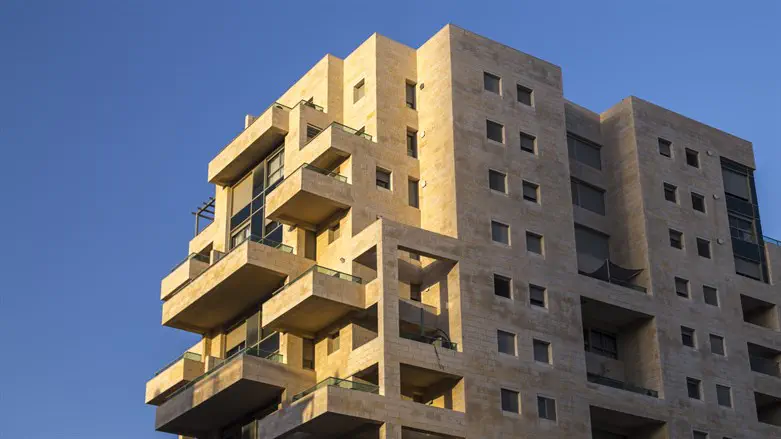
Jerusalem Day 2026 data points to a revolution in the capital’s real estate market, as the city has become the main center of urban renewal in Israel.
In recent years, the municipality has been promoting density and high-rise construction along the light rail and public transportation routes. In certain areas, towers of more than 40 stories are planned, a phenomenon that was almost nonexistent in Jerusalem in the past; some of the plans are facing obstacles from residents who oppose changes to their neighborhoods' zoning and planning.
At the same time, developers in haredi neighborhoods face unique planning challenges that limit the height of buildings.
Yona Green, CEO of Terra Real Estate, explained in an interview with Arutz Sheva - Israel National News that "in the haredi public, there is a clear halakhic (pertaining to Jewish law - ed.) requirement that every apartment have a sukkah (Feast of Tabernacles) balcony, and such a balcony must be exposed to the sky."
According to him, in a tall building, only the upper floors can meet this requirement, and therefore the accepted solution is to build only up to 10 stories.
"It hurts profitability, but this is the reality of construction in Jerusalem," Green says. "You have to understand the community and adapt the project to its needs, otherwise it will not succeed."
Another issue with high-rise buildings is that some Orthodox Jews believe that "Shabbat elevators," which automatically stop at every floor on the Sabbath, should not be used, limiting construction to the number of floors which residents can easily reach using only the stairwell.
Jerusalem has crossed the threshold of one million residents, land reserves are dwindling, and many buildings from the 1950s and 1960s lack protected rooms and elevators. Urban renewal has become the main solution for increasing the housing supply.
A central factor in the revolution is the light rail project, especially the planned new lines.
"The light rail is completely changing the map of Jerusalem," Green explained. "Neighborhoods that were considered far away are becoming accessible and sought-after."