
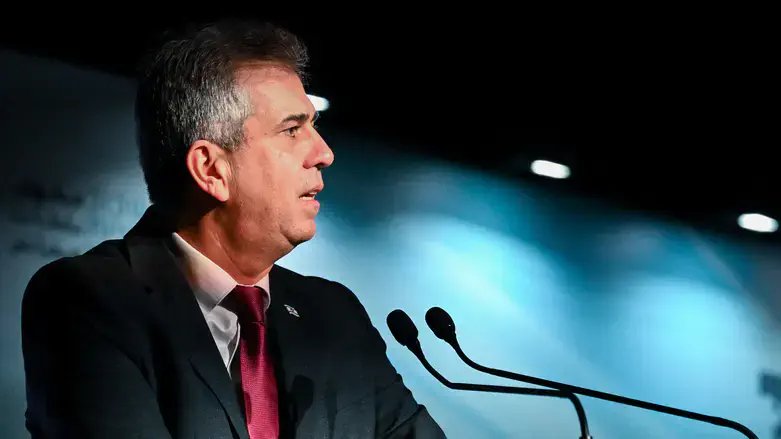
In an interview with Arutz Sheva, Energy and Infrastructure Minister and cabinet member Eli Cohen addressed the frozen confrontation with Iran, the global conduct of the U.S. president, and European sanctions imposed on right-wing organizations and settlers.
Against the backdrop of the US president’s visit to China and its economic focus, Cohen was asked whether economic considerations would ultimately determine developments in the Iranian arena as well - potentially leading to an agreement that would leave Israel alone in confronting Iran.
“We are committed only to the security of the State of Israel," Cohen said, emphasizing the partnership between the United States and Israel, and between President Donald Trump and Benjamin Netanyahu, “to a degree that did not exist in the past."
“In this partnership, the US and Israel are striking the Nazi tyrant of our time. Iran has suffered extremely severe blows - the destruction of its defense industries, damage to its nuclear sites, the elimination of its leadership, damage to its chain of command, and harm to the scientists themselves. Therefore, today’s Iran is not the Iran of a year ago, and Israel is stronger than ever. The US president is deeply committed to the Iranian issue, to preventing nuclear weapons and uranium enrichment."
When asked why he did not mention neutralizing ballistic missiles as part of the American president’s commitments, Cohen replied: “One of the great achievements of the war is the destruction of Iran’s defense industries. We prevented them from being able to manufacture hundreds of ballistic missiles each year. If Iran dares to think - with or without an agreement - about renewing its nuclear program or ballistic missile program, we will be there."
According to Cohen, Israel’s hands would not be tied by any future agreement between the United States and Iran.
“Israel is committed first and foremost to its own security and to ensuring that anyone who seeks to destroy it will find themselves facing the same danger of destruction and neutralization of their capabilities. If Iran attempts to renew its nuclear and ballistic missile programs, our hands will be free to act and do what is necessary against it with full force."
Cohen was also asked about the threat posed by explosive drones and calls to return to decisive military operations and deterrence measures that impose a cost for every attack, instead of focusing primarily on defensive systems.
Cohen stated that despite the ceasefire, the IDF continues operating in southern Lebanon and is even flattening villages there. He described the ceasefire as “a fake ceasefire" and noted that the IDF has “not retreated a single millimeter" from the 7-8 kilometers inside Lebanon where Israeli forces remain deployed.
“We are there, and we have prevented two major threats: terrorist infiltrations into communities near the border fence and anti-tank missile threats. The question is not whether we will return to intense fighting, but when. We are managing the arenas both in Lebanon and Iran in order to maximize achievements for the State of Israel."
According to Cohen, the chances of preventing renewed large-scale war in Lebanon are slim and depend on a scenario he considers unrealistic - namely that Hezbollah would disarm through an agreement or by action from the Lebanese army. Since he considers such a possibility nearly nonexistent, Cohen believes the IDF will ultimately “do the job."
Regarding another northern front - Syria - Cohen was asked what happened to reports about a possible arrangement with the new Syrian government led by al-Julani.
Cohen said he believes such an agreement is no longer realistic, explaining that “it will take time before the picture becomes clear. Regarding al-Julani, the attitude should be ‘respect him but suspect him.’ His intentions are still not fully clear. It is far too early to talk about an agreement with Syria."
The final issue raised during the interview concerned European sanctions against right-wing organizations and activists in Israel. Cohen was asked whether Israel has leverage to respond to such sanctions or whether it would simply lower its head and move on.
“We are not lowering our heads," Cohen declared. “The Jewish people have proven that they know how to act even against major powers, including Iran, in ways others did not dare to act. In many areas, they need Israel. We are not only a military power but also a technological power, and we see the confidence of global investors in Israel, a strong stock market, and a strong shekel. Israel is not helpless."
According to Cohen, Israel will maintain its independence in the face of European pressure and make use of the leverage at its disposal to strengthen itself.
“Bending the knee does not exist in our lexicon," he said.