
Thisweek we are marking 59 years since the Six - Day War - the war in which the territories of Judea, Samaria and Benjamin, the Jordan Valley, Sinai and the Gaza Strip, the Golan Heights, and above all the Old City of Jerusalem and the Temple Mount were liberated.
Itshould be recalled, that the war broke out began when Egypt violated the understandings on the demilitarization of the Sinai Peninsula, established after the withdrawal following the previous conflict, Operation Kadesh. On Israel’s Independence Day in 1967, Egyptian President Nasser deployed the full strength of the Egyptian army into Sinai, which for a decade - since Israel’s withdrawal after Operation Kadesh - had been largely demilitarized and contained UN forces.
The main headline of Maariv on May 16, 1967 (6 Iyar 5727), reported the move, accompanied by a subheadline: “Washington advises Israel not to take the Egyptian show of force seriously." Three weeks later, it became painfully clear how misguided that advice was.
The sweeping victory in the Six - Day War obscured the fact that there had also been an intelligence failure - not unlike that of the Yom Kippur War. The difference is that in 1973 we refused to read the warning signs and ignored clear indications of an impending Egyptian - Syrian surprise attack, whereas in May 1967 Egyptian actions were overt and the Arab world’s calls for Israel’s destruction were so explicit that Israel ultimately had no choice but to launch a preemptive strike to save itself - something that was not done in 1973.
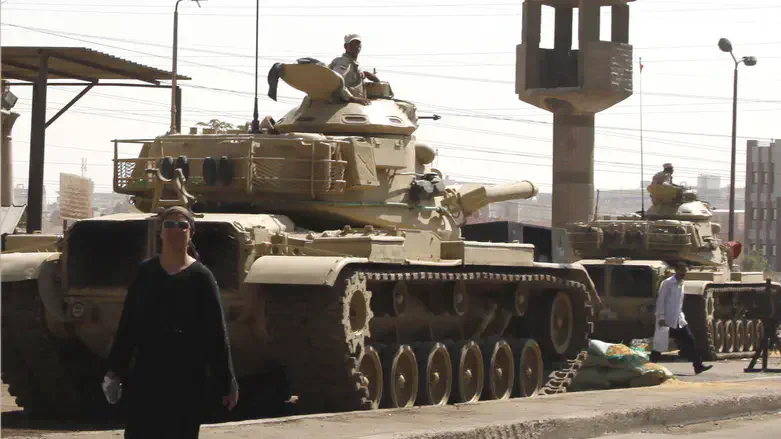
I was reminded of this history, particularly of May 1967, in light of recent reports regarding violations of the peace agreement with Egypt in the Sinai Peninsula - violations that are deeply concerning. Yair Altman reported over the weekend that Egyptian forces in the area now include more than 60,000 soldiers, nearly 1,000 tanks, and hundreds of artillery systems. According to the report, an additional reinforcement of about 10,000 ground troops has recently been deployed to Sinai, along with armored vehicles and heavy equipment. It was also reported that air - defense systems of the Egyptian army have been deployed in the region, including S - 300VM Antey - 2500, Buk - M2, and Tor - M2 systems.
The peace agreement with Egypt, of which little remains in practice, had one central achievement: the demilitarization of the Sinai Peninsula, aside from limited forces explicitly permitted under the treaty. That achievement has been steadily eroded in recent years.
Additional reports, including those published by Netziv, detail further alleged violations. According to these accounts, in the area between al - Arish and the Israeli border there is now a presence of elite units and advanced weaponry:
Armored and mechanized forces: deployment of Abrams tanks - among the most advanced in the Egyptian army - and armored personnel carriers in areas where only light weaponry was previously permitted.
Air defense: positioning of long - range systems such as HQ - 9B and additional advanced missile batteries.
Underground infrastructure: construction of fortified bunkers and subterranean storage facilities in mountainous areas (including reports concerning Jabal al - Halal), intended for command and control and missile storage.
Air infrastructure: expansion of runways at Sinai airbases (such as Rafid and Umm Khashiba), enabling operations of fighter aircraft.
It appears that Israel is treating these developments with excessive complacency and insufficient seriousness. The key lesson of the Six - Day War - and, in reverse, also of the Yom Kippur War and the October 7 massacre - is that an adversary must be assessed by capabilities, not intentions. And the current capabilities in Sinai are deeply concerning.
Even if Israel has no interest in a confrontation with Egypt at this time, the response to these violations must be open, public, forceful, and international. Israel should visibly reinforce its armored forces along the Egyptian border, publicly demand that the United States - as a guarantor of the agreement - press Egypt to remove forces that violate the peace treaty, and clearly signal the seriousness of the situation in a way that resonates internationally. The silence with which these violations are being met is, in itself, the most alarming factor of all.