

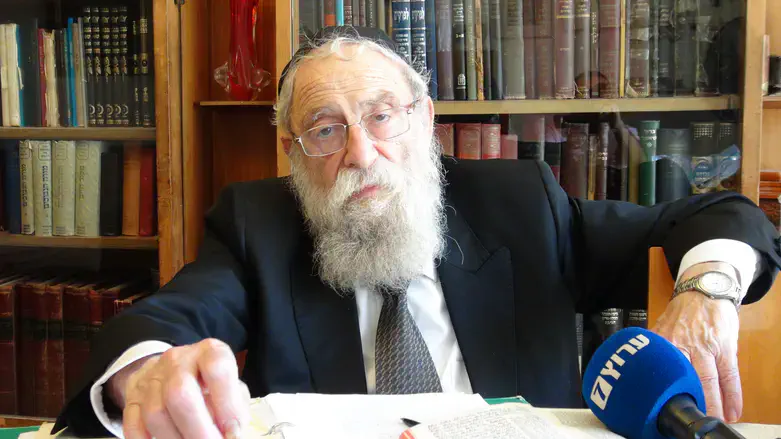
Rabbi Aryeh Stern, the Chief Rabbi of Jerusalem and one of the most prominent rabbinic figures in Religious Zionism over the last generation, passed away on Wednesday night at the age of 81.
For decades, Rabbi Stern was at the heart of the Torah and educational landscape of the Religious Zionist community. He served as the Chief Rabbi of Jerusalem, a member of the Chief Rabbinate Council, and the head of the Halacha Brura Institute.
Born in Tel Aviv in 1944 to Asher and Hava Leah Stern, he was raised in a home that blended Religious Zionism with Hasidic roots. He began his studies at Yeshivat HaYishuv HaChadash and later attended the Hebron Yeshiva. In 1964, he joined the Mercaz HaRav Yeshiva, where he became one of the closest disciples of Rabbi Zvi Yehuda Kook.
In 1966, he was awarded the Ministry of Religious Affairs' prize for Torah compositions. Shortly after, he enlisted in the IDF, serving in the Paratroopers Brigade reserves during both the Six Day War and the Yom Kippur War - periods he often cited as instrumental in shaping his lifelong sense of national and public responsibility.
In 1970, at the request of Rabbi Zvi Yehuda Kook, he co-founded the Halacha Brura Institute. Over the years, the institute became a cornerstone of the yeshiva world’s scholarship, with Rabbi Stern at its helm since its inception. His work focused on synthesizing the rulings of early and later commentators on the Babylonian Talmud.
Alongside his scholarly work, Rabbi Stern taught for decades at a long list of prestigious yeshivas, including Mercaz HaRav, Yeshivat HaKotel, Or Etzion, Kiryat Shmona, Orot Shaul, and Aish HaTorah. Between 1988 and 1989, he also served as the head of Yeshivat HaDarom in Rehovot, becoming a central pedagogical figure for countless students.
Rabbi Stern was also deeply involved in the civic and educational life of Jerusalem. He worked to restore "Beit HaRav" (the historic home of Rabbi Abraham Isaac Kook), was involved in establishing educational institutions, and helped train teachers through the Merhavim Institute. For many years, he served as the rabbi of the "Har Horev" community in the Katamon neighborhood, where he was a beloved and well-known figure among residents.
In 2014, he was elected the Ashkenazi Chief Rabbi of Jerusalem, a position that had remained vacant for over a decade following the death of Rabbi Yitzhak Kolitz. His election was viewed as a landmark moment for the Religious Zionist movement in the city, garnering support from rabbis and public figures across various ideological spectrums.
Upon taking office, Rabbi Stern declared, "I intend to serve as the rabbi for all Jerusalemites - secular, religious, and haredi. To lead the Jerusalem Rabbinate is a great privilege, but it also carries heavy responsibility."
During his tenure, he focused on making religious services more accessible, promoting dialogue between religious and secular communities, and strengthening the city's kashrut standards.
His public stances often drew significant interest. He was a vocal supporter of religious and secular coexistence in mixed neighborhoods and spearheaded dialogue forums. He addressed sensitive religion-and-state issues by seeking a balance between strict adherence to halakha (Jewish law) and broad public responsibility.
Colleagues and students described him as a man of vast Torah knowledge who possessed deep human sensitivity, an inner calmness, and the rare ability to truly listen to anyone who approached him.
Rabbi Stern is survived by his wife, Miriam-Yocheved, and seven children. For years, the family also carried the grief of losing their daughter Shira, who was tragically killed in a road accident in 2007 at the age of 21 - a loss that left a profound mark on the family and the Rabbi’s close circles.
The passing of Rabbi Stern is met with deep mourning by his students, admirers, and the broader public in Jerusalem and the Religious Zionist community, where he will be remembered as a rabbinic authority whose identity was inextricably linked with the holy city.