
Moshe Phillips is national chairman of Americans For A Safe Israel, AFSI, a leading pro-Israel advocacy and education organization.
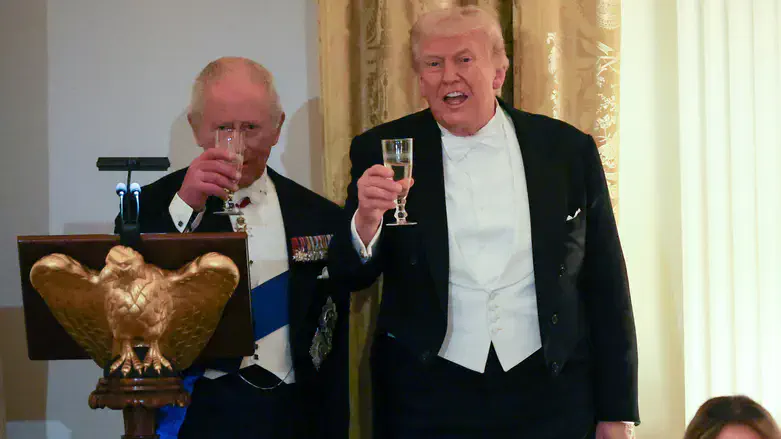
King Charles III’s recent address to the U.S. Congress was, on its surface, a polished diplomatic speech. He invoked shared values, democratic resilience, and the importance of standing with allies under threat-most notably Ukraine.
But what was missing from the speech matters far more than what was included. In a moment that demanded moral clarity, his silence on Israel, terrorism, and the global surge in antisemitism was not just noticeable-it is indefensible.
This wasn’t an oversight. It was a choice. Ours is a time of worldwide resurgent violent antisemitism, and the King knows this. The very next day after his speech, this was tragically proven again when an attacker stabbed two Jewish men in Golders Green, North London.
The fact of anti-Jewish violence in the UK was everywhere in the press throughout April. Just a week before the King left London. "Anxiety mounts in London’s Jewish community amid wave of antisemitic attacks" was the CNN headline on April 20. Also on April 20, this headline appeared in the Guardian "British Jews feel ‘under siege’ and worry about children wearing religious symbols in public."
Over the past several years, Jewish communities around the world have faced an alarming escalation in violence. In Bondi Beach, a mass stabbing shocked Australia and underscored how indiscriminate such violence can be. In Michigan, a man rammed a vehicle into a synagogue, a chilling reminder that even houses of worship are targets. These are not isolated incidents; they are part of a broader pattern that must be described as the worst wave of antisemitism since the Holocaust.
And yet, none of this found its way into the King’s remarks.
At the same time, Israel is not dealing with abstract hostility-it is under active, sustained threat. The regime in Iran continues to fund, arm, and direct a network of proxy militias explicitly committed to Israel’s destruction. From Hezbollah in Lebanon launching rockets across the northern border, to other aligned groups positioning themselves around Israel, this is not a hypothetical danger. It is a coordinated strategy: surround, destabilize, and ultimately eliminate the Jewish state.
Israel’s military actions, often criticized in isolation, cannot be understood without this context. It is a country confronting not just sporadic attacks, but a multi-front campaign designed to overwhelm it. When Israeli leaders authorize strikes against militant infrastructure or target operatives linked to Iranian-backed networks, they are responding to a reality that few other democracies face: the constant threat of annihilation from well-armed, ideologically driven enemies.
This is precisely the kind of struggle King Charles alluded to when discussing global instability-yet he declined to name it where it is most acute.
Contrast that with his unequivocal support for Ukraine. There, the King's narrative was clear: a sovereign nation defending itself against aggression. The moral language was direct, the sympathy unambiguous. But when it comes to Israel, that clarity disappears. Instead of naming terrorism, instead of acknowledging the role of Iranian-backed forces, instead of even mentioning the country at all, the King opted for a safer, more generic framing of “good versus evil."
But moral leadership doesn’t mean speaking in abstractions when specifics are inconvenient.
When King Charles stood before Congress, he carried not just ceremonial authority, but symbolic weight. His words signal priorities. They tell the world which conflicts matter, which victims are seen, and which threats are taken seriously. By omitting Israel and the rise in antisemitic violence, he sent a message-intentional or not-that these issues are somehow secondary, too complex, or too controversial to address directly.
That message resonates far beyond Capitol Hill.
For Jewish students witnessing their fellow students embrace antisemitic extremism, for Israelis living under the constant threat of Iranian rocket fire, for families who have lost loved ones to attacks fueled by the terrorism of Iranian proxies, silence from global leaders is not neutral. It is felt as abandonment.
There’s also an uncomfortable truth behind this omission. Supporting Ukraine has become a broadly accepted, low-risk position in international discourse. Supporting Israel, by contrast, often invites backlash. It requires acknowledging uncomfortable realities about Islamic terrorism, ideology, and the persistence of antisemitism in places many would rather not examine too closely. In choosing to highlight one struggle while ignoring the other, the King didn’t just avoid controversy-he reinforced a double standard.
And that double standard has consequences.
If the defense of democratic values is truly universal, it cannot be selectively applied. Israel is a democracy facing existential threats from terrorist groups that reject not only its policies but its very right to exist. The same principles invoked in defense of Ukraine by the King-sovereignty, security, the protection of civilians-apply here as well. To exclude Israel from that framework is to undermine the very universality those principles claim to uphold.
Words matter, especially from figures of global influence. They shape narratives, guide public opinion, and signal moral priorities. By failing to mention Israel, Islamic terrorism, or the surge in anti-Jewish attacks, King Charles didn’t just miss an opportunity-he contributed to a broader silence that allows these problems to fester.
At a time when clarity about Jew-hatred and antisemitic violence is needed most, the King chose to avoid speaking out. And in doing so, he left a void where leadership should have been.