

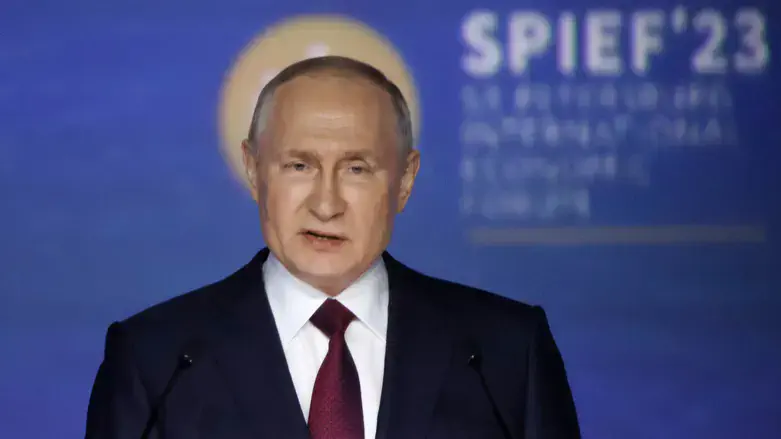
This week, President Trump confirmed that Putin, during a phone call Wednesday, once again offered to serve as the third-country custodian of Iran's 970 pounds of enriched uranium, the same role Moscow played under the 2015 JCPOA. Trump redirected the conversation toward Ukraine, which was the right instinct. But the uranium proposal will not disappear, and the administration needs a firm, principled rejection ready the next time it surfaces. Because it will.
The offer sounds reasonable on the surface. Russia is already a nuclear power, previously stored Iran's low-enriched uranium under the 2015 deal, and possesses the technical infrastructure few countries can match. In a war where the United States is trying to dismantle Iran's nuclear program without putting boots on the ground, handing the problem to Moscow looks like a clean logistical solution. It is not.
It is a trap dressed as a concession, and Washington should treat it accordingly.
Start with the pattern. Russia raised this same proposal during U.S.-Iran nuclear negotiations last spring, before the U.S. and Israeli strikes on Iran's nuclear facilities, and again in the weeks immediately before the current war began. This is not a spontaneous gesture of goodwill. It is a sustained campaign to insert Russia as an indispensable actor in the war's nuclear resolution. Each time the proposal surfaces, Moscow gets closer to legitimizing its role as the region's nuclear referee.
The deeper problem is what custody would actually mean in practice. Once Iran's enriched uranium sits on Russian soil, the Kremlin acquires leverage it currently does not possess. Any future U.S. demand to inspect, dilute, or destroy the material would require Russian cooperation. Any escalation of sanctions on Iran would create pressure on Moscow to use the stockpile as a bargaining chip. Any disagreement between Washington and Moscow over Ukraine, NATO, or anything else would suddenly carry a nuclear dimension it does not carry today.
Russia would not merely be storing uranium. It would be holding a veto card over the most consequential outcome of the entire war.
This is not a hypothetical concern. The JCPOA experience demonstrated exactly how this dynamic works in practice. Russia's custodial role under that deal gave Moscow quiet influence over the pace and terms of Iranian compliance. When the agreement began to fray, Russia consistently used its position to slow accountability and soften verification demands. The 2015 arrangement was sold as a technical convenience. It functioned as political cover for Tehran and strategic insurance for Moscow. Repeating that arrangement now, after Russia has provided Iran with satellite intelligence and drone technology during active hostilities, would be an act of strategic self-sabotage by the United States.
The U.S. position, according to officials, is that the uranium must be secured. That is the right goal. But secured by whom matters as much as whether it is secured at all. A stockpile held in Russian facilities under ambiguous custody terms is not a nonproliferation achievement. It is a deferred crisis with a Russian signature on the lease.
There is a better path. Before the war, Iran itself floated the idea of diluting the uranium inside its own facilities under IAEA supervision. That proposal collapsed under the pressure of events, but its logic holds. An IAEA-monitored dilution or transfer under Western-led oversight, potentially involving France or Japan as technical partners, would achieve the actual objective of neutralizing the weapons-grade threat without handing Moscow a permanent stake in the outcome.
The United States should be constructing that alternative right now, not leaving a vacuum that Russia is rushing to fill.
Trump's instinct to steer Putin back toward Ukraine was correct, but it was a deflection rather than a rejection. The administration needs to close this door entirely before diplomatic pressure to accept the offer intensifies. European capitals, always eager for off-ramps, will eventually frame Russian custodianship as the pragmatic compromise. American negotiators will face a moment, probably sooner than expected, when Putin's offer sits on the table alongside a ceasefire framework and the temptation to accept it will be enormous.
The uranium question will define the endgame of this war more than any ceasefire line or sanctions framework. Getting it wrong means handing Moscow an instrument of coercion it will never voluntarily relinquish. The United States won the battlefield initiative. It cannot afford to lose the nuclear table to Vladimir Putin.
Amine Ayoub, a fellow at the Middle East Forum, is a policy analyst and writer based in Morocco. Follow him on X: @amineayoubx