

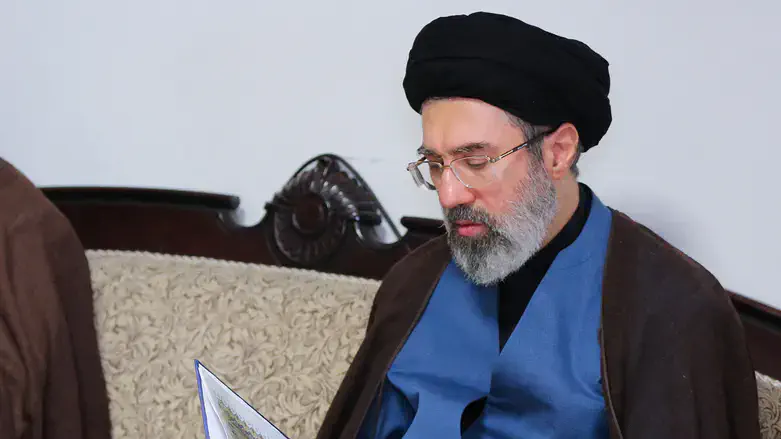
The New York Times published new details today (Thursday) about the condition of Iran’s new supreme leader, Mojtaba Khamenei.
According to the report, Khamenei is far more seriously injured than previously reported and is living under an extreme security regime out of concern that Israel may track his whereabouts.
Khamenei, who was wounded in the deadly attack in which his wife and son were also killed, is surrounded by a senior medical team. According to the report, his leg has undergone three surgeries and he is awaiting the fitting of a prosthetic limb. His hand was also operated on and is undergoing gradual rehabilitation.
He reportedly suffers from severe burns to his face and lips that make speaking difficult, and he is expected to undergo plastic surgery.
The report further stated that Iran’s president, Masoud Pezeshkian, who is a cardiac surgeon by profession, and the health minister are personally involved in his treatment. Despite the injuries, Khamenei is said to remain mentally sharp.
Because of his physical condition and concerns about projecting weakness, Khamenei has not yet recorded any visual or audio message. His communication with the outside world and senior regime officials is reportedly conducted through a primitive but secure method.
Messages are delivered only in handwritten sealed envelopes, passed hand-to-hand through motorcycle couriers traveling across highways to the hiding location.
In addition, commanders of the Islamic Revolutionary Guard Corps reportedly do not visit the leader physically, in order not to “draw" Israeli intelligence to his exact location.
While Khamenei recovers from his injuries, the country is effectively being run by a “board of directors" made up of hardline generals. According to the sources, Khamenei functions as a “chairman of the board" who approves their decisions, though he rarely opposes them.
The leading figures at the top are said to include Ahmad Vahidi, commander of the Revolutionary Guards; Mohammad Bagher Zolghadr, head of the Supreme National Security Council; and hardline military adviser Yahya Rahim Safavi.
Senior Revolutionary Guards officials believe that after five weeks of intense fighting, they have succeeded in halting the threat to the regime’s survival.