

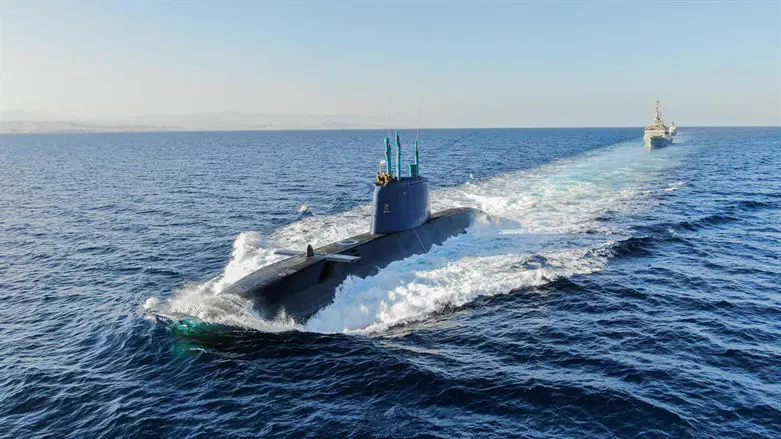
Under a heavy veil of secrecy, the Navy’s submarine flotilla (Shayetet 7) achieved unprecedented strategic accomplishments during the current war.
With the retirement of Major General David Saar Salama as commander of the Navy, the IDF revealed that the flotilla reached a historic peak in both distance and operational presence deep inside enemy territory.
The most striking detail disclosed is that the submarines reached “the farthest location in the history" of the submarine flotilla as part of an operational mission.
The submarines were deployed simultaneously across three different sectors, with thousands of kilometers separating each vessel. For the first time, the submarine flotilla (7) and the missile boat flotilla (3) operated jointly against enemy air defense systems and aircraft, destroying them from the sea.
In the Syrian theater, a historic achievement was recorded when the Navy exploited a brief window of opportunity to strike the Syrian fleet with dozens of munitions. Within about an hour, 15 vessels were sunk and dozens of missiles with ranges of 80-200 km were hit, significantly degrading most of Syria’s naval capabilities.
In operations against Hezbollah, the Navy managed to severely damage the strategic coastal missile array. These missiles, which were hidden beneath residential buildings and in underground warehouses, were largely destroyed, leaving the organization with only a small number remaining.
Another achievement was recorded in Operation Behind the Back, in which Shayetet 13 captured Imad Amhaz for interrogation, leading to the exposure of Hezbollah’s secret naval unit.
The Navy also operated intensively against the Houthi threat: strikes up to 150 km inside Yemen led to 80% of goods failing to reach their destinations. During Operation “Roaring Lion," the Navy directed and provided intelligence for strikes on no fewer than 95 targets in Iran.
The naval commandos carried out hundreds of missions since the start of the war, including operations in areas thousands of kilometers from Israel where they had never operated before. In Gaza, the flotilla was involved in core combat operations: from raids on the Shifa and Rantisi hospitals, to the capture of the harbor, and rescue missions for hostages as well as logistical landings deep בתוך the Strip.
During the fighting, the four Sa’ar 6-class ships were fully operationalized and took part in both defense and attack missions. The fleet was reinforced with two landing craft that sailed from the United States during the war, and a sixth submarine, INS “Drakon" (dragon), is expected to arrive soon. To improve surveillance and drone capabilities at sea, a new unit called “Netz" was established.
Overall, during the 48 days of Operation Roaring Lion," naval forces logged approximately 26,000 hours at sea, carried out 154 strikes, and managed 40 successful defense and interception events against aerial targets.