
Yaron Perez was a Torah Mitziion Shaliach in Toronto (2016-2018) and is an Educator, teaching at Hartman Highschool for Boys, Jerusalem
"... And according to the understanding of the son, his father teaches him. He begins with disgrace (Gnut) and concludes with praise (Shevach); and he expounds from 'A wandering Aramean was my father' until he completes the entire passage ." (Mishnah Pesachim 10:4)
The Mishnah teaches us the proper way to study and teach the story of the Exodus: we must begin with words of disgrace and conclude with words of praise.
Why is it necessary to start with disgrace? The Maharal explains in Netzach Yisrael (Ch. 1): "Why begin with disgrace? Because praise has no true recognition except through its opposite." According to the Maharal, without acknowledging the reality of the evil (the disgrace) that existed previously, one cannot truly understand or appreciate the essence of the good (the praise) that followed.
The Gemara records a dispute between Rav and Shmuel regarding the nature of that "disgrace":
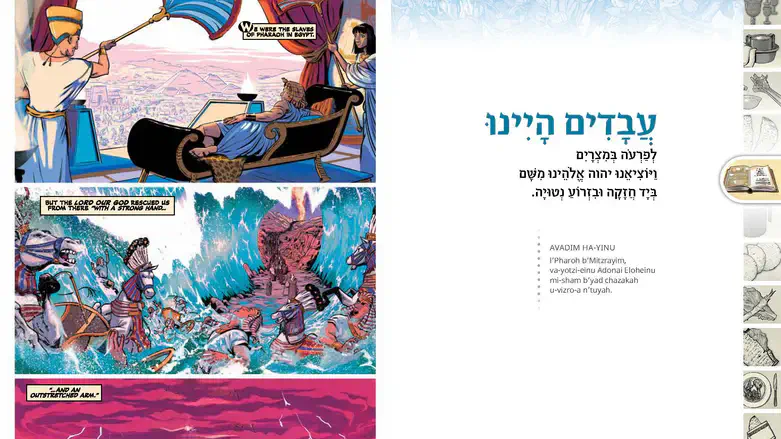
" He begins with disgrace and concludes with praise. What is the disgrace? Rav said: 'At first, our ancestors were idolaters.' [Shmuel] said: 'We were slaves '" (Babylonian Talmud, Pesachim 116a).
According to Rav, the disgrace is the recognition that Bnei Yisrael were idol worshippers. According to Shmuel, the disgrace is the fact that Bnei Yisrael were slaves. Rav's opinion is clear-idolatry is a profound spiritual disgrace. However, Shmuel’s opinion is puzzling: What is disgraceful about our ancestors being slaves? Idolatry is a choice, but a person becomes a slave against their will.
Slavery is a low socio-economic status. A slave is considered the property of his master. While the Torah does not encourage slavery, it recognizes its necessity in extreme cases-such as someone who lacks basic means or cannot repay a debt. Slavery is unpleasant and even shameful, but why is it disgraceful? It is a harsh economic reality, not necessarily a moral failing.
Furthermore, the Torah tells us in Genesis (Ch. 47) that the economic situation of Bnei Yisrael before the enslavement was excellent. Their slavery was not caused by poverty, but by Pharaoh’s fear of a demographic threat (Exodus 1:8-14). This strengthens the question: What is the "disgrace" in the slavery of Bnei Yisrael?
To understand this, we must look back at the root cause of the decree of exile. According to the Midrash, there was a specific reason Bnei Yisrael became slaves:
" Rabbi Hanina said: Since all the measures of the Holy One, Blessed be He, are 'measure for measure'... In the beginning, before they descended to Egypt, the sons of the Matriarchs [Leah and Rachel] belittled the sons of the Handmaids [Bilhah and Zilpah], and did not treat them with brotherhood... The Holy One, Blessed be He, said: 'How shall I make them accept the sons of the Handmaids? I will bring them down to Egypt and they will all be slaves.' And when I redeem them, I will give them the commandment of the Passover... and they will all say 'We were slaves to Pharaoh'-finding them all equal.
Why all this? To make known the greatness and praise of the Holy One to all inhabitants of the world, that they may know how to make peace between His creatures. .." (Otzar Midrashim, Pesiqta p. 487).
Rabbi Hanina links the cause of slavery to the internal conduct of Jacob's sons. G-d was pained by the fractured relationship between the brothers caused by perceived class differences. To repair this, He sent them into slavery so they would all share the same status. In the future, they would all say "We were slaves"-together, as equals.
The Midrash Tehillim continues this theme:
"Rabbi Hanin said: The Holy One said to the Tribes: You sold him [Joseph] as a slave... by your lives, you shall recite every single year: 'We were slaves to Pharaoh in Egypt '" (Midrash Tehillim 107). The annual repetition of "Avadim Hayinu" serves as a reminder of the sale of Joseph-the pinnacle of the breakdown in brotherhood.
The Imrei Emes (Vaeira, 5691) teaches us that even during the enslavement, Bnei Yisrael had not yet learned this lesson. When Moses saw an Egyptian striking a Hebrew, he killed the Egyptian, seeking to raise the banner of redemption. The next day, when he saw two Hebrews fighting and tried to intervene, one spoke disparagingly of Moses' actions. Moses responded: "Indeed, the matter is known" (Exodus 2:14).
The Midrash Rabbah explains:
"Moses was wondering in his heart: 'What did Israel do to deserve enslavement more than all other nations?' Once he heard [the slander], he said: 'There is lashon hara (evil speech) among them; how can they be worthy of redemption?' Therefore he said, 'Indeed, the matter is known'-now I know the reason they are enslaved. " (Shemot Rabbah 1:30).
It appears that even in Egypt, the people had not yet corrected the behavior that caused the exile. Moses realized they were not yet ready for redemption because they had not learned the lesson of unity.
Now we can understand the "disgrace" that Shmuel refers to. The disgrace of "We were slaves" is not the slavery itself, but the reason for it. The punishment of slavery was given because they belittled one another and acted with arrogance, reaching the low point of selling their own brother. And even under the yoke of slavery, they continued to speak ill of one another.
We say in the Haggadah: " In every generation, a person is obligated to see himself as if he went out of Egypt ." The story of the Exodus and "We were slaves" is not just history; it is relevant today. Are we worthy of leaving Egypt? Have we repaired our relationships with those around us? Do we treat one another with respect or with condescension?
On this night, we begin with disgrace and must end with praise. The true "praise" will be when we show that we have learned the lesson of the slavery-when we take it upon ourselves to repair the relationships between the children of Jacob, sitting together (all the children) around the Seder table, worthy of the final redemption.
" Thus said the Holy One to Israel: My children, do I lack anything? What do I seek from you? I seek only that you love one another, and honor one another ..." (Eliyahu Rabbah, Ch. 26).
For comments: yaronperez1@gmail.com