
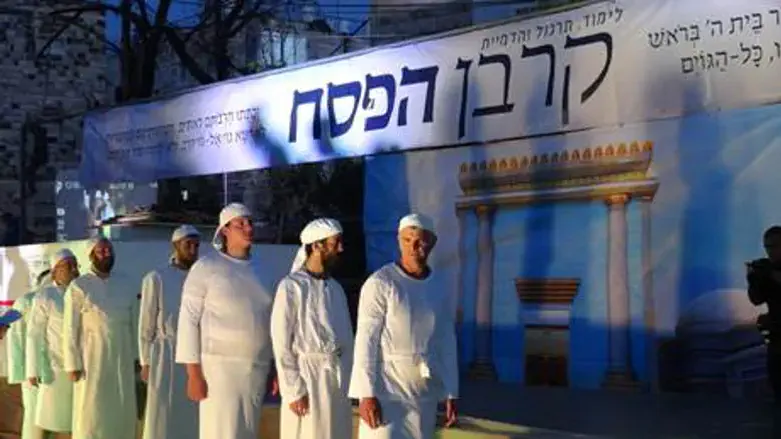
The Shabbat which immediately precedes Pesach is called Shabbat ha-Gadol, “the Great Sabbath".
This is the Shabbat which recalls the great miracle which happened immediately before the Exodus from Egypt:
Nine of the Ten Plagues had already happened, with only the Slaying of the Firstborn still to come. On the 1st of Nissan, G-d told the Jews that nine days hence, on the 10th of the month, they were to take a lamb or kid (the Hebrew word שֶׂה can denote either), keep it for 5 days, and then, on the 14th of the month, slaughter it as the primordial Pesach Sacrifice (Exodus 12:3-6).
Obviously these kids and lambs, held in the Jews’ houses, were bleating. Of course the Egyptians knew exactly what their former slaves were doing.
And the Egyptians worshipped the sheep as one of their chief gods, so of course they were furious - yet they were powerless to prevent the Jews from mistreating their gods so blatantly.
And when the Jews slaughtered these lambs and kids, when they roasted them whole over open fires (vs. 8-9), the Egyptians inevitably smelled the roasting meat - and again they were powerless to prevent the Jews from mistreating their gods so brazenly (following the Midrash, Pesikta de-Rav Kahana, Parashat ha-Chodesh s.v. דַּבְּרוּ).
And equally obviously, the corollary was that for the Jews to openly treat their former masters’ god with such contempt took tremendous courage and faith in G-d. Keeping this god tied to a bed-post for five days and four nights was a continuous challenge to Egypt; it demanded far more dedication than a single impetuous act of bravery in a moment of excitement.
As the Midrash continues: “Moshe called to all the elders of Israel, saying to them: Draw forth the flock and take it to yourselves’ (Exodus12:21) - every single one must drag around a god of Egypt, and slaughter it in front of them".
They had to extend this brazenness into the public squares and streets of Egypt, by slaughtering and roasting the Egyptian god in front of the Egyptians.
G-d commanded them to “eat it roasted over fire…do not eat of it raw [partially roasted], or cooked in water - only fire-roasted, its head with its legs with its innards" (Exodus 12:8-9).
Why this specific way of preparing the meat?
- “Because it was an abomination for the Egyptians, slaughter it! And so that no [Jew] would say, We won’t roast it thoroughly lest it infuriate the Egyptians, it says ‘do not eat of it raw [partially roasted]’. And so that no Jew would say, We will cook it and thus conceal it in a pot, it says ‘do not eat of it …cooked in water’. And so that no Jew would say, We will cut off its head and its legs so they won’t recognise it, it says ‘its head with its legs with its innards’" (Da’at Z’keinim mi-Ba’alei Tosafot, Exodus 12:9).
The Pesach sacrifice was a massive act of defiance against the idolatrous Egyptian oppressors.
The Midrash further continues by quoting Rabbi Yochanan:
“Their taking of the lamb stood by them at the River Jordan, and their eating of it stood by them in the days of Haman: they had eaten the flesh on this night - the night when ‘the king’s sleep eluded him’ (Esther 6:1)".
The day they took the lamb, the 10th of Nisan, was the same date that they would cross the River Jordan into Israel forty years later (Joshua 4:19).
And the date that they slaughtered and ate the Pesach sacrifice was the same date that King Achashverosh’s sleep would elude him 957 years later:
Haman promulgated his decree of genocide on the 13th of Nisan (Esther 3:12), so the three days of fasting that Esther decreed (4:16) were the 13th, 14th, and 15th of Nisan. Hence the day that Esther risked her life by donning royal apparel and going to King Achashverosh (Esther 5:1) was the first day of Pesach. The previous night, when “the king’s sleep eluded him", was the night of the 14th of Nisan (vide Esther Rabbah 8:7, Pirkei de-Rabbi Eliezer 50, Seder Olam Rabbah 29, Targum, Esther 5:1 et al.).
The Talmud (Shabbat 87b) and the Midrash (Mechilta de-Rabbi Yishma’el, Beshallach, Masechet de-Vayasa 1) record that the 15th of Nisan 2448, the day that the Children of Israel left Egypt, was a Thursday:
“So they slaughtered their Pesach sacrifices on the Wednesday, and it was on the previous Shabbat that they had taken their Pesach lambs, because that was the tenth of the month. And it is therefore called Shabbat ha-Gadol - the Great Shabbat, because a great miracle was wrought thereon" (Tosafot, Shabbat 87b s.v. ואותו יום).
The Haftarah-reading for Shabbat ha-Gadol is the very last prophetic vision ever - the final 21 verses of the prophecy of Malachi, the final prophet, who prophesied during the early Second Temple era.
After castigating Israel for their lack of gratitude to G-d and their defiling of the Holy Temple with their sub-standard sacrifices, Malachi portrays the Messianic era.
The Haftarah begins by contrasting the future glorious time with our past misdeeds:
“Then the offering of Judah and Jerusalem will be pleasing to Hashem, as in days of old and as in former years" (Malachi 3:4). In his final message - the message which seals prophecy for all time - he exhorts Israel: “Remember the Torah of Moshe My servant, which I commanded him in Horeb for all Israel, decrees and statutes. Behold! I send you Elijah the prophet before the great and awesome Day of Hashem comes" (or: “…before the day of the Great and Awesome Hashem comes").
Why did our Sages select specifically this prophecy for the Haftarah of Shabbat ha-Gadol? If they wanted to link the redemption from Egypt with the final Messianic Redemption, then why not select one of the more impressive prophetic passages from Isaiah? Or why not one of Jeremiah’s magnificent descriptions of the final Redemption, which he depicts as being even more majestic than the redemption from Egypt (for example, 16:14 onwards, or 31:30 onwards)?
I suggest: -
The Targum (Malachi 1:1) identifies Malachi as Ezra, which is also the opinion of two Talmudic sages, Rabbi Yehoshua ben Korha and Rabbi Nahman (Megillah 15a).
Later commentators disagree: the Radak and the Ibn Ezra (commentary to Malachi 1:1) state that Ezra and Malachi were two different prophets.
The Rambam (Introduction to the Mishneh Torah), Rashi (commentary to Sukkah 44a and Bava Batra 15a), and Rabbi Ovadiah of Bartinura (commentary to Pirkei Avot 1:1) all state that Malachi was part of Ezra’s Beit Din, which was called the כְּנֶסֶת הַגְּדוֹלָה, the Great Assembly.
What is undisputed is that the prophet Malachi lived through the second redemption - the return of the exiles from the Babylonian/Persian exile and the rebuilding of the Holy Temple in Jerusalem. Malachi was born during a period of exile, of destruction, when the majority of Jews were in foreign lands and the Land of Israel was under foreign occupation, with the Temple Mount in Jerusalem lying desolate.
Malachi witnessed King Cyrus’ proclamation, granting the Jews the right to return to Israel and rebuild the Holy Temple in Jerusalem (Ezra1:1-3, 2 Chronicles 36:22-23); he was part of the second redemption, the end of the Babylonian/Persian exile.
It is no coincidence that during the second redemption, the first Festival that the Jews celebrated was Pesach (Ezra 6:15-22); neither is it coincidence that Ezra began his Aliyah journey on the 1st of Nisan (7:9), and led his followers from the River Ahava - the last leg of the journey to Israel - on the 12th of Nisan (8:31), scant days before Pesach.
Malachi’s prophecy, then, is the synthesis between the first, second, and third redemptions, and is therefore the perfect reading for Shabbat ha-Gadol.
Malachi had a unique perspective on Redemption, because he had experienced redemption in his own life.
“On the 15th of Nisan…[G-d] spoke to Abraham our father in the Covenant between the Parts; on the 15th of Nisan the ministering angels came to announce to him that his son Isaac would be born to him; on the 15th of Nisan Isaac was born; on the 15th of Nisan they were redeemed from Egypt; and on the 15th of Nisan they will in the future be redeemed from subjugation to exile" (Tanhuma, Bo 9).
As we prepare to celebrate the first redemption, it is especially relevant that the prophecy of the prophet who, during the second redemption, foretold the final and eternal Redemption, resounds in every synagogue in the world.