
Kabbalah teaches of the ten סְפִירוֹת, sefirot (the Divine “attributes", “emanations", “manifestations"). These sefirot are:
- חָכְמָה, Chochmah (wisdom);
- בִּינָה, Binah (understanding);
- דַּעַת, Da’at (knowledge);
- חֶסֶד, Chesed (loving-kindness);
- גְּבוּרָה, Gevurah (might);
- תִּפְאֶרֶת, Tiferet (splendour);
- נֶצַח, Netzach (eternity or victory);
- הוֹד, Hod (grandeur);
- יְסוֹד, Yesod (foundation);
- מַלְכוּת, Malchut (kingship).
These are G-d’s ten attributes, so to speak, by which He controls the world and the people in it. To express it differently, these are the manifestations of G-d’s characteristics, so to speak - the guises in which He and His decrees become apparent in directing human history.
These are also the ten characteristics which every human has, the ten attributes which build our personalities. Every single one of has all ten of these attributes; but in which order they appear, which one is more dominant, how powerful each attribute is - this is unique to each individual.
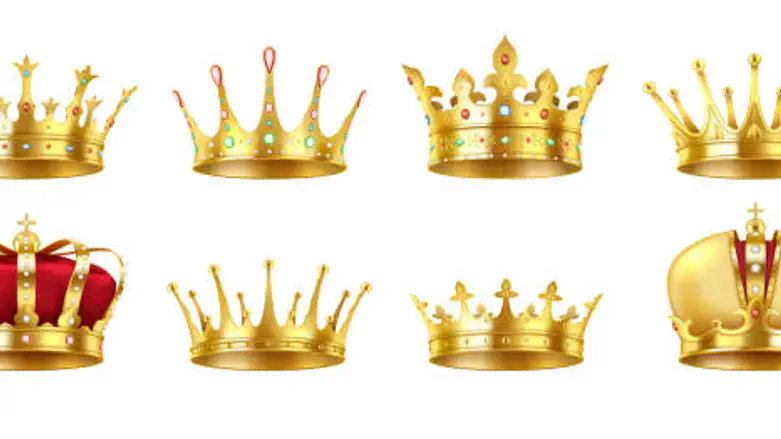
Megillat Esther, which we read recently on Purim, is replete with the attribute of מַלְכוּת, Malchut (“kingship"). The root מלך (king) in its various grammatical forms occurs some 251 times in the Book of Esther.
Purim is the Festival of Kingship; and it is the prequel to Pesach, the Festival which celebrates the greatest manifestation of G-d’s Kingship in this world.
The month of Adar, the month of Purim, is the prequel to the month of Nissan, the month of Pesach.
As the Mishnah teaches, Rosh Chodesh Nissan is the New Year for Kings and for Festivals (Rosh Hashanah 1:1). This means that if a king ascends to the Throne on the final day of Adar, then the next day, the first of Nissan, he already begins the second year of his reign.
Adar, with its Festival of Kingship, prepares us for Nissan, and Nissan is the month of Kingship - both the manifestation of G-d’s Kingship in this world and the kingship of Israel.
Ever since the yearly cycle of Torah readings was standardised towards the end of the Second Temple era, and the fixed calendar as calculated by Hillel II (Hillel ben Yehudah, Nasi or head of the Sanhedrin) was adopted in 4119 (359 C.E.), Parashat Vayikra has invariably been the first Shabbat of Nissan in non-leap years (as this year 5786 is).
In leap years, Parashat Vayikra almost always coincides with Shabbat Zachor, the Shabbat which immediately precedes Purim.
Very occasionally it is the first Shabbat in Adar II. (This happens solely in a leap year which begins on a Thursday and in which Marcheshvan and Kislev both have 30 days; the last time was 12 years ago, and the next time will be in 9 years.)
This prompts the question: Is there any organic connexion between Parashat Vayikra, Nissan, and Purim?
Let us begin our answer by noting the many factors which connect Purim and Pesach:
They are both Festivals which celebrate redemption (Pesach the first redemption from Egypt, Purim the second redemption from Babylon/Persia);
We have a principle that we begin studying the laws of every Festival 30 days before the Festival, therefore we begin studying the laws of Pesach on Purim;
Haman cast the lot to decide in which month to exterminate all the Jews in the Persian Empire in Nissan (Esther 3:7), and Adar was selected as the month for extermination;
The three-day fast that Esther proclaimed (Esther 4:16) was on the 13th, 14th, and 15th of Nissan (Esther Rabbah 8:6), so the day that Esther revealed Haman’s plot to King Achashverosh (Esther 7) was on the first day of Pesach;
Haman therefore was hanged on the first day of Pesach;
In a leap year we celebrate Purim in Adar II, “in order to connect [the Festival of] redemption with [the Festival of] redemption" (Megillah 6b, Yerushalmi Megillah 1:5 et al.). This is counterintuitive, because the Book of Esther itself records the events as having happened “in the twelfth month, which is the month of Adar" (Esther 3:7, 3:13, 8:12, 9:1); in a leap year, however, “the twelfth month" is Adar I - yet we celebrate Purim in Adar II, which is the thirteenth month. The principle of connecting Purim to Pesach overrides the principle of celebrating Purim “in the twelfth month".
The Talmud tells us that “when Adar comes in we increase our joy" (Ta’anit 29a), on which Rashi comments simply, “Israel had days of miracles - Purim and Pesach".
There is more, but we have established the principle that Purim and Pesach are intimately connected.
And now we come to the Book of Leviticus:
The Book of Exodus opened with the Children of Israel enslaved in Egypt, and records the Exodus with all its attendant miracles, the Splitting of the Red Sea, the Giving of the Torah, the manna - and then, the final five Parashot, the final 16 chapters of the Book, record the preparations for building the Mishkan (the Tabernacle) and the actual building thereof.
Well over one-third of the Book of Exodus - 454 verses out of a total of 1,209 - is dedicated to the construction of the Mishkan; this is the conclusion of the Book of Exodus.
Now, with the Mishkan ready to function, ready for sacrifices, the Book of Leviticus begins:
“When He called to Moshe, Hashem spoke to him from the Tent of Meeting saying: Speak to the Children of Israel, saying to them: Any person from among you who sacrifices a sacrifice to Hashem…", and then follow the laws for sacrifices.
The אֹהֶל מוֹעֵד, Tent of Meeting, is the most commonly-used name for the Mishkan.
The Ramban, in his Introduction the Book of Exodus, notes that when the Children of Israel left Egypt they were redeemed from slavery, but they were still in exile, not yet in the Land of Israel. So the redemption from Egypt would be complete only 40 years later, when they crossed the River Jordan into Israel.
Completing the construction of the Mishkan was another crucial step on the way to redemption. It was only with the functioning Mishkan that every Jew was able to bring sacrifices, and thus to build a closer and more immediate relationship with G-d:
The word קָרְבַּן, korban, meaning “sacrifice", is from the root קָרוֹב, karov, meaning “near". Hence the sacrifice is best rendered as a “closeness-facilitator": the קָרְבַּן, korban (sacrifice) brings the Jew קָרוֹב, karov (close) to G-d.
The Book of Leviticus is saturated with sacrifices, and as such is the introduction to the redemption.
So it is beautifully appropriate that we begin reading this Book on the Shabbat of the month of redemption (whether Nissan or Adar), on the Shabbat immediately before the Festival of Redemption - either Pesach or Purim.
We take a closer look at the opening words of the Book of Leviticus:
“When He called to Moshe, Hashem spoke to him from the Tent of Meeting saying: Speak to the Children of Israel, saying to them: Any person (אָדָם) from among you who sacrifices a sacrifice to Hashem…".
The Midrash cites Rabbi Berechiyah who notes that the Torah here uses the word אָדָם (adam) for “person", rather than the more usual אִישׁ (ish), and expounds:
“Rabbi Berechiyah said: G-d said אָדָם (adam), alluding to Adam, the first person ever, to instruct us: Let your sacrifice be like Adam’s sacrifice. Everything belonged to him, therefore he sacrificed nothing that was stolen. You, too, are to sacrifice nothing that was stolen" (Vayikra Rabbah 2:7).
G-d called the first man אָדָם (Adam), a name which means “person". Yet our Sages tell us that “You [Israel] are called אָדָם (adam), while the other nations are not called אָדָם (adam)" (Yevamot 61a, Bava Metzi’a 114b, K’ritot 6b et al.).
The Vilna Gaon explained this:
Hebrew has several synonyms for “man": אִישׁ (ish), גֶּבּר (gever), בֶּן אָדָם (ben-adam), אֱנוֹשׁ (enosh), אָדָם (adam).
Each of these has a plural form: אִישִׁים (ishim), גְּבָרִים (g’varim), בְּנֵי אָדָם (b’nei-adam), אֲנָשִׁים (anashim).
But the word אָדָם (adam) has no plural form. Just as Adam was unique in the world and had no plural form, so too Israel is unique in the world and has no plural form. Hence Israel are called אָדָם (adam), and the other nations are not called אָדָם (adam).
And so “any person (adam/אָדָם) from among you who sacrifices a sacrifice to Hashem…".
The first word of the Book of Leviticus is וַיִּקְרָא (Vayikra), “He called". There is a peculiarity in this word: the letter א (aleph) is shrunken, written smaller than all the other letters (in Masoretic nomenclature, א' זְעִירָה).
Several commentators offer several explanations for this small aleph; I offer my own observation:
The א in the word וַיִּקְרָא is the sole small א in the Torah (there are 7 other small letters scattered through the Torah). There is one enlarged א in the Tanach (in Masoretic nomenclature, א' רַבָּתִי) - the first letter in the Book of Chronicles, the Book which summarises the entire Tanach, which begins with the name אָדָם (Adam), written with an enlarged א, which balances out the diminished א in the first word of the Book of Leviticus.
On the first of Tishrei G-d created Adam; on the first of Nissan G-d called to Moshe. Each of these is a New Year: the 1st of Tishrei is the New Year for years, the 1st of Nissan is the New Year for Kings.
Rosh Chodesh Nissan brings in the month of מַלְכוּת, Malchut (kingship), the attribute that Purim symbolised so powerfully.
And Parashat Vayikra introduces us to our Service of G-d in the Mishkan, the prelude to the Holy Temple which would one day be built in Jerusalem, the physical manifestation of G-d’s Kingship.
On Rosh Chodesh Nissan G-d called to Moshe, telling him how every אָדָם/adam (person) was to sacrifice to Him, as Adam, the first person, did.
G-d’s Kingship will once again be manifested in this world when we rebuild the Holy Temple in Jerusalem, there to restore the sacrifices to G-d. And then, the diminished א of וַיִּקְרָא will again be restored.