


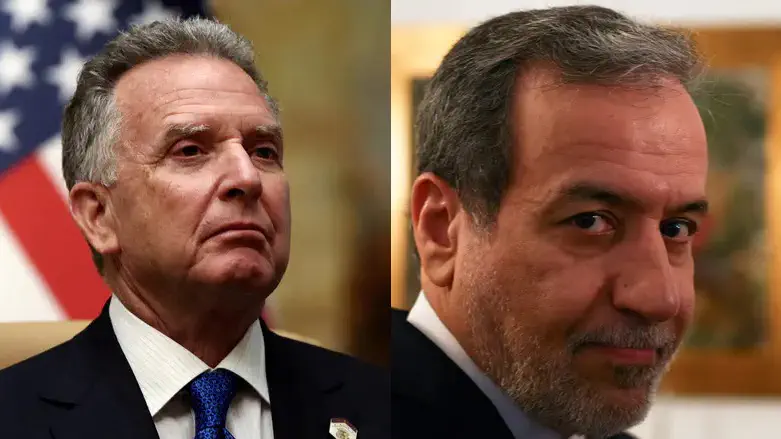
A direct communications channel between US envoy Steve Witkoff and Iranian Foreign Minister Abbas Araghchi has been reactivated in recent days, Axios reported on Monday, citing a US official and a source with knowledge.
The report said it is not clear how substantive the messages between Araghchi and Witkoff were, but it marked the first known direct communication between the sides since the war began more than two weeks ago.
After the report was published, Araghchi denied the claim in a post on social media.
"My last contact with Mr. Witkoff was prior to his employer's decision to kill diplomacy with another illegal military attack on Iran. Any claim to the contrary appears geared solely to mislead oil traders and the public," he wrote.
Asked about Araghchi’s comment, a US official told Axios the Iranian Foreign Minister was lying and said Araghchi was the one who initiated the contact with Witkoff.
The US official and the source with knowledge said Araghchi sent text messages to Witkoff that focused on ending the war.
Drop Site News reported on Monday that Witkoff had sent messages to Araghchi and quoted Iranian officials who claimed the Iranian Foreign Minister was ignoring the White House envoy’s messages.
The US official, however, said the outreach came from the Iranian side, while adding that the US "is not talking" to Iran.
Neither source provided details about how many text messages were exchanged or what exactly they contained.
President Donald Trump told reporters on Sunday that Iran “badly" wants to negotiate a deal with the US, but added he does not believe that Iran is ready to do what needs to be done to achieve a deal.
“They want to negotiate. They want to negotiate badly. I don't think they're ready, just from what I'm hearing," he said.
“They want to negotiate badly, as they should. But I don't think they're ready to do what they have to do."
Iranian officials have said publicly in recent days that they are not holding any ceasefire negotiations with the Trump administration.
According to those officials, Iran is not interested in a temporary ceasefire that would allow the US and Israel to regroup and attack again, but instead wants guarantees that any peace deal would be permanent.
Witkoff recently revealed that, during his talks with Iran on a potential nuclear deal, the Iranians boasted of their ability to make 11 nuclear bombs.
Speaking to Sean Hannity on Fox News, Witkoff also stated that it was clear during the talks that the Iranians were not interested in reaching a deal.
“The 20 percent material can be brought to 90 percent, that's weapons grade, in roughly one week, maybe 10 days at the outside. The 20 percent can be brought to weapons grade inside of three to four weeks," he said.
“In that first meeting, both the Iranian negotiators said to us directly, with no shame, that they controlled 460 kilograms of 60 percent, and they're aware that that could make 11 nuclear bombs, and that was the beginning of their negotiating stance. So they were proud of it. They were proud that they had evaded all sorts of oversight protocols to get to a place where they could deliver 11 nuclear bombs," Witkoff told Hannity.
“It was pretty silly, but they thought they could strong-arm us," recalled Witkoff, who added, “You know, President Trump sent me and Jared [Kushner] there to to really determine on his behalf whether they were serious about doing a deal that that addressed his objectives, which are elimination of their of their missile program, elimination of their advocacy and support for proxies, which is destabilizing the entire Middle East, elimination of their Navy so we can have freedom of the seas and not be threatened with the shutdown of the Gulf of Hormuz. And finally, no nuclear enrichment that can get them to weapons grade, which means no nuclear bomb."
He continued, “And we went in there and tried to make a fair deal with them. And it was it was it was very, very clear that it was going to be impossible probably by the end of the second meeting. But we then went back for the third meeting just to give it the last college try. And, of course, they thought they wanted us to report positivity. It was not positive, that meeting."