

While the security establishment in Israel remains hyper-focused on its strikes against Hezbollah and Iran, as well as on the escalating drumbeat of the US in Epic Fury, a profound geopolitical earthquake is quietly reshaping Israel’s western flank. The recent historic summit in Cairo, where Egyptian President Abdel Fattah el-Sisi hosted Turkish President Recep Tayyip Erdogan, was not merely the ceremonial end of a decade-long diplomatic deep freeze. It marked the crystallization of a new military and industrial axis that directly challenges the balance of naval power in the Eastern Mediterranean.
The Sisi-Erdogan embrace should trigger immediate strategic alarm. The developments in Cairo threaten to upend the regional security architecture that has secured Israel’s economic boom over the last decade.
The Collapse of the EastMed Paradigm
Over the past ten years, Israel’s Mediterranean strategy was built on a very specific foundational assumption: the enduring and bitter rivalry between Cairo and Ankara. Capitalizing on this rift, Jerusalem, Athens, and Nicosia successfully forged the EastMed Gas Forum (EMGF). This bloc effectively isolated Turkey, transforming Israel into a regional energy hub and promising a secure corridor for natural gas exports to a Europe desperate to decouple from Russian energy.
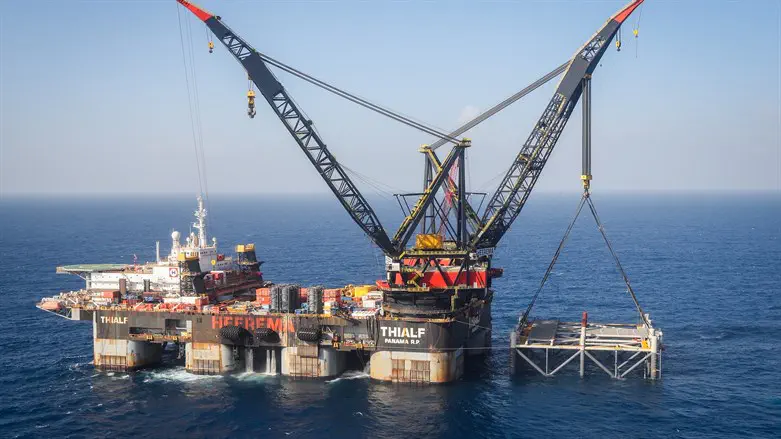
The crown jewels of this strategy-the Leviathan, Tamar, and Karish offshore gas fields-became symbols of an unprecedented Israeli economic and diplomatic renaissance. However, the foundational assumption of a divided Mediterranean may now be obsolete.
A New Military Calculus and the North African Pivot
The agreements signed during the recent High-Level Strategic Cooperation Council in Cairo go far beyond diplomatic pleasantries. They outline a comprehensive framework for defense integration between the region’s two largest militaries. This includes the resumption of the "Sea of Friendship" joint naval exercises-a critical signal of shared maritime projection. Even more concerning from an arms-balance perspective is the agreement to co-manufacture unmanned aerial vehicles (UAVs) and Egypt’s reported inclusion in the development program for Turkey’s KAAN fifth-generation stealth fighter.
To understand the scale of this threat, one must also look at the chronic volatility of North Africa. Libya is not stabilizing anytime soon; if anything, with opponents of Prime Minister Abdul Hamid Dbeibeh currently mobilizing for a "Ramadan Intifada" in Tripoli, the fractured state remains on the brink of deeper collapse. By effectively freezing their proxy conflict and agreeing to jointly manage the Libyan fallout, both powers are freeing up massive military and diplomatic bandwidth. This tactical détente allows them to pivot their combined naval attention northward into the Mediterranean basin, directly challenging the Israeli-Hellenic monopoly.
The EEZ Chokehold
The diplomatic and legal threat to Israel is immediate. Turkey has long felt aggrieved by its exclusion from the Eastern Mediterranean energy bonanza, famously attempting to disrupt the paradigm via a controversial 2019 maritime border memorandum with Libya. Now, Ankara has found a far more potent and legitimate partner in Cairo.
If Egypt and Turkey maneuver to reach a mutual understanding on maritime borders and Exclusive Economic Zones (EEZs), they could effectively draw a legal and naval wall across the Mediterranean. This contiguous zone would physically bisect the proposed route of the EastMed pipeline or any subsea electricity interconnectors aimed at linking Israel to Europe via Cyprus and Greece. By altering the legal maritime maps, Ankara and Cairo can assert veto power over Israeli energy exports without firing a single shot.
Exposing Offshore Vulnerabilities
Beyond the geopolitical chessboard, the physical security of Israel’s energy infrastructure is increasingly at risk. Israel relies almost entirely on its offshore platforms to secure its domestic electricity grid and fund its sovereign wealth. The IDF has invested heavily in defending these assets, deploying the Sa'ar 6-class corvettes equipped with the maritime Iron Dome (C-Dome).
Yet, defending against localized proxy threats like Hezbollah’s drones is vastly different from operating in a maritime theater dominated by an aligned Egyptian-Turkish naval front. Both nations possess advanced submarine fleets, modern drone swarms, and highly sophisticated intelligence, surveillance, and reconnaissance (ISR) capabilities. A coordinated Egyptian-Turkish maritime posture drastically limits the freedom of maneuver the Israeli Navy has historically enjoyed in international waters. In any future regional escalation, this combined fleet could impose unprecedented pressure on critical shipping lanes, complicating Israel’s ability to export energy or receive vital maritime resupply.
A Wake-Up Call for Israel
This realignment comes at a perilous moment. The United States is currently stretched dangerously thin, distracted by the imperative of containing Tehran, deploying assets like the USS Gerald R. Ford to deter immediate Iranian aggression, and managing crises in the Strait of Hormuz and the Red Sea. Washington simply does not have the bandwidth to micromanage the Mediterranean balance of power.
The Egyptian-Turkish rapprochement is a fundamental shift in the regional security architecture. The military and political establishment must urgently abandon the complacency born of the EastMed Gas Forum's early successes.
Israel requires a new Mediterranean doctrine-one that accounts for a united Cairo-Ankara axis, aggressively bolsters the trilateral alliance with Greece and Cyprus, and ensures that the nation's vital offshore energy assets do not become hostages to this new geopolitical reality.
Amine Ayoub, a fellow at the Middle East Forum, is a policy analyst and writer based in Morocco. Follow him on X: @amineayoubx