
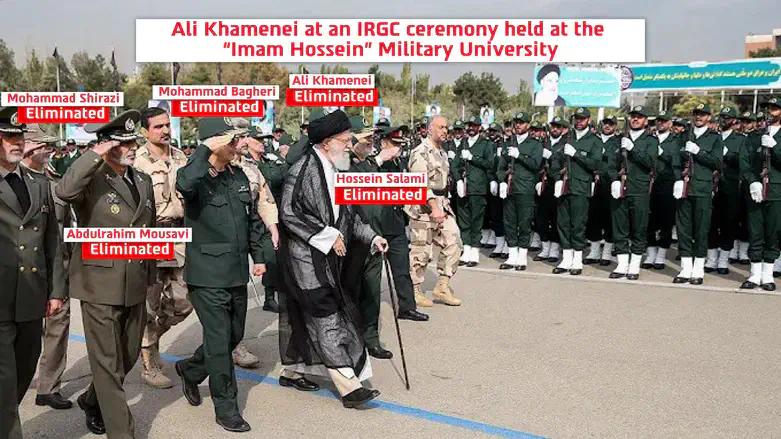
Thirteen days have passed since the beginning of Operation Epic Fury/Roaring Lion the joint military campaign by the United States and Israel against the Iran Junta-Mullah regime in Tehran. What initially appeared to be a purely military confrontation has now evolved into something far broader. The war is no longer confined to the skies above Iran or the battlefields of the Middle East. It has become a multidimensional conflict that includes cyberwarfare, global terrorism networks, maritime coercion, and the possibility of attacks far beyond the region.
During these thirteen days, the military balance has clearly shifted. Strategic strikes conducted by the United States and Israel have reportedly neutralized nearly 6,000 targets inside Iran, including missile launch facilities, drone bases, naval infrastructure, intelligence compounds, and elements of the regime’s security apparatus. Among the most symbolic operations were the strikes carried out by Israel against the Basij (also at checkpoints Basij set up to prevent demonstrations) a paramilitary organization that has long served as one of the central instruments of repression inside Iran.
The Basij has been responsible for enforcing ideological conformity, suppressing protests, and intimidating the Iranian population for decades. By targeting this structure, Israel has signaled that the objective of the campaign is not limited to degrading military capabilities,j but also includes weakening the internal mechanisms that sustain the regime’s authoritarian control.
However, the weakening of the regime’s military infrastructure does not mean that the threat has disappeared. On the contrary, history demonstrates that regimes built upon revolutionary ideology and terrorist networks rarely collapse simply because their conventional forces are weakened. The Iran Junta-Mullah regime has always relied heavily on asymmetric warfare.
Its power has long rested on a network of intelligence operations, ideological militias, covert sleeper cells, cyber units, and global propaganda systems. Even if missile launchers, naval vessels, and air defense batteries are destroyed, the regime’s clandestine capabilities remain intact.
For the Department of Homeland Security, this reality presents a serious strategic challenge. Counterterrorism professionals must recognize that the conflict with Tehran cannot be viewed only as a distant military campaign. The regime’s operational doctrine has always included the projection of terror beyond its borders.
One of the most concerning elements of this doctrine is the use of sleeper cells. Over decades, Iranian intelligence services and affiliated networks have developed covert infrastructures in different parts of the world. These cells are designed to remain inactive until geopolitical circumstances require their activation.
The current war creates precisely such circumstances.
Within the United States, analysts increasingly warn that the Jewish community represents one of the primary targets of the regime’s ideological hostility and global terror strategy. The regime has spent decades portraying Israel and Jewish communities worldwide as enemies in its propaganda narratives. That rhetoric has often translated into real-world operations.
From Latin America to Europe, Iranian-linked terrorist activities have historically targeted Jewish institutions and Israeli diplomatic sites. In the current atmosphere of conflict, the possibility that extremist actors connected to the regime could attempt attacks against synagogues, Jewish schools, or community centers in the United States cannot be dismissed.
Protecting these communities must therefore remain a central priority for American counterterrorism agencies.
At the same time, new forms of technological warfare are emerging. The FBI has reportedly warned about the potential for drone-based terrorist attacks connected to the Iranian regime, including possible scenarios in California (later denied). The proliferation of commercially available drones has fundamentally changed the security landscape. What once required sophisticated military capabilities can now be attempted by small networks or individual operatives.
A drone carrying explosives or hazardous materials could cause severe casualties if deployed against a civilian gathering, religious site, or infrastructure facility. Iranian military forces and their affiliated militias have gained extensive experience using drones in conflicts throughout the Middle East. Translating that experience into terrorist tactics abroad is a real possibility.
Cyberwarfare represents another major front in this expanding confrontation. Iranian cyber units have intensified their activity during the current conflict. One of the most alarming developments has been a reported cyberattack targeting Stryker, a major American medical equipment manufacturer.
The choice of such a target is significant. By attempting to disrupt companies connected to healthcare infrastructure, cyber attackers seek to generate widespread societal disruption without engaging in direct military confrontation. Hospitals, medical suppliers, and healthcare networks represent critical infrastructure sectors that must be protected with the highest level of vigilance.
Meanwhile, beyond cyber operations and covert networks, the regime continues to expand the regional battlefield through its proxies. Reports indicate that Iranian-aligned forces have launched attacks against a military installation used by Italian forces in Iraq and against the United States Embassy in Baghdad.
Such operations follow a familiar pattern. When the regime faces direct pressure, it relies on allied militias and proxy organizations to widen the conflict while maintaining plausible deniability.
At sea, the regime has also attempted to leverage one of the world’s most important strategic waterways. By threatening to hold the Strait of Hormuz hostage, Tehran seeks to influence global energy markets and exert pressure on the international economy. This tactic is not merely regional brinkmanship. It represents a form of economic warfare designed to destabilize global markets.
The regime’s allies have also escalated their actions. Iranian forces and Hezbollah have reportedly used cluster munitions against Israel, a weapon whose use violates the spirit of international humanitarian norms governing warfare. Such actions demonstrate once again that the regime and its affiliated militias operate outside the boundaries of internationally accepted military conduct.
These developments highlight a crucial reality: the war with the terrorist regime of Shiite mullahs in Iran is a prolonged one and it is far from finished.
Even if the current military campaign continues to weaken the regime’s infrastructure, the networks that sustain its terrorist activities will not disappear overnight. For this reason, the role of the Department of Homeland Security becomes even more important.
DHS operates at the intersection of border security, intelligence coordination, infrastructure protection, and domestic counterterrorism. The agency’s ability to integrate information from federal intelligence services, state authorities, and local law enforcement will be essential in preventing potential attacks.
The U.S. border itself represents another possible target and vulnerability. Hostile actors could attempt to exploit existing smuggling routes or clandestine infiltration networks to enter the country. For this reason, border security must be understood not only as an immigration issue but also as a critical component of national counterterrorism strategy.
At the same time, many observers hope that a new era of leadership within DHS, following the departure of the controversial Secretary Kristi Noem, will lead to a deeper strategic focus on counterterrorism threats connected to Iran. Addressing the complexity of this conflict requires leadership that fully understands the hybrid nature of the regime’s warfare strategy.
The United States now faces an adversary that combines ideological radicalism, advanced military technology, covert intelligence networks, cyber capabilities, and global propaganda operations. Defeating such a system requires vigilance, strategic coordination, and long-term commitment from every component of the American national security structure.
For DHS agents and counterterrorism professionals across the country, the lesson is clear. The battlefield may be thousands of miles away, but the consequences of this conflict could eventually reach American soil if vigilance fades.
Preparedness, intelligence sharing, and proactive counterterrorism operations must remain the foundation of homeland security.
Operation Epic Fury may represent a turning point in the military confrontation with Tehran. But the broader struggle against the networks built by the Iran Junta-Mullah regime will continue long after the last missile strike.
The war against the regime’s terror apparatus is not over.
I myself have been wounded by a mistaken ICE poliicy. I have previously shouted loudly about part of this humiliation caused by ICE’s misguided actions towards me. (1450 days in U.S. ICE; see Israel National News). This was the behavior of the United States of America toward an Iranian writer who opposes the Iran regime, a counterterrorism analyst, and a supporter of America and Israel.
A country such as Australia, in a single day without detention, humiliation, or psychological abuse granted asylum to five Iranian female athletes, while U.S. ICE wanted to hand this writer over to the Iran regime. I am grateful to Israeli media that saved my life.
But in the matter of counterterrorism, and in defense of America and Israel against the terrorism of the Islamic Republic, I will stand until death and I will honestly place my expertise and knowledge at their service.
Without any consideration or caution, it must be stated plainly: the detention of the author of the book Tehran’s Dictator in U.S. prison was literally and categorically in favor of the Junta-Mullah terrorist regime in Iran.
I sincerely hope that the United States will never again commit such a clear injustice against another person who has spent twenty-five years writing against Islamic terrorism. One must not have fear or shame in speaking and expressing the truth.
Today the counterterrorism leadership of DHS must understand clearly that a bloodthirsty and criminal regime-which in January 2026 committed the genocide of at least 40,000 Iranian citizens-possesses a deeply Nazi-like ideological mindset. The destructive ideology of this regime is Khomeinism, and its foundation is rooted in Islamic terrorism.
This war has openly and without disguise exposed the true nature of the regime. In complete violation of the laws of war and in opposition to the entire international community, it fires cluster munitions at Israeli civilians. One must imagine what such a regime would do if it possessed nuclear weapons-how it would launch them against Israel and the United States.
The Junta-Mullah regime feels no shame in committing crimes. One only needs to read the ideological texts of the Shiite clerical rulers to understand the mentality behind this system.
At present the regime, absurdly displaying cardboard posters of Mojtaba Khamenei, struggles desperately to preserve its criminal system of power. Yet the regime is clearly taking its final breaths.
I sincerely wish success for the counterterrorism professionals of DHS.
The Junta-Mullah regime in Iran continues its relentless attacks throughout the Persian Gulf region, with no end in sight. Just as the IDF and Mossad work to paralyze the financial and operational networks of the regime’s ruling clerical families, it is hoped that DHS will actively pursue the destruction of the terrorist sleeper cells of these criminal mullahs on American soil.
The Islamic terrorist authorities within the IRGC, MOIS, and the Quds Force have never hesitated to pursue catastrophic attacks. These ideological extremists would have no hesitation in attempting to create another 9/11 on American soil if the opportunity presented itself.
You in DHS must prepare yourselves for the reality that you are dealing with a fanatical, brutal, and criminal cult. The war against Islamic terrorism is long, complex, and multi-layered-an arduous path filled with twists, turns, and enduring challenges.
Erfan Fard is an Iranian expatriate and Middle East political analyst. His latest book, “Tehran’s Dictator," examines the theocratic era of Ali Khamenei, from 1989 to 2026.