
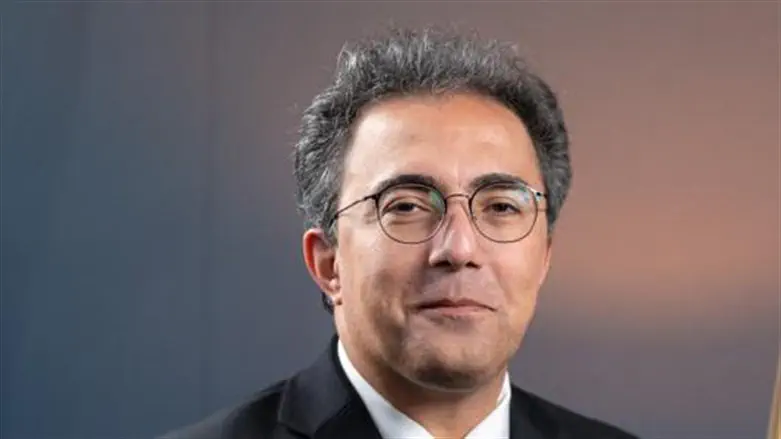
In the Middle East political arena, few voices have been as steadfast, fearless, and courageous as Erfan Ghani Fard. (See here). He is a counterterrorism analyst, journalist, and author who, over decades of work, has examined and exposed the growth of extremism, analyzed the inner structures of the Iranian regime, and critiqued the narratives dictators use to maintain power.
Erfan Fard is a highly educated and accomplished individual; he holds a PhD in International Relations and Security Studies and has served as a university professor. He has no criminal record, no history of violence, and has always been a peaceful, law-abiding individual committed to contributing meaningfully to society.
His writings, interviews, and published works are not merely academic or theoretical—they are acts of resistance. By speaking truth to power, he has placed himself in significant personal danger.
Today, he is detained by U.S. Immigration and Customs Enforcement (ICE) in Texas, facing a future fraught with serious personal risk.
Mr. Fard’s published work includes articles in Israel National News, The Jerusalem Post, and Israel Hayom. He is also the author of several books, including Regime Change in Iran, : The Gruesome Mullah, Tehran Dictator and The Black Shabbat. These writings openly expose extremism, terrorism, and repressive regimes—activities that make him a direct target for retaliation if returned. Because of this record, deportation would almost certainly lead to persecution and could be fatal.
It is important to note that Erfan’s current situation relates solely to his immigration status, an issue that arose primarily due to the negligence of his previous lawyer. This matter has no connection to his political or professional record.
While certain individuals on social media, motivated by personal reasons or Iranian involvement, have sought to attack his character and fabricate cases against him. These attempts are clearly based not on truth but on hostility and individual agendas or Iranian regime supporters.
Erfan has repeatedly responded to these allegations with clear explanations, and official video responses remain available on his personal social media pages, demonstrating the baseless nature of these claims.
Throughout his career, Erfan’s path has been marked by fearless analysis and candid critique. He has written extensively about Iran’s security apparatus, the role of militias in regional crises, and the links between extremist ideologies and state-sponsored terrorism. His interviews and articles have reached audiences across the Middle East and the West, providing clarity in an environment saturated with propaganda and misinformation.
For many Iranians, his work has been a source of truth and hope, but for Tehran’s authoritarian rulers, his writings are provocative and unforgivable.
Given his educational, academic, and professional background, Erfan’s release is essential so that he can continue to contribute to society and remain with those who care deeply for him. His detention not only hinders his important work but endangers his life and future.
Erfan is currently in the custody of U.S. Immigration. On paper, this may appear to be a routine immigration case, but in reality, it is a test of whether the United States remains committed to its own principles.
If he is returned to Iran, he will be sent into the hands of a regime against which he has spent his life advocating. The danger awaiting him is not hypothetical—it is imminent. His name, books, and interviews have long been on the Iranian regime’s blacklist. Deporting him to Iran would effectively silence a critical voice through imprisonment, torture, or worse.
This issue is not just about one individual. Erfan’s detention raises a deeper question: will democratic societies stand by those who risk everything to defend freedom, or will they abandon them at a critical moment?
The international community has repeatedly emphasized that freedom of thought and expression are universal rights. Erfan has exercised these rights on behalf of millions who cannot speak freely, and ignoring his fate would betray the very principles repeatedly upheld by democratic societies.
Lawmakers, human rights organizations, journalists, and the public must pay urgent attention to Erfan’s case. The urgency cannot be overstated. Every day he remains in detention brings him one step closer to deportation—a deportation that would almost certainly place his life in immediate danger.

Negar Karamati, a Baháʼí Iranian-American journalist and legal advocate, brings a vital voice to the conversation. Based in Los Angeles, she has been active in journalism since 2009, serving as a news editor, reporter, anchor, and translator across Persian-language and international media outlets. Karamati works in close coordination with opposition movements seeking a democratic future for Iran.With a professional certificate in paralegal studies, she integrates legal knowledge into her coverage, analyzing how discriminatory laws fuel human rights abuses.