
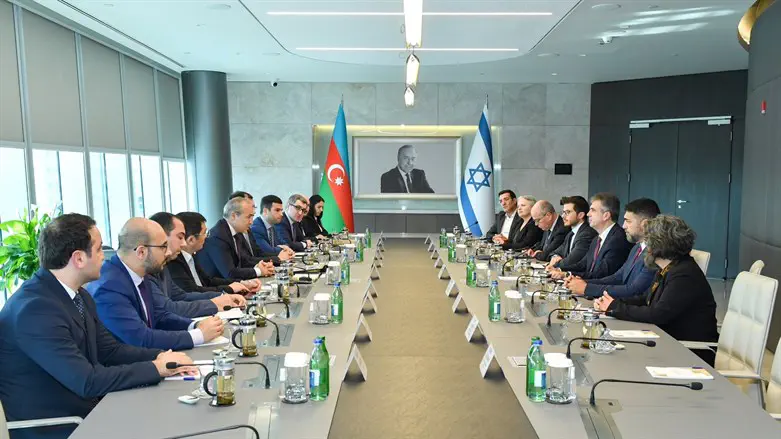
Several weeks have passed since Vice President J.D. Vance’s February 9 arrival in Armenia and subsequent February 10 visit to Baku. These were not merely sequential diplomatic stops. They reflected Washington’s effort to reinsert strategic attention into a region where influence is increasingly diffused among multiple global actors. In the South Caucasus, presence alone is no longer sufficient; continuity and clarity now define relevance.
The visits occurred at a moment of recalibration. Armenia is reassessing long-standing security assumptions. Azerbaijan is consolidating its post-conflict positioning as a regional transport and energy hub. The broader environment is shaped not only by Russia’s diminished but lingering footprint and Iran’s sensitivities, but also by China’s expanding economic reach across Eurasia.
For Azerbaijan, U.S. engagement carries strategic validation. The Middle Corridor-also known as the Trans-Caspian International Transport Route-has gained new importance as trade routes through Russia face geopolitical constraints. The corridor links China and Central Asia to Europe through Kazakhstan, the Caspian Sea, Azerbaijan, Georgia, and Türkiye. Baku’s infrastructure investments in ports, rail modernization, and logistics capacity position it as a central transit node in this emerging east-west architecture.
This is where China’s role requires deeper analysis. Beijing’s Belt and Road Initiative (BRI) is not abstract in the South Caucasus; it operates through concrete investments and supply-chain integration. Chinese firms have participated in port development, rail connectivity, and logistics networks connected to the Trans-Caspian route. While Azerbaijan has carefully avoided excessive dependence, Chinese cargo volume remains essential for the Middle Corridor’s long-term viability. Economic leverage in such frameworks develops gradually: financing arrangements, construction contracts, and trade flows translate into structural influence without overt political declarations.
China’s approach differs from traditional geopolitical competition. It does not seek visible dominance. Instead, it embeds itself through infrastructure financing, long-term commercial partnerships, and integration into trade corridors that shape future economic patterns. If U.S. engagement proves episodic rather than sustained, Beijing’s incremental strategy could gain disproportionate weight over time.
For Armenia, the American visit signaled reassurance. Yerevan’s evolving foreign policy orientation-marked by diversification away from exclusive reliance on Moscow-creates space for broader Western cooperation. However, Armenia’s geographic and economic realities require careful balancing. Engagement with Washington must coexist with pragmatic management of relations with neighboring powers.
The stabilizing argument for U.S. involvement rests on three pillars. First, energy diversification. Azerbaijan remains a significant supplier of natural gas to Europe, contributing to reduced dependence on Russian energy. Second, connectivity. Supporting reliable transit corridors strengthens regional economic resilience. Third, conflict management. Encouraging durable arrangements between Baku and Yerevan reduces long-term instability.
Yet a credible analysis must also address counter-arguments.
One concern is strategic bandwidth. The United States is simultaneously engaged in Ukraine, Indo-Pacific deterrence, and Middle Eastern security challenges. Sustained policy attention to the South Caucasus requires resources and political continuity that cannot be assumed. Without consistent follow-through, high-profile visits risk becoming symbolic rather than structural.
Another consideration is escalation dynamics with Iran. Tehran closely monitors Western engagement along its northern border, particularly given Azerbaijan’s cooperation with Israel and expanding Western ties. Although U.S. diplomacy is not directed at Iran, perceptions influence reactions. A miscalibrated expansion of visible U.S. security presence could amplify rhetorical tensions or encourage proxy signaling. Stability requires measured engagement, not performative projection.
A third challenge involves mediation credibility. If Washington is perceived as favoring one side in Armenian-Azerbaijani negotiations, its capacity to facilitate balanced dialogue could weaken. Sustainable diplomacy in the South Caucasus depends on careful neutrality while advancing practical outcomes.
China’s expanding presence adds a further layer. Beijing’s integration of BRI corridors with digital trade systems, port infrastructure, and logistics financing offers regional states tangible economic incentives. In contrast to overt security alliances, economic integration reshapes strategic orientation gradually. The durability of U.S. influence will depend not only on diplomatic visits but on competitive economic engagement.
Russia, while weakened in relative terms, remains embedded in regional security calculations. Any shift in alignment occurs within a crowded geopolitical environment rather than a vacuum.
For Azerbaijan, the optimal strategy continues to be diversification. Baku has cultivated relationships with Washington, Brussels, Ankara, Moscow, and Beijing simultaneously. Its foreign policy emphasizes sovereignty through multiplicity rather than exclusive alignment. For Armenia, diversification has become a mechanism for reducing vulnerability.
The central question is therefore not whether the United States can appear in the region-but whether it can remain constructively engaged without overextension, escalation, or imbalance.
If Washington sustains economic cooperation, supports practical connectivity, and reinforces a stable peace trajectory between Baku and Yerevan, its influence will deepen organically. If attention shifts elsewhere, alternative actors-particularly China through Belt and Road infrastructure-are positioned to expand their structural role.
The South Caucasus does not operate within a binary framework. It sits at the intersection of corridors, capitals, and competing models of engagement. In such an environment, measured consistency carries greater weight than episodic visibility.
Diplomacy in this region is no longer defined by grand declarations. It is defined by who builds, who invests, who sustains, and who remains present when headlines fade.