
A decade ago, amid a financial crisis, the Jewish Theological Seminary turned to its assets, selling real estate as well as rare books from its world-renowned library. The book sales were private, and the institution has never detailed what was sold or for how much.
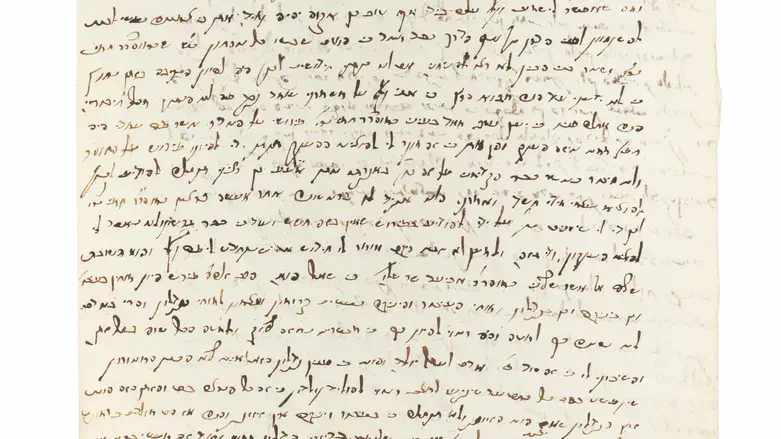
Now, a lost treasure from the library has once again emerged at auction: this time, a letter written and autographed by the 18th-century Jewish luminary Moshe Chaim Luzzatto, also known as the Ramchal.
When it was housed at the library, the letter belonged to a Ramchal collection numbering hundreds of pages. Removed from the collection and marketed to the auction house’s Orthodox clientele as a profound text by “a great and holy Kabbalist," the letter sold on Sunday for nearly $400,000. The identities of the seller and buyer are not publicly known.
The price reflects the massive appeal of heritage items in a newly affluent Orthodox market, where rare texts and autograph material are increasingly treated as both status symbols and investment vehicles. It is a market the auction house, Genazym, has helped supercharge by selling not just books, but proximity to revered rabbinic figures.
Born in 1707, Luzzatto was an Italian Jewish thinker, mystic and writer whose influence far exceeded his brief life. His best-known work, “Mesillat Yesharim," became a cornerstone of Jewish ethical literature and remains widely studied today. Though his mystical teachings stirred suspicion among some contemporaries, later generations regarded him as a major figure of Jewish thought.
In a famous 1928 essay titled "The Boy from Padua," the Hebrew poet Hayim Nahman Bialik offered one of the most enduring modern interpretations of Luzzatto’s legacy. Bialik described Luzzatto as a forerunner of three great streams of modern Jewish history: the Lithuanian rabbinic tradition, Hasidism and the Enlightenment.
The auctioned letter, spanning two handwritten pages and addressed to his mentor, captures Luzzatto engaged in a detailed discussion of mystical concepts. He uses the space to explain his reasoning and mentions additional writings then in progress.
For scholars like David Sclar, the quiet removal of Luzzatto’s writings from the JTS library and their transfer to private hands suggests a cultural decline.
"It’s a scandal within the world of scholarship and American Jewish institutions," Sclar, a librarian at a Modern Orthodox high school in New Jersey, said in an interview. Sclar wrote his dissertation on Luzzatto using primary sources such as the auctioned letter.
He is also a former employee of the special collections division at JTS who left the institution years before the crisis that precipitated the sell-off. He sees the outcome of the auction as evidence of not only wrongdoing but incompetence.
"This is one of the items that they sold through the back door, which means they sold it for probably virtually nothing," Sclar said. "And the tragedy in all of this, besides JTS sort of destroying cultural heritage, is that it’s also stupid, because if they had decided that they were desperate for money then just do an auction. Don’t do it through the back door."
The librarian at JTS, David Kraemer, declined a request for an interview, directing questions to the institution’s spokesperson, who offered a brief emailed statement.
"Decisions were made at the time with careful consideration of what was in the best interest of the institution," the spokesperson wrote.
In 2021, amid earlier revelations of the library’s sell-off, Kraemer told the Jewish Telegraphic Agency that he had been ordered to sell items of his choosing to raise a specified amount of money, which he did not disclose.
In their defense of the sales, Kraemer and other JTS officials said at the time that the deaccessioned materials had been digitized and were deemed to have limited research value, allowing scholars to access their contents even after the originals left the collection. Seminary leaders described the decisions as financially prudent and of minimal impact on the library’s core mission.
Critics, however, argue that digitization does not replace the scholarly and cultural value of original manuscripts.