
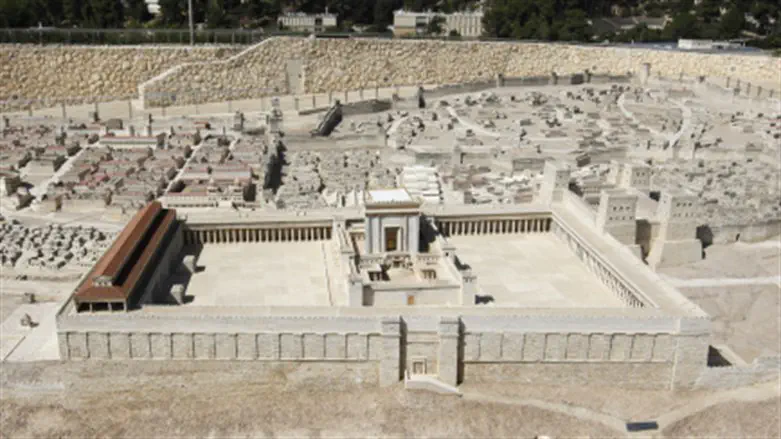
The Haftorah for Parashat Teruma (I Kings 5:26-6:13) describes what is arguably the most ambitious construction project in Jewish history: the building of the First Temple by King Solomon.
It is not a passage filled with miracles, prophecy or war but with measurements.
Cubit upon cubit. Cedar beams. Gold overlay. Carved cherubs. Windows recessed within thick walls.
At first glance it reads like an architectural blueprint rather than sacred literature. Yet that is precisely the point.
The Torah portion commands the construction of the Mishkan (Tabernacle) in the wilderness, while the Haftorah presents its permanent successor in Jerusalem. Together they teach a revolutionary Jewish idea: holiness is not only experienced in moments of inspiration but constructed through deliberate effort in physical space.
G-d does not merely appear. We make room for Him.
“And they shall make Me a sanctuary, and I shall dwell among them" (Exodus 25:8).
Not in it - but among them.
The Divine Presence rests upon a people who actively prepare a place for it. As the Kotzker Rebbe (Rabbi Menachem Mendel of Kotzk, 1787-1859) taught, G-d is to be found where we let Him in.
Solomon’s Temple was not simply a religious building. It was the focal point of Jewish national identity. Every tribe, every pilgrim, converged upon a single mountain in Jerusalem. The Temple unified heaven and earth, priest and farmer, king and shepherd.
When the Temple stood, Jewish longing had an address. And when it was destroyed, Jewish yearning became history’s longest memory.
For nearly two thousand years Jews prayed facing one direction - geographically, not metaphorically. Every wedding shattered a glass to recall its loss. Every Passover ended with “Next year in Jerusalem." Every synagogue echoed something absent.
We did not simply remember the Temple. We organized our civilization around its absence.
But in recent years, something remarkable has begun to unfold.
Increasing numbers of Jews have ascended the Temple Mount, not merely as tourists, but as worshippers.
For decades after 1967 Jews were discouraged, even intimidated, from praying there. The holiest site in Judaism became the only holy site in the world where Jews were effectively barred from worship.
History, however, has a momentum of its own.
Today, thousands of Jews ascend the Mount in accordance with their rabbi's halakhic guidelines. Many immerse beforehand. Many whisper Psalms. Some bow. Increasingly, they pray openly.
This is neither a political movement nor a provocation.
It is a spiritual reflex.
A people that recited three daily prayers for the restoration of the Temple cannot indefinitely remain strangers to its location.
In light of this, the Haftorah’s architectural precision now takes on renewed meaning.
Judaism does not await a vague utopia. The prophets describe courtyards, gates, altars, all of which are tangible realities in a tangible place.
Faith in Judaism has a strong geographic component. Sinai happened somewhere. Hebron is somewhere. The Temple Mount is somewhere.
The growing Jewish presence there reflects continuity. It is what happens when a people takes its liturgy and longing seriously.
If King Solomon measured walls because holiness requires structure, Jewish history measures time because redemption requires preparation.
You cannot pray daily for the rebuilding of the Temple while emotionally treating the Temple Mount as irrelevant.
Eventually prayer demands proximity.
Critics portray Jewish prayer on the Mount as destabilizing. But longing for one’s sacred site is not radical - it is human.
The Haftorah reminds us the Temple was built through devotion. It carried a vision from Sinai to Jerusalem.
Today’s Jewish visitors to the Temple Mount (even those who do not ascend due to their rabbis' halakhic interpretation, ed.) are not forcing redemption. They are expressing hope in Jewish memory and faith in our collective destiny.
They stand where prophets rebuked kings and face the place toward which Jews have prayed in every exile - Babylon, Spain, Poland, Morocco, Yemen and America.
For the first time in two millennia Jews can physically ascend the place their prayers never abandoned.
History has closed a circle.
At the Haftorah’s conclusion G-d tells Solomon:
“If you walk in My statutes… I will dwell among the children of Israel and will not forsake My people" (6:12-13).
The Temple was never guaranteed by stone alone. It depended on spiritual readiness.
Perhaps that is why this generation approaches the Mount not in triumph but yearning - descendants returning to a long-lost home.
Parashat Teruma teaches that a sanctuary begins with a teruma, a lifting of the heart.
The renewed Jewish presence on the Temple Mount may be exactly that: a collective offering of memory and hope.
And a people that still longs for the Divine Presence is already preparing a place for it. May we witness it soon.