
It seems to be over.
The body of Ran Gvili, the final hostage, has been returned. Hostage Square in Tel Aviv has gone dark. After 843 days, 12 hours, and 6 minutes, all those abducted by Hamas on that terrible day have returned home, those alive and those who are dead. For the first time in nearly 12 years, there are no hostages, living or dead, in Gaza.
It’s a day that many people believed would never come. To be completely honest, I never thought Israel would be able to pull it off. It seems the Arabs weren't the only ones who underestimated what we were capable of.
No one really believes that this is really the end. Hamas has been defeated but not destroyed. We know that they're already regrouping, gathering strength and numbers, carefully preparing for the next atrocities. Most of us in Israel are simply waiting. We hold our breaths, anticipating as best we can what we know is coming.
But now, for a short whille, there is cause for rejoicing. We have every right to celebrate our successes. But while we revel, I'm reminded of a certain story brought down by Bahya ibn Paquda, in his book Chovott HaLevavot:
"They said of a pious man that he encountered soldiers returning from battle, carrying spoils after a fierce war. He said to them: You have returned from the minor war, bearing spoils - prepare yourselves now for the great war. They asked him: And what is the Great War? He replied: The war against the yetzer (evil inclination) and its armies."
This is what we now face. We might have vanquished the external threat, but countless internal troubles threaten to bring us down as our enemies never could.
Even if we were momentarily brought together against a common threat, the political divide that has torn this country apart has yet to heal. We all remember the protests against judicial reform that rocked the country in the months leading up to October 7th. On one side, citizens were calling for what they felt was needed change. On the other side were those who felt that these changes would undermine the very fabric of our country.
Both sides were passionate. Both sides felt that they were defending democracy. And because each side felt that they were completely right, they assumed that the other side must be completely wrong.
Neither group was really willing to hear the other out. With the kind of clarity that comes from thinking that the truth is entirely on your side, each party saw its opponent as an enemy, with whom dialogue was not only impossible but, since they were intrisically in the wrong, also unnecessary. (Although the Justice Minister dd try to set up talks with the opposition and was rebuffed, ed.)
What followed were months of civic unrest. Too often, anger replaced discourse. It was not concern for the mutual good, but partisan rage that fueled the debate on the matter. The result was a country so polarized and so distracted by the issue that it was where the country’s collective attention was turned on October 7th. We were so focused on fighting each other, we never even noticed the real danger until it was too late.
The fight between the left and the right is tragically not the only rift in Israeli society today. Since the founding of the Jewish state, there has been a divide between the religious Jews and their secular counterparts. I am religious. I grew up secular. I have heard both sides.
The secular side says that the religious are trying to take over. That they want to turn Israel into a theocracy, where basic Western rights are denied. They claim that religious Jews are all extremists, practicing an outdated and at times barbaric belief system, completely out of place in the modern world. They feel that religious Jews already have too much control, and succeeding any more will lead to the downfall of the state.
On the other side, the religious Jews see the ongoing actions of their secular counterparts as an assault on their communities as well as an attempt to undermine their faith. The haredi religious world decided to close itself off and circle its wagons. They perceive every secular action as an assault against their ongoing existence. Sensing the feelings of their countrymen, they withdraw from them and instead focus on the needs of their own communities.
Despite taxpayer support for yeshiva students, religious Jews have a long history of unfair behavior towards them by secular governments. Yemenite children were taken away from their parents, and religious Jews found themselves, years ago, in a mostly secular army. Thank G-d, that has changed. They have been on the defensive for so long against so many threats that they are understandably worried about lowering their guard.
And so, each began to see the other as a threat to their way of life. Each saw in the other an attempt to undermine the values our country holds most dear. Instead of being as the Torah commands, "One nation with one heart," they became two hearts fighting over the fate of one nation.
October 7th should have permanently shattered any misconceptions of Jews being separate. Our enemies killed secular alongside religious and called the entire country a "settlement." The violence and destruction weren't aimed at any one group. They wanted us all dead. They saw the Jewish people as the whole we failed to see ourselves as.
Today, the debates continue to rage. Thousands have taken to the streets in protest against the government's attempts to draft haredi youth into the army. To some, the draft is an assault on the Torah way of life. They see an attempt to take students away from the learning whose merit protects this country, including the soldiers. They see this as another attempt to secularize their youth. On the other side, they see a religious community that only takes from the public and never contributes, and the many young haredi men who are not in yeshivas but who do not enlist ruin it fo the sincere Torah scholars. A growing population demographic refuses to do their fair share.
Yet we only have one Israel. We can no longer allow ourselves the luxury of a house divided. We've already seen that the enemies will kill us as one. Now we need to find the strength to live as one.
The fragmentation doesn't just happen at the civic level. It's a poison that has spread all the way to the top. Our higher political echelons are a disgrace. Politicians on both sides and at the highest levels have been convicted of crimes. More are being charged. We can no longer turn to our leaders for moral clarity and guidance.
It's clear that to many in the Knesset, their role is no longer to serve the Israeli people. Instead, they focus on policies that benefit their own small group of constituents and hence will earn them the votes to retain power. Our leaders forget that they serve not only their voters, but the country as a whole, and that therefore their duty is to every Israeli citizen, to the greater good.
And so, the country as a whole is left to rot. Israelis from every sector are suffering, and no help is coming to them. Food prices in this country have risen, there is a dramatic increase in house prices and many families struggle to afford rent, which has likewise risen to extremes. While the prices continue to increase, earning money becomes an ever more difficult challenge.
For many, even finding a job is impossible. Israel's poverty level is allegedly high compared to other developed nations, with around 21% of the population (nearly 2 million people) living below the poverty line (there is, of course, undeclared income not taken into account) . Poverty affects 28% of children, coming to 880,000 young people, the 2nd-highest rate of child poverty among OECD countries. 150,000 senior citizens (around 13% of our elderly) are affected. Recent studies show that 4.7% give up a hot meal at least every two days. Clearly, we have to do something.
Still our politicians seem to ignore the cries for help all around them. Our country once boasted a system that ensured that all its citizens would be cared for. We've failed to enact the necessary reforms to allow our country to achieve the same standards of living enjoyed by so many other nations. Of course, the high cost of war is the main problem, and the government is going all out for reservists, but more can be done.
This is an issue that crosses party lines. The religious parties focus on stipends for Kollel students while thousands of other Israelis can’t meet their basic needs. The left-wing parties that should be promoting social welfare agendas continue to remain silent on the concrete changes to the way our country operates. Many of those with the power to create change refuse to see beyond their own narrow views.
As long as we have a government where each party is so focused on getting the biggest share of the pie, we will have people who will be forced to go without.
Israel is experiencing a record outflow of citizens, with over 82,800 people emigrating in 2023, marking a 44% increase from the previous year. This trend continued in 2024 and 2025, with over 69,000 leaving in 2025, driven by security concerns, the war in Gaza, and political instability, Many of them, however, are non-Jewish iimmigrants from Russia,
For years the nation has been experiencing a "brain drain", as it is a small country with many talented citizens educated with taxpayer money (college tuition is minimal in Israel) who leave to what they hope are green pastures. They experience antisemitism instead. Still, the average citizen doesn't experience the standard of living that they work so hard to provide. And so, looking for a life they can’t have here, they leave.
Each day brings new examples of what the now open antisemitism and hatred mean. Jews are massacred. Synagogues are burned. Fear is widespread as rioters take to the streets and overrun college campuses. Those who hate Jews were only looking for an opportunity to turn the world against us. They not only found it, but they discovered a world alarmingly receptive to their message.
Nowhere is this clearer than with Iran. War against the terror state seems once again imminent. The days to follow might well bring another round of missiles. More death. More destruction. And just as the world ignored the brave Iranian citizens fighting in the streets against the tyranny of a brutal regime, so too it will ignore and even condemn our fight for survival. Israel is again being vilified for taking the steps to prevent its own destruction. The West and the world at large care more about upholding their false narratives than they do about promoting freedom and safety. Especially when Jews are involved.
If anything, the events should force to acknowledge a hard truth we've long tried to bury. Israel cannot win the propaganda war against a global media that in its hatred against our country, elected to publish an unending chain of unsupported modern day blood libels. Once trusted news organizations have become terrorist mouthpieces, unquestioningly repeating the vilest lies our enemies can come up with as verified fact. When time the truth comes to light, it's quickly buried. they've already moved on to the next attack. From the start, we were forced to fight a war knowing that our every action would be twisted and distorted.
We might have the greatest friend in our nation's history with the US president, but if anything, this war has opened our eyes to the fact that we have never been more alone on the national stage.
Since October 7th, it's become damningly clear that those we thought were on our side never were at all. It's not that we've lost our friends, it's that at last we've uncovered our enemies.
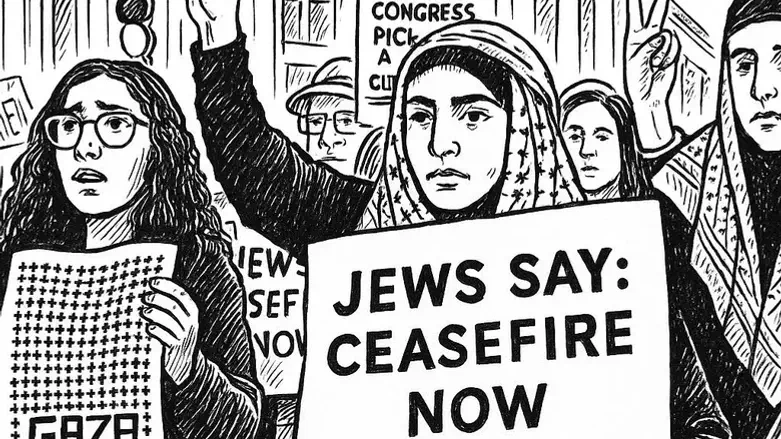
Sometimes the worst of these enemies came from within. Some of the strongest condemnations against Israel came from fellow Jews, so brainwashed by Western culture and so desperate to be loved by the gentiles that they proudly become spokesmen against their own people. A small but infinitely damaging percent of us betrayed us by becoming token Jews for antisemites. These "as a Jew" Jews gave legitimacy to the monsters who wanted us, and them, dead.
What is to be done about them now is a question that will take time to answer. The Torah teaches that teshuvah, repentance is always possible. But how will we welcome back into our communities these people whose actions put our lives in very real danger? Can they ever fully wash the blood away? How do we rehabilitate such people, and how do we even convince them to return. Are we to simply accept that another slice of the Jewish world is gone, lost to self-hatred? And where do we, knowing that these people bent on our very destruction find the strength to forgive? Perhaps they will discover in time that the world hates all Jews, even those so-called "good ones."
With the whole world against us, it's clear that we can only count on each other. This fighting will continue until we realize the truth. The war is not secular against the religious. It is not left vs. right. Our fellow Jews are not the enemy. We all have the same enemy. The eternal enemy, the yetzer hara, the evil inclination.
The yetzer hara has come across the prefect strategy. It knows we can't be defeated by external forces, so it fools us into trying to destroy ourselves.
It's the yetzer hara that makes us see divisions where none need to exist. It's who turns us against each other. It makes us use all of our energy and resources fighting each other so that we have nothing left and are defenseless when the real enemy comes. It tricks us into seeing our allies as our foes, and therefore makes us not only tear down what's already been built, but also prevents us from starting all the good work we could all do together.
We survived. Hashem has given us the greatest possible gift, that of a new day, a new chance. It's a chance to create a truly remarkable Israel. But we can only create it together.
Gaza has ended, at least for the time being. It's so tempting to want to stop worrying and simply fall back into our old routines, those routines that were so comforting and which we missed so much when the war began. We might want to return to normal, but we must never allow ourselves to return to what we were just before October 7.
Ilan Goodman is a museum collections professional and exhibition curator. He also serves as a rabbi and educator. He made Aliyah to Israel in 2011 and lives with his wife and children in Beit Shemesh.
...