
If AIPAC has any regrets about pouring more than $2 million into opposing a candidate who calls himself pro-Israel - and ultimately lost to an anti-Israel opponent - it isn’t saying so. In fact, the pro-Israel group’s affiliated super PAC suggests it would do it again.
“We are going to have a focus on stopping candidates who are detractors of Israel or who want to put conditions on aid," Patrick Dorton, a spokesperson for the United Democracy Project, said in an interview.
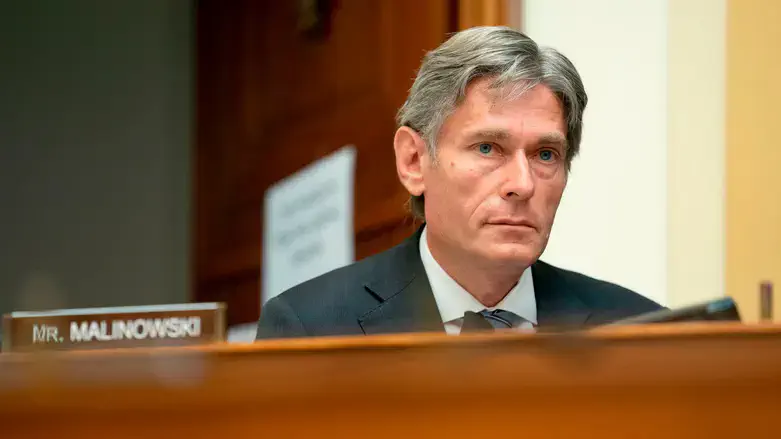
The target of the UDP’s recent spending was Tom Malinowski, a former congressman who was running in a special election in New Jersey’s 11th Congressional District, which he conceded on Tuesday morning. Malinowski, who calls himself pro-Israel and has been endorsed by the liberal Zionist organization J Street, has said he’d be open to placing conditions on some US aid to Israel.
AIPAC pummeled Malinowski with $2.3 million in negative ads - but not about Israel. Instead, the ads tarred him from a progressive angle - one emphasized his vote on a 2019 bill that included increased funding for ICE, the immigration enforcement agency.
In a statement, Malinowski congratulated the winning candidate, Analilia Mejia, and credited her for “running a positive campaign and inspiring so many voters on Election Day."
“But the outcome of this race cannot be understood without also taking into account the massive flood of dark money that AIPAC spent on dishonest ads during the last three weeks," Malinowski wrote.
He added, “I met several voters in the final days of the campaign who had seen the ads and asked me, sincerely, ‘Are you MAGA? Are you for ICE?'"
By one measure, AIPAC’s spend could be seen as a success: The candidate it opposed, seen as a favorite, did not score an easy win on Election Day. But in another crucial way, the effort appears to have backfired by throwing open the door for Mejia, a progressive grassroots organization leader who is far more critical of Israel.
Mejia, who was the national political director for Bernie Sanders’ 2020 presidential campaign, was ahead of Malinowski by less than 1,000 votes when he conceded the race. Tahesha Way, the former lieutenant governor of New Jersey who is thought to have been AIPAC’s preferred candidate, finished in a distant third.
Critics, including AIPAC supporters, have slammed AIPAC’s strategy in the race.
“They could not have gotten a worse result than what they got," said Alan Steinberg, a journalist in New Jersey who was an EPA administrator under George Bush. “I’m a very pro-AIPAC person, very supportive of AIPAC, but this is one of the worst strategic errors that they could’ve ever made."
The UDP got into the race because of Malinowski’s comments on US aid to Israel at a time when a large number of Democrats, and some Republicans, were expressing new openness to attaching conditions to the aid as they sought to press Prime Minister Benjamin Netanyahu to end the war in Gaza and adopt different policies in Israel and the West Bank.
Asked last fall about the possibility of conditioning or suspending aid to Israel, Malinowski told Jewish Insider that he “would make case-by-case judgments given what’s happening on the ground." He said he would similarly make case-by-case judgments for any US ally receiving aid.
“We had very serious concerns about Tom Malinowski, who clearly was open to conditioning aid to Israel," Dorton said. “He knew that he had moved to what is not a pro-Israel position."
Dorton indicated that the UDP would likely go after other candidates who have expressed openness or interest in conditioning aid. “Adding conditions to aid to Israel, and undermining the US relationship, is a top priority for us in assessing candidates," he said.
In New Jersey, the result could be elevating a politician whose stance on Israel is much harsher. Mejia has accused Israel of committing a genocide in Gaza and pledged not to take any AIPAC-funded trips to the country. She also began calling for a ceasefire in Gaza within weeks of Hamas’ Oct. 7, 2023, attack on Israel after tweeting on Oct. 10, “Every fiber of my being is horrified beyond words at what is furthering in Gaza. Yet again we see how oppression & dehumanization leads to despair & unthinkable destruction."
Mejia’s campaign focused on affordability and she drew endorsements from progressives including Bernie Sanders, Alexandria Ocasio-Cortez and Ro Khanna. If she holds her lead, she will become the Democratic nominee for April’s special election to fill the House seat vacated by now-governor of New Jersey, Mikie Sherrill.
Steinberg said he thought that AIPAC “never took seriously the possibility of her winning in this primary," and that Malinowski would be far more aligned with AIPAC on Israel.
“I don’t think Malinowski is anti-Israel," said Steinberg. “I know Tom, I disagree with him on Israel, but he is much preferable to Analilia Mejia. Much preferable."
Jeremy Ben-Ami, the president of J Street, which endorsed Malinowski, wrote in a Substack column that AIPAC was responding to criticism of the Israeli government’s policies as if it were hostility toward the country itself.
“AIPAC now treats even good-faith criticism from friends as a threat to be crushed," he wrote.
Malinowski wrote that his “support for Israel as a Jewish and democratic state" would not waver “because of who supports or opposes me."
“But our Democratic Party should have nothing to do with a pro-Trump-billionaire-funded organization that demands absolute fealty to positions that are outside the mainstream of the American pro-Israel community, and then smear those who don’t fall into line," he wrote.
Dorton downplayed the impact of a Mejia primary victory because the upcoming special election decides only which candidate fills the seat until the end of 2026. A second primary, held in June 2026, will decide the Democratic nominee for the regular November election.
But others are viewing her potential win as a larger victory for progressives, and specifically the pro-Palestinian movement.
“Analilia Mejia for New Jersey just set a new precedent in NJ and beyond," wrote pro-Palestinian activist Linda Sarsour in a Facebook post on Monday featuring a photo of Mejia raising her hand as the lone candidate indicating that she believed Israel committed genocide, at a forum hosted by the Council on American-Islamic Relations. “She’s teaching us that it’s okay to stand alone so as [sic] long as you are on the right side of history."
The UDP has spent millions on congressional races to mixed results since AIPAC began directly funding candidates in 2021; it had previously worked only to cultivate support for Israel among politicians. In 2024, it spent at least $14.5 million against the incumbent “Squad" member Jamaal Bowman in New York, and more than $8 million to take down Cori Bush in Missouri; both incumbents lost their primaries. But the $4.5 million it spent was not enough to beat Dave Min for Katie Porter’s House seat in California.
Now, the upcoming midterms will likely serve as a test of AIPAC’s strength as lawmakers and voters on both sides of the aisle distance themselves from Israel and its advocates. They will also answer the question of what dividends AIPAC - whose PAC opened the year with a nearly $100 million war chest - will draw if it focuses on punishing candidates who show insufficient support for Israel.
“If AIPAC backs a candidate - openly or surreptitiously - in the June NJ-11 Congressional primary, I will oppose that candidate and urge my supporters to do as well," Malinowski wrote. “The threat unlimited dark money poses to our democracy is far more significant than the views of a single member of Congress on middle east policy."
Dorton said he is not concerned about shifting sentiment toward Israel and AIPAC. The UDP is looking ahead to the June midterm primaries and will “continue to run ads that move the needle" in primary races about issues that mostly don’t involve Israel, he said. He added that the group is assessing polling data and “candidate viability" for dozens of races around the country - including in NJ-11.
“There is a strong bipartisan pro-Israel majority in Congress," Dorton said. “And we intend to keep it that way."