
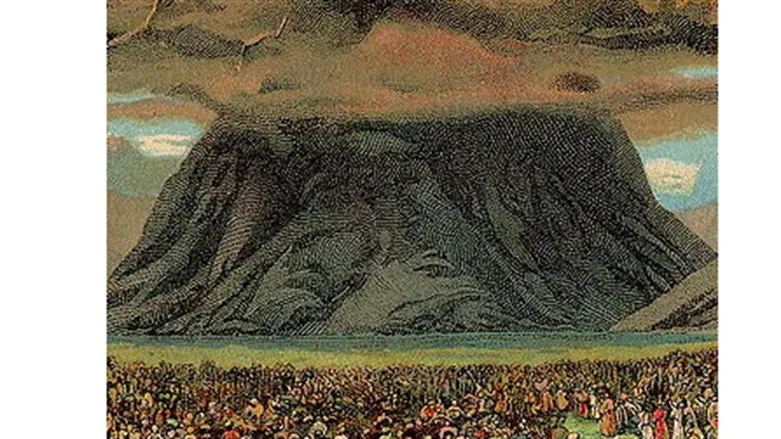
Parashat Yitro opens by telling us that “Yitro [Jethro], the Minister of Midian, Moshe’s father-in-law, heard everything that G-d had done to Moshe and to Israel His nation, that Hashem had taken Israel out of Egypt" (Exodus 18:1).
Consequently, Yitro came to the Sinai Desert and joined the Children of Israel together with his daughter Zipporah, whom Moshe had married decades earlier, and then sent back to her father’s house where she could sit out the turmoil of the Ten Plagues in peace and safety (Exodus 18:2, as explained by Mechilta de-Rabbi Yishmael, Yitro, Massechet de-Amalek 1).
The Torah records Yitro’s joining the Jewish nation immediately after the battle with Amalek (Exodus 17:8-16, the final paragraph of Parashat Beshallach), implying that Yitro joined, and Zipporah re-joined, the Children of Israel immediately after that battle, shortly before the Giving of the Torah.
However the Talmud (Zevachim 116a) and the Midrash (Mechilta de-Rabbi Yishmael, Yitro, Massechet de-Amalek 1) record a disagreement regarding the chronology:
The sons of Rabbi Hiyya, following the simple reading, said that Yitro indeed came shortly before the Giving of the Torah. But Rabbi Yehoshua ben Levi, following the principle that “the Torah does not necessarily follow chronological order" (Pesachim 6b, Yerushalmi Megillah 1:5 et al.), says that he came after the Giving of the Torah.
So we have two different opinions as to when Yitro joined, and Zipporah rejoined, the Children of Israel: shortly before the Giving of the Torah, or shortly after it.
The Talmud (Zevachim 116a) also records three different opinions among the Tannaim as to what exactly prompted Yitro to join the Children of Israel. They pick up on the phrase “Yitro…heard everything that G-d had done…", and ask: What specifically did he hear?
Rabbi Yehoshua, following the simple reading, says that Yitro heard about the battle with Amalek.
Rabbi Elazar of Modi’in opines that he heard about the Giving of the Torah (thereby agreeing with Rabbi Yehoshua ben Levi that the Torah recounts this whole episode out of chronological sequence).
And Rabbi Eliezer says that Yitro heard about the Splitting of the Red Sea.
Why do these different Tannaim give their respective reasons for Yitro joining Israel? And does it really matter why Yitro joined Israel?
Let us begin our search for an answer by defining who and what Yitro was:
The Torah describes him as כֹּהֵן מִדְיָן (Exodus 18:1), which we translated above as “the Minister of Midian". The Midrash (Mekhilta de-Rabbi Yishmael, Amalek 1) offers two meanings of the word כֹּהֵן, Kohen, in this context:
Rabbi Yehoshua, who said that Yitro joined Israel after hearing about the battle with Amalek, said that it means a minister of religion (i.e. a priest of idolatry). Rabbi Elazar of Modi’in, who said that Yitro joined Israel after hearing about the Splitting of the Red Sea, said that it means a national leader (what today we would call a senior Government Minister).
Whenever the Talmud speaks of Rabbi Yehoshua without defining which Rabbi Yehoshua (there were more than fifty rabbis in the Talmud called Yehoshua), it refers to Rabbi Yehoshua ben Hananiyah of Peki’in in the Galilee. Rabbi Yehoshua ben Hananiyah was a brilliant logician and philosopher who debated Jewish heretics, meaning Judeo-Christians (Hagigah 5b), Greek philosophers (Bechorot 8b-9a), and Roman emperors (Hullin 59b-60a), and defeated them all.
In his disputations with the Judeo-Christians and the Greek philosophers, Rabbi Yehoshua manoeuvred his opponents into situations in which they forfeited their very lives by losing the arguments.
Rabbi Yehoshua was the closest disciple of Rabban Yohanan ben Zakkai - the man who tried with all his power to prevent the destruction of the Second Temple and to preserve Jewish sovereignty in the Land of Israel; and after the Destruction, he did all he could to preserve and to strengthen and to encourage the shattered and conquered Jewish nation in the Land of Israel.
Rabbi Yehoshua posited that Yitro joined Israel when he heard that Israel had defeated Amalek. In Rabbi Yehoshua’s world-view, Yitro had been a priest of idolatry, and for an idolater (or former idolater), Israel’s military victory was proof of the supremacy of the G-d of Israel.
Rabbi Yehoshua understood the pagan mind - and for the pagan mind, the idea of a god who allows his people to be defeated was simply inconceivable. In the idolatrous conception, a nation was defeated when its god was unable to grant it victory. Hence to Rabbi Yehoshua it was clear that Israel’s military victory over Amalek was what proved Hashem’s mastery to Yitro.
Rabbi Elazar of Modi’in (who said that Yitro joined the Children of Israel after hearing about the Giving of the Torah) was also a disciple of Rabban Yohanan ben Zakkai. Like Rabbi Yehoshua, Rabbi Elazar of Modi’in was nourished by the Torah of Rabban Yohanan ben Zakkai - an uncompromising, passionate, even desperate love of and connexion with the Land of Israel.
But unlike Rabbi Yehoshua, Rabbi Elazar of Modi’in posited that Yitro had been a political leader of Midian before joining Israel. For a political leader, victory in war is no proof of truth; tactical superiority yes, but not truth.
However the Giving of the Torah, the institution of the perfect system of laws, would have suggested Divine guidance to a political leader, accustomed to all the shortcomings and corruption which are inevitable in any man-made legal code.
Rabbi Eliezer posited that Yitro was inspired by having heard about the Splitting of the Sea. Whenever the Talmud mentions Rabbi Eliezer without defining which Rabbi Eliezer, it speaks of Rabbi Eliezer ben Hyrcanos, known as רַבִּי אֱלִיעֶזֶר הַגָּדוֹל, Rabbi Eliezer the Great (Gittin 57a); Rabbi Eliezer, of whom his master and mentor Rabban Yochanan ben Zakkai said: “If all the Sages of Israel were on one pan of the balance-scale and Eliezer ben Hyrcanos on the other one, he would outweigh them all" (Pirkei Avot 2:8).
Rabbi Eliezer ben Hyrcanos was a second-generation Tanna, among the greatest disciples of Rabban Yochanan ben Zakkai. And he would later become Rabbi Akiva’s primary teacher: Rabbi Akiva studied under him for 13 years (Yerushalmi Pesachim 6:3).
Rabban Yochanan ben Zakkai and Rabbi Akiva both experienced destruction at the hands of the Roman Empire: Rabban Yochanan ben Zakkai lived through the Great Jewish Revolt against Rome (66-73), during which the Holy Temple was destroyed; and Rabbi Akiva was the spiritual leader of the last great Jewish Revolt against Rome, the Bar Kochba Revolt (132-135).
Rabbi Eliezer ben Hyrcanos lived in this maelstrom of hope and despair, persecution and struggle. He had fully imbibed the determination to smash the chains of Roman occupation, and passed that ideology on from his master Rabban Yochanan ben Zakkai to his disciple Rabbi Akiva.
For Rabbi Eliezer ben Hyrcanos, our miraculous salvation at the Splitting of the Sea and resounding defeat of oppressive enemies would have been the inspiration for Yitro to join the Children of Israel.
And now we come to the sons of Rabbi Hiyya:
Whenever the Talmud speaks of רַבִּי חִיָּיא, Rabbi Hiyya without defining which Rabbi Hiyya (there were 77 rabbis in the Talmud called Hiyya), it refers to the Rabbi Hiyya who lived in the generation which straddled between the Tanna’im and the Amora’im.
The Tanna’im (“those who teach by repetition") were the Masters from the time of Hillel and Shammai until Rabbi Yehudah the Prince redacted the Mishnah, from 10 until 200; the Amora’im (“those who teach by talking") were the Masters from the time of the redaction of the Mishnah until the close of the Talmud - from 200 until 500.
The Tanna’im, the earlier generations, closer to the Giving of the Torah, were on a higher level than the Amora’im. Indeed Rabbi Yehudah the Prince committed the Mishnah to writing for the first time precisely because he identified how the nation was descending spiritually under Roman occupation and persecution, and feared that the Mishnah would be lost if it would continue to be transmitted solely orally.
Rabbi Hiyya was among the last of the Tanna’im and the first of the Amora’im (Niddah 26a and Rashi there, s.v. אמר אביי). A contemporary and colleague of Rabbi Yehudah the Prince, a member of his “inner circle" (Eiruvin 73a), he was known as רַבִּי חִיָּיא רַבָּה, Rabbi Hiyya the Great (Shabbat 18b).
Rabbi Hiyya was born in Babylon, and made Aliyah to Israel with his sons Yehudah and Chizkiyah (Sukkah 20a). As an indication of how great he was, and how great and lasting his influence on all future generations of Jews was, it was Rabbi Hiyya who, together with his colleague Rabbi Oshaya, who wrote all the Baraitot - the teachings of the Tanna’im which were not included in the Mishnah, but which are essential in determining Halachah (Hullin 141b).
Rabbi Hiyya’s sons had the perspective of having been born in Babylon, and having made Aliyah to an Israel that was suffering under Roman persecution. They had been raised by a father whose dedication to Torah was so uncompromising that he was willing to leave exile, even though Babylon at the time was materially far safer and more comfortable for Jews than Israel was.
This was a generation after the Bar Kochba Revolt, when the majority of Jews had already been exiled by the Romans. A time when Jewish destiny seemed bleak. A time when it would have appeared that Jewish future would be in Babylon. A time when the Land of Israel was largely desolate.
But Rabbi Hiyya could see beyond the gloom of current reality, into the far more inspiring future that awaited Jewry. He could see that however flourishing the Jewish communities of Babylon and however oppressed the Jewish communities of Israel, however wealthy the Babylonian Jewish communities and however impoverished the Jewish communities in Israel, however secure the Jews of Babylon were and however precarious Jewish life in Israel was, it was still in Israel that Jewish tradition would be inscribed and preserved for all time.
His sons said that Yitro joined the Children of Israel shortly before the Giving of the Torah - at a time when they were wandering through the desert, their destiny as yet unclear. G-d had not yet given them the Torah, they were not yet “a Kingdom of Priests and a holy nation", as G-d would define them shortly before giving them the Torah (Exodus 19:6).
Rabbi Hiyya’s sons could fully identify with an outsider who saw beyond the uncertainty of current reality and into an infinitely more inspiring future. They could derive inspiration from a leader of his nation who abandoned his secure, comfortable, and familiar surroundings to join a newly-emancipated nation of erstwhile slaves just setting out into the unknown, without even a code of laws to guide them.
So when did Yitro join the Nation of Israel? Before the Giving of the Torah or after it?
And why did Yitro join the Nation of Israel? Because he heard about the Splitting of the Red Sea, or because he heard about the battle against Amalek, or because he heard about the Giving of the Torah?
Rabbi Hiyya’s sons, Rabbi Yehoshua ben Levi, Rabbi Yehoshua ben Hananiyah, Rabbi Elazar of Modi’in, and Rabbi Eliezer each had their perspectives on what inspired Yitro to throw his lot in with the Jewish Nation.