

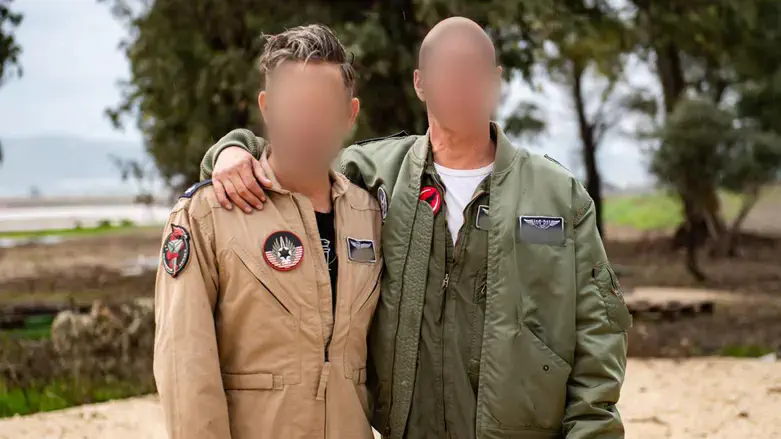
Combat pilot Brig. Gen. (res.) A and flight inspector Lt. Col. (res.) R are childhood friends from Tivon who repeatedly found themselves together at critical moments during their service and reserves-one in the control tower, the other in the cockpit.
A, 48, grew up in the Jezreel Valley and held a series of senior command roles until leaving active service three years ago. Since then, he has continued to serve in the reserves with Squadron 109 (“The Valley"), flying F-16s and training the next generation of aircrew.
R, who enlisted in 1996 as a flight inspector, became over the years a key figure in the control and supervision system, commanded the control tower at Ramat David, and during the most recent war served no less than 380 days in reserve as a combat leader.
The first time their professional paths crossed was during A’s flight course. “When A was in flight school, there’s a test called ‘Ramat David Navigation,’" R recalls. “It was the first time he flew over the Jezreel Valley, and the first time I supervised him in flight. From that moment, 27 years have passed, and we have never parted-neither in life nor in the military."
For A, hearing his friend’s voice in the headset provided an irreplaceable sense of security. “Flying over the valley was thrilling, and even more so when your best friend responds over the radio," he says. “It gave a sense of security and closure. This feeling accompanied us throughout our service. Many times, completing a mission requires flexibility and creativity, and when R is there, I know we’ll succeed."
This trust was tested in extreme conditions. R recalls a particularly stormy winter day in the north when A took off for a critical strike mission. “It was one of the most turbulent days of the year. A launched for a very important strike. Flying in such weather was very difficult, but we decided to send the formation. It required creativity and thinking outside the box while ensuring everyone’s safety. On flights like these, the pilot must trust those in the tower one hundred percent."
The pinnacle of their joint service came during Operation “Rising Lion," when the Air Force struck targets in Iran. A was in the cockpit, while R managed the operation from the tower. “During several sorties, including my first flight, R supervised me," A recalls. “There was tension in the air, but you learn to manage it. It’s a profound feeling to cross borders and fly over rivers you learned about as a child. Flying over targets for hours while checking for threats or drones sent toward Israel is a unique experience."
R describes his role in the historic operation: “I was the combat leader in the tower, responsible, among other things, for the wing’s first formation. I prepared extensively. That afternoon, we understood it was happening. Many aircraft took off from Ramat David-a crazy operation that usually doesn’t happen anywhere."
Despite the vast physical distance-one in enemy skies, the other in the control tower-the personal bond remained strong. “Whenever we communicate, we always have a quick chat to make sure everything is okay. It’s always nice to hear R’s voice," A says. “During the flights to Iran, I always thought about him and how he was feeling."
Now, after decades of intense service and a long, significant combat cycle, the two have decided it is time to retire from the cockpit and leave the tower. “We decided to close this chapter and make way for younger, talented soldiers," A explains. “The decision to finish is no less important than the decision to start."
For R, leaving the tower at Ramat David feels like leaving home. “The feelings are mixed, leaving a home of 30 years. The tower has been a major part of my life. When I announced the end of my reserves, I wrote to friends that a person’s greatness is knowing how to give the next talented generation the chance to take the reins and lead."
In closing, A emphasizes that they are not the main story, but only a small part of a vast human mosaic. “We are one case among thousands of service members. Behind every person and service number lies a full story of emotions, sacrifice, and a family that took part no less than we did. There is a whole support system behind every mission-the tower personnel, technical crews, runway teams, and all the soldiers. That, to me, is what’s important to remember."