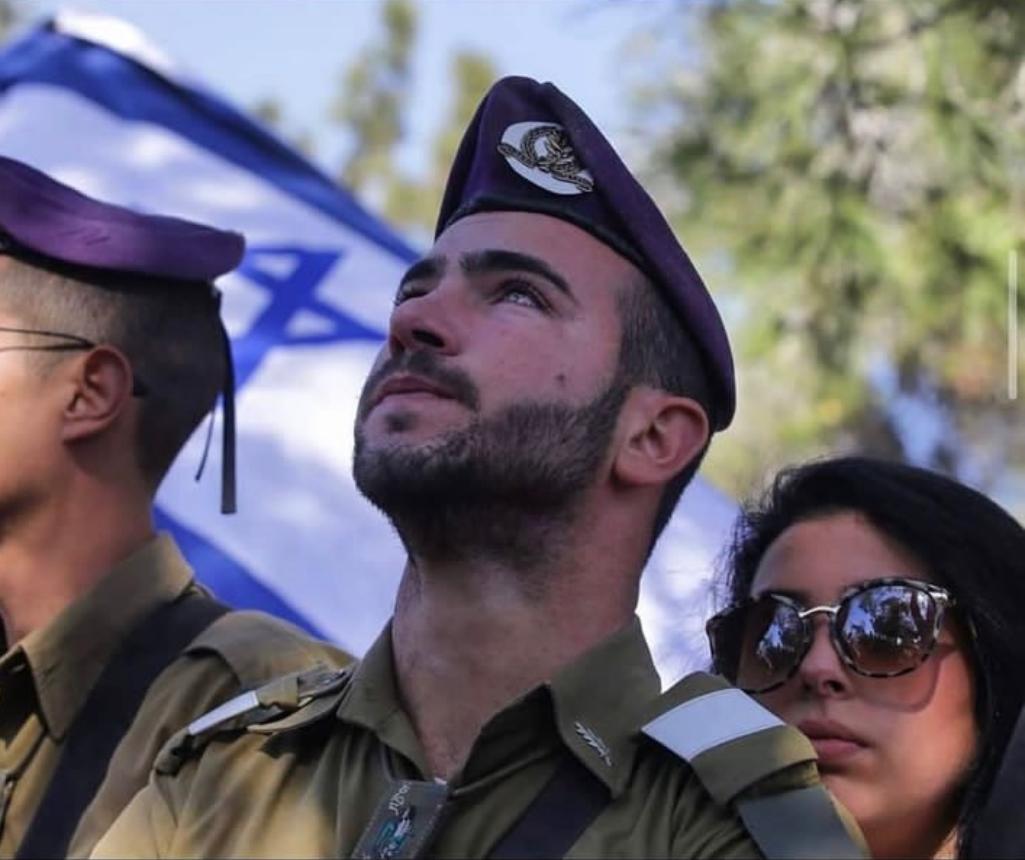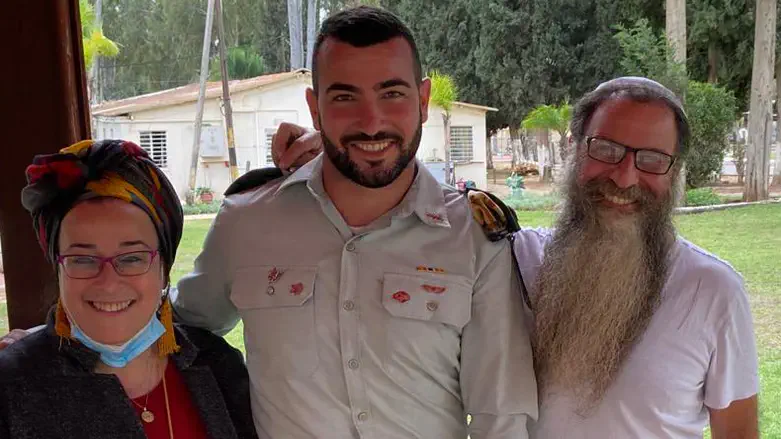
Amir Zini, father of Nirel, who was murdered on October 7, hears the claim that after the return of Ran Gvili and his burial in Israel, there are no more hostages in Gaza, and reminds everyone that his son's body has not been fully returned. In a difficult conversation with Arutz Sheva, he shared his painful story about his son’s head that has not yet been returned for burial.
Zini described his son as a model for life, someone who would never leave anyone behind, always taking care of those around him, both as a civilian and in his military roles, where he was seriously injured in 2015.
For two years, Amir Zini refrained from publicly sharing his story, feeling that others were in even more pain, with many others not having any graves to visit at all, while his son had a funeral and a grave, even if not all of him was buried there.
At the request of his neighbor and friend, Brigadier General (Res.) Oren Solomon, Amir Zini came to the Knesset and shared his difficult story, which he elaborates on in an interview with Arutz Sheva: "From the very first moment, we felt something was incomplete, but we didn't know what exactly," he said, noting, "The media didn’t want to deal with it. They told us it was too difficult and painful to say his head was missing. I told them that I didn’t write this script..." His son, Nirel, was murdered alongside Niv Raviv, and was supposed to propose to her two days later. Their engagement was supposed to be on the anniversary of his serious injury in 2015, an injury that led him to continue serving in the IDF for six years, only to have to leave when it was discovered that his heart was operating at only a quarter of its capacity.
It was the police from Lahav 433 who knew about the missing head of Nirel’s body but chose not to inform the relevant authorities or the family. "They were the only ones who knew that perhaps terrorists had taken the head, and this information was never passed to anyone, especially not to us as a family. Someone decided for us that they knew what was best for us to know and what not to know."
Even when the family was invited to Lahav 433, the unit didn’t think to update them, and "only after a few questions did I realize there was no investigation. I demanded to see pictures. They told me the pictures were too difficult and questioned why I should see them. I felt there was something they didn’t want me to see," he says. When he insisted, he was asked to sign certain documents, which led him to see images that made it clear that his son’s body was buried without his head.
When he asked if the information had been passed to anyone, he was told that the Shin Bet hadn’t requested the information, so they didn’t receive it. They also said the information hadn’t been passed to the military, but later they reversed their statement and claimed it had been sent. When he asked to see the documentation of this information transfer, he was told it was communicated in a conversation.
Amir Zini continued to recount the efforts made by the forensic identification unit, led by Lt. Col. Yossi Cohen, consisting of about a thousand soldiers who gathered and identified body parts. But when it became clear to him that his son was buried without his head, he was told that the unit's soldiers had already been released. In fact, he says, the reality is that the search for the rest of his son’s body wasn’t classified as a "mission," meaning there was no order to retrieve his son's head, as there was in other cases. And when there’s no mission, the required actions are not carried out.
Zini spoke of difficult conversations where he demanded answers and received only partial responses, if any. When he asked why his son was not being treated as a hostage, he was told there was no intelligence indicating this. He questioned how they could find intelligence if they weren’t looking for it. Some tried to calm him by saying they were searching. The Shin Bet told him that the service doesn't handle civilians unless there’s a request from the police or another official entity, and such a request was never made.
Zini described the decision to begin independent searches. Every morning at five a.m., he would arrive at a location in Be'eri, where his son’s body was found, and together with family members, and sometimes volunteers, they searched the ground for evidence. Sometimes they brought a tractor to lift two or three shovels of dirt for searching, and at the end of the day, they returned the dirt to avoid disturbing the lives of the residents of the Gaza village.
When asked if he regrets waiting two years to share his story, Amir Zini answered negatively but mentions that after the story began to come out, he received a phone call from Lahav 433 investigators asking to meet with him. "I told them I wouldn’t come if they didn’t have anything new for me," he said. "Only if they admit to their mistake and say they intend to begin corrective actions will I come. Now, I don’t believe I will get such a call."
We also asked Amir if his story reached any Knesset members, and he says yes. One time when he came to search for evidence in the Gaza village, the Speaker of the Knesset, Amir Ohana, arrived at the location. Someone connected them, and Zini shared his story. Ohana promised to try to help, contacted the police, who acknowledged that it was unacceptable for a father to search for his son's bones in the ground himself and assured him that this would be handled. Zini was passed from one officer to another until he reached one who told him he had been asked to assist but wasn’t given a schedule for it. The officer decided on his own to go with the cadets on a free day to help search on one of the Fridays. Together, they sifted sand, but found no evidence.
"I was referred to Gal Hirsch. I went to meet him after phone calls and conversations. The meeting felt like they were doing me a favor," he said, adding, "I sent a letter to the Prime Minister through his assistants. I don’t know if he received it or read it." Now, he expects at least a meeting with the Prime Minister as an authority who can instruct the initiation of serious searches.
When asked what he believes happened, Amir Zini concluded: "Terrorists took the head to trade it." He adds that another body, that of Aviad Edri, was found in a similar condition, just ten meters from his son's body. Again, the family wasn’t informed. "The Chevra Kadisha (Jewish burial society) returned the bodies to honor the family. I had a feeling that Nirel’s body was being returned," said Zini and recounted the story of the shocking facts about Aviad Adari’s case, an event in which he himself was also involved. The decision not to inform the families, says Zini, was made in a CEO’s committee, a committee that "decided we don’t need to know."
"No soldier should risk their lives to bring the head, but it should be a mission," emphasized Zini, adding that in the operation to locate Ran Gvili, many unexamined findings were found, including heads. Soldiers who were in the operation sent him photographs so that he could conduct an independent examination, so far without results. "What is not ordered will not be done," he said, noting that his ambition is "for us to know who we are dealing with and that Amalek exists in our generation. If terrorists can get away with it, we should name the child after him."