

For more than a decade, the Grand Ethiopian Renaissance Dam (GERD) has exposed the collapse of traditional diplomacy and the steady erosion of Egypt’s strategic position. What began as a technical dispute has become an existential struggle over water, power, and regime survival. At its core lies a stark truth: Egypt’s future depends on the Nile, and Cairo surrendered leverage at the very moment it most needed to defend it.
The decisive error came in 2015, when President Abdel Fattah al-Sisi signed the Declaration of Principles with Ethiopia and Sudan. Marketed as a diplomatic breakthrough, the agreement instead legitimized Ethiopia’s project without securing binding guarantees on reservoir filling, drought mitigation, or enforcement. Ethiopia gained political and legal cover to proceed at full speed, while Egypt accepted ambiguity in place of security. What state media described as strategic restraint was, in practice, a forfeiture of leverage that Addis Ababa exploited relentlessly.
As Ethiopia built and filled the dam, Cairo focused inward. Political repression, prestige megaprojects, and fiscal mismanagement replaced sustained diplomatic or strategic pressure. By the time Egypt attempted to reassert itself, the GERD was no longer a proposal to be negotiated but a reality to be managed. Ethiopia had created a hydrological fait accompli, and Egypt was left reacting to outcomes rather than shaping them.
The consequences surfaced dramatically in 2025. The final filling of the reservoir coincided with irregular rainfall, producing a sharp decline in downstream flows. For the first time, the GERD’s impact translated into visible stress across Egypt’s water system. Agricultural production in the Nile Delta declined, groundwater extraction surged, and food prices rose. The regime’s ability to mask shortages through administrative controls eroded, exposing the link between water scarcity and political stability.
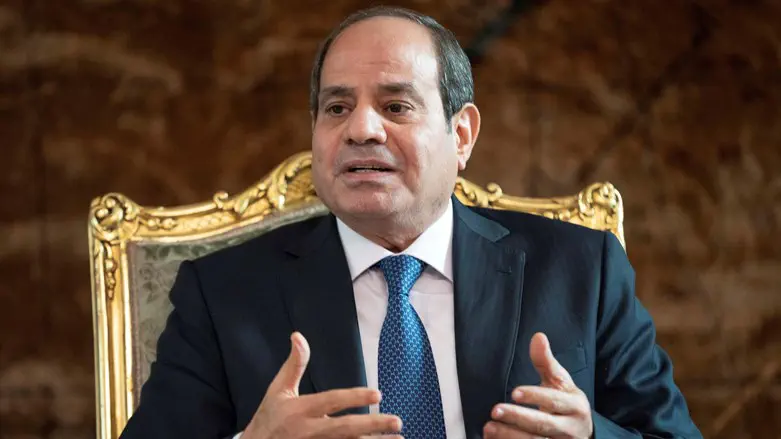
By early 2026, Egypt reached a point of acute vulnerability. Inflation soared, rural livelihoods deteriorated, and water insecurity became a daily concern rather than an abstract national-security issue. In a country where scarcity has historically triggered unrest, the risk was unmistakable. Water protests threatened to evolve into broader political confrontation, placing the Sisi administration in a defensive posture. His appearance at Davos reflected this reality: Egypt was no longer negotiating from strength but seeking an external lifeline to stabilize a system weakened by years of strategic miscalculation.
Israel has viewed this trajectory with mounting alarm. A destabilized Egypt would undermine regional security, threaten the Sinai Peninsula, and jeopardize the broader architecture of Arab-Israeli normalization. For Israel, Egypt functions as a strategic buffer-containing demographic pressure, securing key transit routes, and preventing instability from cascading across the eastern Mediterranean. A water-starved Egypt risks becoming a source of radicalization, mass migration, and even military escalation, outcomes that would endanger Red Sea shipping and regional trade.
These shared concerns have driven Washington toward a more coercive, leverage-based approach. Rather than relying on African Union mediation or symbolic agreements, the United States is now treating the Blue Nile as a strategic asset whose stability is tied to global energy, trade, and security interests. The emerging framework reframes the GERD not as a symbol of Ethiopian sovereignty but as a regional infrastructure node subject to conditional access and oversight.
At the center of this strategy is the “Electricity for Peace" concept. Under this model, Ethiopia would trade guaranteed, legally binding water-release commitments for concrete economic benefits, including debt restructuring, financial access, and advanced water-management technology. Fixed minimum flows, enforceable drought protocols, and transparent operational data would replace voluntary coordination. Compliance would be incentivized through markets and enforced through conditionality.
Israeli involvement strengthens this framework. Israel’s expertise in desalination, irrigation efficiency, and water recycling offers Egypt alternatives that reduce absolute dependence on Nile flows, while Israeli technical systems provide credible monitoring and verification. By embedding Israeli and American oversight into the dam’s operational architecture, Washington aims to eliminate the data opacity that has defined the dispute and prevent unilateral manipulation.
The agreement envisioned in Davos seeks to strip the Nile of its value as a political weapon. Egypt would gain predictability but surrender autonomy. Ethiopia would gain economic integration but lose unilateral control. In both cases, sovereignty would be subordinated to enforceable systems designed to prevent crisis escalation.
Sisi may survive the Nile crisis, but only within a transformed regional order. Egypt’s stability would depend on an American-led security framework that prioritizes resource security and Israeli strategic interests over traditional notions of state discretion.
The post-2025 Middle East will not be governed by goodwill or declarations. It will be shaped by enforceable control over scarce resources-and by those with the power to impose it.
Amine Ayoub, a fellow at the Middle East Forum, is a policy analyst and writer based in Morocco. Follow him on X: @amineayoubx