
I was learning Parashat Bo this past Shabbat, and a thought came to mind.
During the Plague of the Firstborn, Makat Bechorot, the Jews are commanded to put blood on their doorposts. The Torah explains why: “And the blood shall be for you as a sign… and I will see the blood and pass over you."
Does God need us to mark our houses so that He knows where we live?
Let’s be real. If Google knows where we live, God does too.
The verse is not about God knowing our location. It is about God looking for something else entirely.
What He was looking to see was not our address, but our actions.
He was looking for an external expression of trust. For Jews willing to place their belief on the outside of their homes while the world around them was dark, unstable, and dangerous. While fear, and turning inward, would have been the most natural response.
The blood was not a GPS signal to God. It was a statement by the Jews.
“This is who we are."
“This is Who we trust."
“Even now."
Only after that does the Torah say that God passes over the houses. Not because He needed help identifying them, but because He was responding to a visible act of faith that refused to stay hidden.
At that moment, the Jews were still slaves. Redemption had not yet arrived. Egypt was falling apart. And still, they were asked to step out of fear and into identity.
Belief that remains internal is easy. Belief that shows up in the world, when there may be consequences, is much harder.
And the doorpost matters. It is the boundary between inside and outside. Between private belief and public identity.
By placing blood there, the Jews made a decision that their faith would not stay behind closed doors.
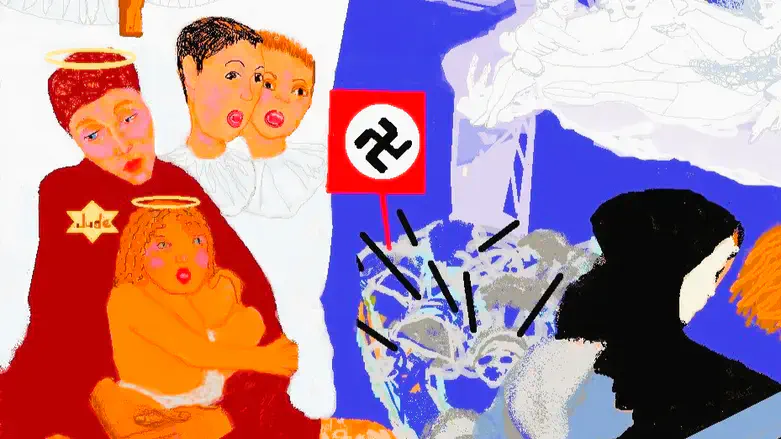
Across the Jewish world today, we are seeing a familiar instinct resurface. The urge to qualify ourselves. To distance. To speak in the language of “as a Jew, but…" The hope that if we present ourselves correctly, condemn the right Jews loudly enough, or shrink our identity into something less visible, the hatred will pass us by.
But it never does.
Antisemitism does not care how you identify. It does not care how religious you are, how progressive you are, or how carefully you separate yourself from other Jews. Jew hatred does not respond to our explanations. It responds to our existence.
We have learned this before.
Throughout history, many Jews believed that if they were quiet enough, assimilated enough, invisible enough, they would be spared.
They were not.
Hiding was not a solution then. It is not a solution now.
This is not a call to put yourself in dangerous situations. There is a difference between protecting life and allowing fear to dictate who we are willing to be.
God did not need the blood on the doorpost. We did!
We needed to see ourselves choosing trust over fear before we could walk out as a free people.
Parashat Bo reminds us that redemption does not begin with safety. It begins with identity. With being willing to place who we are on the outside, even when the world feels unstable.
So the question is simple.
Do we let fear determine how visibly Jewish we are?
Or do we remember that our survival has never depended on disappearing?
God is still not looking for our address.
He is looking to see who we choose to be.
And that choice still starts at the door.