

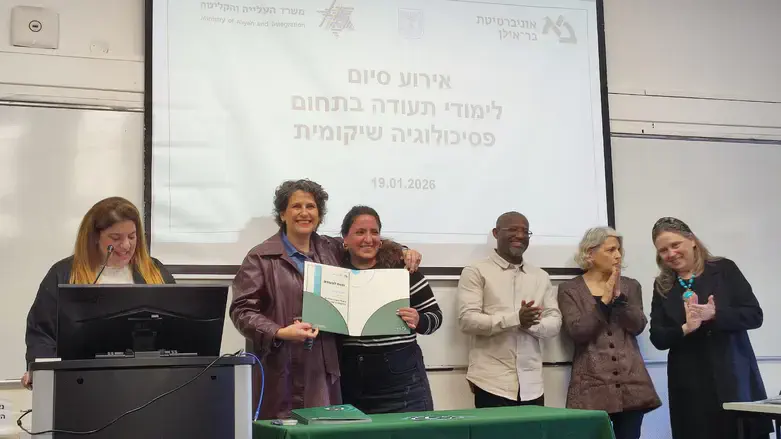
Fifteen immigrant psychologists received certificates today upon completing an intensive two-month training program in rehabilitation psychology, marking a significant milestone in their professional integration into Israel’s healthcare system.
The program was held under the academic supervision of Prof. Noa Vilchinsky, Head of Bar-Ilan’s Division for Designated Programs, and was taught by leading lecturers in rehabilitation psychology, primarily from Bar-Ilan University, alongside experts from outside the university.
Conducted in Hebrew, the program provided participants with both theoretical knowledge and practical tools, including training in neuropsychological assessment and analysis, in preparation for specialization in rehabilitation psychology.
“Today’s certificate ceremony represents much more than the completion of a course," said Prof. Vilchinsky, academic supervisor of the program. “It reflects an important investment in both people and the healthcare system. These psychologists bring with them extensive knowledge and experience, and this program helps bridge the gap between their professional background and the specific clinical and regulatory requirements in Israel. At a time of acute shortage in rehabilitation psychologists due to the enormous numbers of war casualties and PTSD in Israel, their integration is critically important."
Participants in the program immigrated to Israel from many different countries, such as Russia, Ukraine, Argentina, Brazil, and Mexico. With the completion of the course and receipt of their certificates today, the psychologists are expected to continue specializing in the field through formal internships and advanced professional training.
The training program was jointly initiated by the Ministry of Aliyah and Integration and the Ministry of Health in response to the considerable challenges immigrant psychologists face in integrating into Israel’s professional frameworks, particularly in securing internships and specialist placements.
At the same time, Israel faces a significant shortage of rehabilitation psychologists and a growing need for their services -- especially in the aftermath of the Swords of Iron war, which has heightened demand for rehabilitation and mental health care nationwide.
Among the graduates is Veronica Levy, a 36-year-old psychologist who immigrated to Israel from Argentina four and a half years ago. Levy enrolled in the course as part of her path toward specialization in rehabilitation psychology and has since begun her internship at an Israeli HMO.
“The program gave me a strong professional base for my work with patients," Levy said. “We learned how to conduct neuropsychological testing and analyze the results, and it prepared me for what I am doing now in my specialization. The lecturers were true experts in their fields and the learning experience was both fascinating and meaningful."
Another graduate, Martin Reznik, is a special education teacher originally from Mexico City. After completing a BA in psychology and an MA in cognitive behavioral therapy, Reznik wanted to enter rehabilitation psychology, a field not yet offered in Mexico.
“Without this course, I had no way to start," Reznik said. “I didn’t understand what it was at first, but the lecturers explained everything with patience and care. I learned how to conduct all the assessments in psychology and gained many tools to work with trauma and rehabilitation. This is a new and fascinating area for me, and I decided to give it a try." Reznik, 29, now plans to do his clinical internship at the National Institute of Neuropsychological Rehabilitation.