

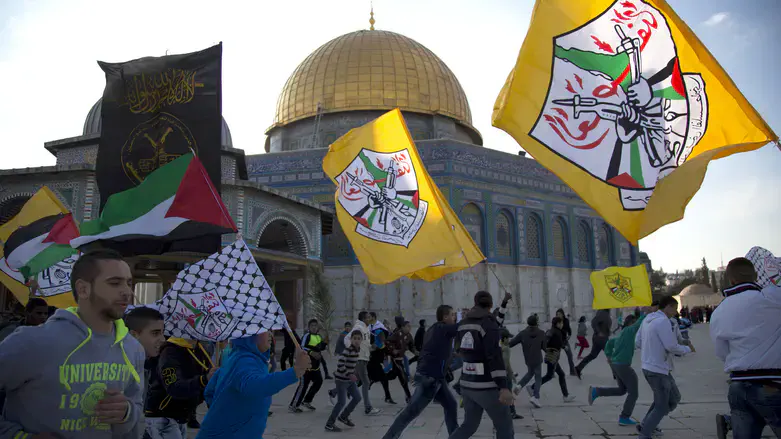
As the Islamic holy month of Ramadan approaches in mid-February, the State of Israel finds itself at a civilizational crossroads. Following a pivotal briefing to the Knesset National Security Committee on Monday, the Israel Police and security forces have issued a clear, uncompromising vow: there will be no “victory display" for Hamas on Jerusalem’s Temple Mount.
The primary objective for the coming month is the prevention of a "victory picture"-the staged, triumphalist imagery of Hamas flags fluttering over Judaism’s holiest site.
These displays are often dismissed as mere symbolic expressions of religious fervor. However, symbols are the lifeblood of rejectionism. In the reality of the Middle East, conflicts do not end through polite negotiation or economic incentives; they end only when the aggressor internalizes its own defeat. To allow a weakened, cornered Hamas to project an image of dominance in the heart of Jerusalem would be to grant them a strategic lifeline precisely when they must face the reality that their war aims have failed.
For decades, an analytical failure governed the Temple Mount. Security officials frequently sought "quiet" at any cost, often framing blatant religious incitement as "freedom of worship" . This was the era of "managing the conflict"-a strategy that treated terror as a seasonal nuisance rather than an existential threat.
By allowing radical groups and Iranian-backed proxies to weaponize the Al-Aqsa Mosque as a staging ground for jihadi optics, Israel inadvertently signaled that its sovereignty was negotiable. Chief Supt. Ido Katzir’s recent statement that Ramadan now takes place against the "backdrop of war" is a refreshing, if overdue, admission that the Temple Mount is a battlefield of narratives where celebrations of terror have "no place".
The tactical measures proposed for Ramadan 2026-limiting entry to men over 55, women over 50, and children under 12-are not "escalations," as Hamas claims, but essential pillars of security. These restrictions are designed to decouple genuine religious observance from the demographic most susceptible to the "lone-wolf" recruitment favored by Tehran. By limiting the presence of younger groups, the police are physically removing the shock troops used by Hamas to manufacture "clashes" for international consumption.
National Security Committee chairman Tzvika Foghel correctly identified that managing the fallout of the current conflict requires a formula for success based on inter-organizational cooperation, specifically targeting the potential for incitement by Iranian-backed entities that use religious events to ignite the masses.
Crucially, this security architecture must extend beyond the Old City walls.
The IDF’s reinforcement of the "Seam Line"-the security barrier along the pre-1967 boundaries with Judea and Samaria-is a vital defensive component. As security officials have noted, these communities serve as the "protective wall" for the major cities of central Israel . A porous Seam Line during Ramadan would allow for the infiltration of terrorists who view the holiday not as a time for prayer, but as a window of opportunity for mass-casualty attacks.
The current conflict cannot be allowed to relapse into a wave of lone-wolf stabbings or car-rammings because the state was too timid to enforce its borders.
Hamas has already characterized these security measures as a "dangerous escalation" and an attack on religious freedom. This is a predictable script from an organization that has systematically converted religious and civilian spaces into military hubs .
The strategic imperative is clear: true peace follows the recognition of reality, and that reality requires the enemy to concede that their violent goals are impossible. If Hamas believes they can still achieve a "victory display" in Jerusalem, they will continue to resist disarmament and reconstruction efforts in Gaza. The road to a stable, post-Hamas reality begins with the total eclipse of their influence in Jerusalem.
The Israel Police and the IDF must remain steadfast. A ceasefire is not a surrender, and a pause is not a peace. The current era of regional conflict will only reach its conclusion when the citizens of Israel see that the flags of jihad have been permanently lowered.
By preventing a Hamas victory picture this Ramadan, Israel is doing more than just securing a holy month; it is asserting the permanence of the state and the finality of its security goals. First recognition of defeat, then a path to stability.
Amine Ayoub, a fellow at the Middle East Forum, is a policy analyst and writer based in Morocco. Follow him on X: @amineayoubx