

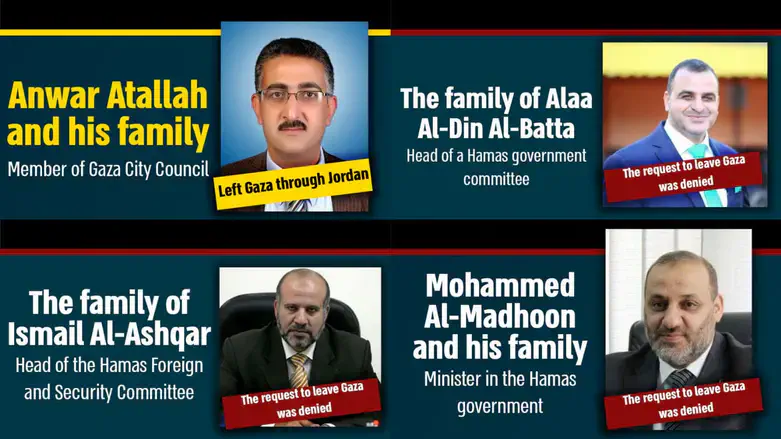
The announcement by Hamas that it will "dissolve" its Gaza administration marks a critical inflection point in the two-year regional conflagration. The terror group’s directive to its governing agencies to prepare for a handover to a "technocratic Palestinian government" appears to be a concession to the U.S.-brokered peace plan . However,this is not a surrender; it is a calculated "technocratic" rebrand designed to preserve the organization’s core while outsourcing the burden of governance to international donors and vetted puppets.
As the "Board of Peace" (BoP), headed by President Donald Trump and directed by Bulgarian diplomat Nickolay Mladenov, prepares to implement Phase Two of the Comprehensive Plan, the West must resist the siren song of a managed transition . The only acceptable outcome of the Gaza war is the total and irreversible organizational destruction of Hamas.
The Ploy of Technocracy
The directive, issued through Hamas's official media outlet SAFA, instructs agencies to "be ready to hand over all areas" to a technocratic body overseen by the Board of Peace . On the surface, this aligns with the Trump administration’s demand that Hamas "not wield power in Gaza".
Yet, the history of Islamist "reconciliation" suggests that technocracy is merely a shell game. By retaining its weapons and its shadow network, Hamas intends to remain the "power behind the throne," utilizing a vetted Palestinian Arab committee as a human shield against future Israeli kinetic action while siphoning reconstruction funds for the "unity of the fronts" .
The Necessity of Organizational Annihilation
The failed "mowing the grass" strategy of the last twenty years must be replaced by a commitment to total organizational annihilation. Coexistence with an organization whose foundational covenant demands the destruction of the Jewish state is a strategic impossibility.As Prime Minister Benjamin Netanyahu recently declared, there is "no more containment," only initiative and constant activity.
Victory will not be declared when the "Board of Peace" appoints a new committee, but when the organizational infrastructure of Hamas is pulverized beyond the point of reconstitution.
The Tunisian Safe Haven: A Mediterranean Risk
Perhaps the most alarming dimension of this potential "rebrand" is the reported negotiation to relocate senior Hamas leaders from Gaza to Tunisia . Citing security sources, analysts warn of a "coordinated escape" that mirrors the 1982 exit of Yasser Arafat and the PLO from Beirut to Tunis . While some in the international community view exile as a mechanism to decapitate the Gaza branch, the strategic reality is far more dangerous.
Under President Kais Saied, Tunisia has drifted into a populist, anti-Western orbit . Saied’s July 2021 power grab and subsequent crackdown on judicial institutions have left the country increasingly isolated and economically dependent on an Algeria-Tehran alignment .Tehran views North Africa as a vital geo-strategic region to broaden its "Axis of Resistance" and counter-balance Israeli diplomatic gains on the continent .
Turning the Mediterranean into a Proxy Sanctuary
Hosting Hamas in Tunis would provide Iran and its proxies with a vital Mediterranean foothold. This presence would enable military threat projection toward Europe and potentially fulfill the threats by Iranian security figures to "close the Strait of Gibraltar". Furthermore, a Tunisian base could serve as a hub for "narcoterror," replacing the severed Caracas-Tehran nexus-which collapsed following the January 2026 capture of Nicolás Maduro-with a southern Mediterranean smuggling hub .
There is a severe risk that Hamas could rely on criminal networks linked to migrant smuggling to exploit them as financing or logistics channels across North Africa.The arrival of a political-military group of Hamas’s caliber would further destabilize Tunisia, creating a "safe haven" where the group could engage in propaganda, fundraising, and the coordination of the Tamkeen strategy-institutional entrenchment-across the southern Mediterranean .
The Age of Responsibility
The Middle East enters 2026 in a state of "exhausted realignment" . As the "Donroe Doctrine" signals a U.S. pivot to the Western Hemisphere, the burden of stability now rests on a pro-Western regional architecture. Israel, acting as the "Guardian of Minorities," must rise to meet this challenge by ensuring that the collapse of the Khomeinist order in Iran is not replaced by a metastatic Hamas presence in the Maghreb.
Hamas's announcement is a desperate attempt to avoid organizational finality. The international community must not be fooled by the mask of technocracy.
There is no such thing as a "moderate" or "independent" Islamist administrator selected with the group's blessing.
Whether in Gaza City or the streets of Tunis, the organization remains a threat to Western civilization and the pluralism of the Middle East. True peace requires not just a new board of directors, but the complete dismantling of the machinery of terror.